Tea leaf rolling is her specialty. Every day, Dhananjani Madhumathi, 40, settles into the workshop at Amba Estate (“the Amba estate”), an organic plantation in the Ceylon designation perched in the Highlands, in the center of Sri Lanka. “Madhu,” as close relatives call her, sits at a long wooden table. Above a wicker basket, she delicately, with the tips of her fingers, rolls the morning-picked shoots. “Here, we only pluck the bud and the very first leaf, which appear every ten or eleven days at the tip of the stems, she explains. That is how we obtain the best aromas.” Quality teas typically consist of the bud and the first two leaves of the shoot, the freshest and most tender. Here, we are therefore one notch above. The rolled tea is then dried on large sieves, packed, sent by truck to Colombo, the capital, and then exported.
A Century-Old Plantation
For twenty years, Amba Estate has been trying to restore the reputation of a sector known for its poor image. Typically housed in line houses, rows of tiny, squalid shacks built on the estate where bare earth serves as floor and tarpaulins as ceilings, Sri Lankan tea pickers (still predominantly women, reputed to be more meticulous than men) are descendants of Tamil laborers displaced from India in the 19th century by the British. They work under conditions still precarious, inherited from the colonial era, with little access to healthcare or schooling for their children, which the plantations, of which this is a responsibility, seldom fund.
“It’s apartheid”, sums up Nishan de Mel, director of Verité Research, an independent institute based in Colombo that advises public and private actors and has produced several alarming reports on the subject. As for the minimum wage for pickers (1,750 rupees per day, 4.76 euros, i.e., 120 euros per month), it is far from guaranteed: it requires collecting at least 18 kilos of leaves in a day, an impossible task when the weather is bad or the tea bushes grow slowly. Not surprisingly, young people no longer want to take on this job, which is so poorly regarded.
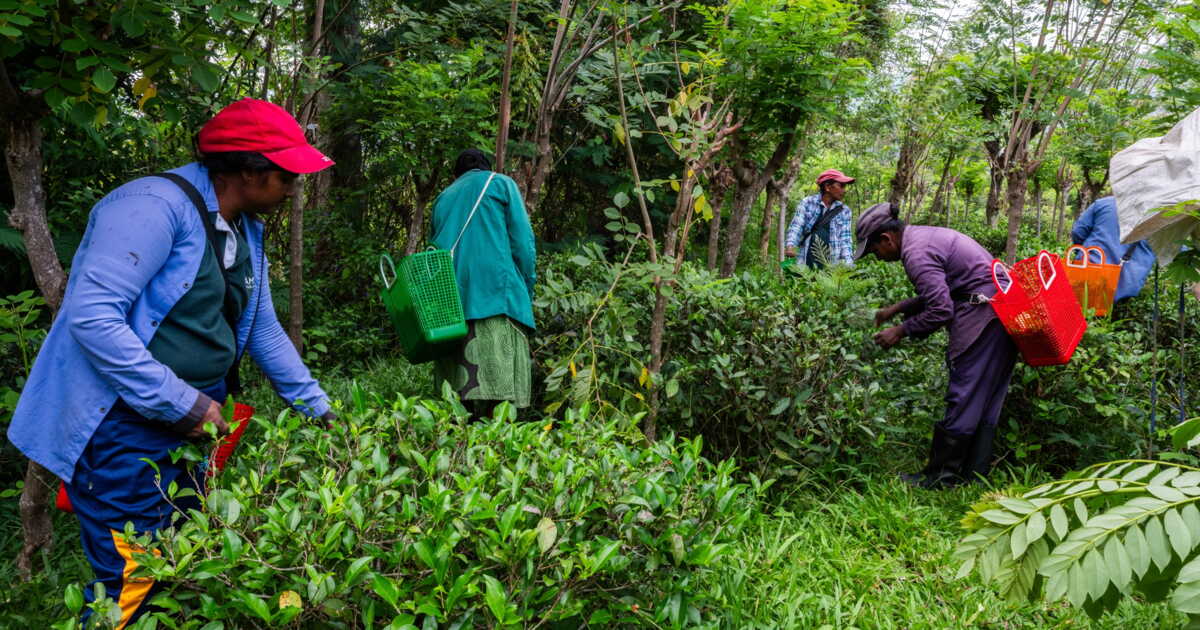
To turn away from this fate and to retain labor, Simon Bell, an Anglo-Irishman, joined with three friends living in Sri Lanka to buy the lands of Amba Estate in 2006. At the time, this century-old plantation had been fallow for decades because of the ongoing civil war. In the Ambadandegama hills, a half-hour drive south of Ella, the Amba estate offers spectacular views of the famous Ella Rock, rising to 1,312 meters. Sixty employees and about forty seasonal workers cultivate the tea on twelve hectares of steep terrain. Half are Tamil, the other half Sinhalese. A novelty. Men are responsible for land maintenance, digging, spreading manure and compost. Plucking, however, is reserved for women (80% of the staff).
A Fixed and Decent Salary
All of them hail from the nearby village of Ambadandegama. “When we took over the place, two families were still living in the shacks of the old property,” recalls Simon Bell. “We provided them with housing in the village, off the plantation. We also built another for an elderly couple. And allocated a plot of land to a third family with children, so that they could build their home.”
Madhu, the leaf-rolling expert, is today a tea artisan (master artisan), the highest level of qualification on the estate. “I earn 60,000 rupees a month [€163],” she says. “I was able to renovate the leaking roof of my house, my family has enough to eat, and my children can go to school.” Not bad, when you know that in Sri Lanka, the median salary is €155 per month, with a wide gap between urban and rural areas.
The Quality Bet
“Our workers receive fixed salaries, regardless of quantities harvested, as well as bonuses and a profit-sharing scheme,” notes Neethanjana Senadheera, production director. “As a result, they sometimes earn up to three times more than on other plantations. We redistribute about 10% of turnover.” In 2025, the extra pay amounted to around €400 per person on average. A portion of this pool (1%) funds a fund managed by the employees, which helps finance their children’s education, weddings, funerals, bus transport, and zero-interest loans.
Under a clear blue sky, Sandhya Kumari, 45, takes a 10 a.m. break, sharing a cup of black tea with her colleagues, in the shade of a silky oak (Grevillea robusta). Large rubber boots protect her from leeches and venomous snakes that roam the fields, sometimes deadly. A luxury when you consider most of the country’s pickers work in flip-flops or barefoot. “We are all proud to work here, we are well trained, our salaries rise every year, and in addition to the share of profits, we get bonuses,” she notes: “15,000 rupees [€42] minimum per month in August, and a similar amount for the New Year—January for Catholics, April for Buddhists—or in autumn, during Diwali, for Hindus.”

By betting on quality, Amba Estate sells its artisanal tea ten times the average market price (between $100 and $200 per kilo depending on the varieties, instead of about $20 on average). Processing, packaging, and marketing are handled in-house. The four shareholders take no dividends, and for three of them, no salary. They have diversified the business, branching into coffee production, spices (pepper, cinnamon, ginger, etc.), jams and chutneys… and in eco-responsible tourism, which generates half of the turnover: about a dozen rooms welcome curious travelers eager to learn the secrets of Ceylon tea.
In the neighboring village of Ambadandegama, this renewal has also benefited local artisans who work for Amba Estate. And the plantation’s leadership supported the Sri Lankan NGO Tea Leaf Trust in establishing a school to teach English to youngsters from disadvantaged families, donating the land and taking charge of levelling, building an access road, toilets, water supply, and waste management. A British foundation funded the building itself. On this November day, the school’s principal, Petthan Shanmugapriya, is giving an exam to about thirty students aged 19 to 28. “This learning also trains them in emotional management and values like perseverance and gender equality…”, she notes. A bet on a future where the tea fields could become, who knows, a tool for personal growth and emancipation. And a model that is slowly beginning to inspire imitators in other small Highlands plantations.
Sorting Some Jobs Out of Poverty
284 million people do not earn a living from their labor
Textile workers, tea pickers, waste collectors… According to the latest ILO report, in 2025, 284 million people, or 7.9% of the world’s active workforce, lived in extreme poverty with less than $3 per day. In low-income countries, this affects 20 to 25% of workers (vs. less than 1% in Europe). While Africa accounts for 17 to 18% of the global workforce, it concentrates two-thirds of workers living on less than $3 per day. In Madagascar, an economy heavily dependent on subsistence agriculture and informal employment, 86% of workers live below this threshold.
A glimmer of hope
Over twenty years, globally, the rate of extreme poverty at work (less than $3) has fallen by a factor of 3.3, down to 8% in 2025. A drastic drop driven by Asia (China, India, Vietnam), where hundreds of millions of precarious agricultural workers shifted to the manufacturing and services sectors. But for the past decade, progress has slowed, the slowdown of the world economy hindering the creation of decent jobs. This occurs in a context where, according to the ILO, nearly half of humanity (47.6% of the global population, about 3.8 billion people) benefits from no form of social protection. A rate that exceeds 80% in Africa, according to the ILO.
➤ Article appeared in GEO magazine no. 567, “Islands of Provence, bubbles of serenity on the Great Blue,” May 2026.
➤ Are you already a GEO content devotee? Then, to miss nothing, discover our subscription plans to receive GEO at home every month with ease.