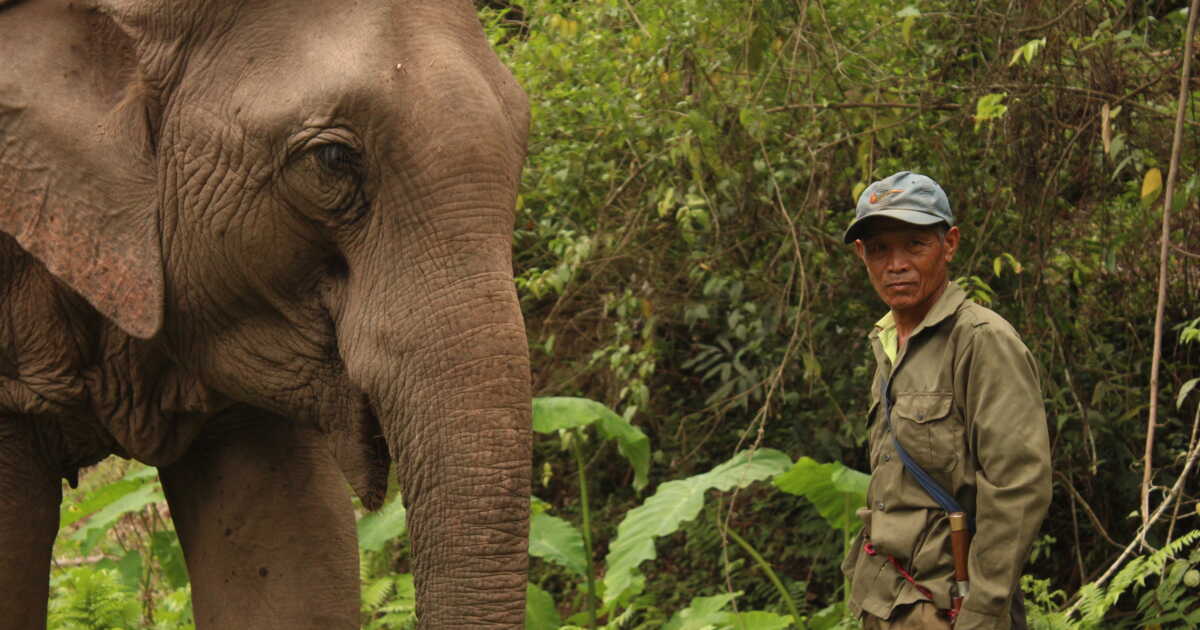
Whispering in the ears of elephants, guiding them but above all respecting them. Such is the responsibility of a mahout. Also called mahouts in Sanskrit, an ancient language originating from India, the mahouts nurture a privileged relationship with elephants in Laos. But for about a decade, this connection has deteriorated due to intensive deforestation and mass tourism. Today, sanctuaries are attempting to rebuild this bond, not without difficulties.
Perspiration beads form on my forehead as we arrive in Paklay, in Sayabouri Province, northwest Laos. A driver awaits us. We climb into a 4×4 for a one-and-a-half-hour journey toward Muang Thong, a small village inside Nam Phouy National Park. “About thirty mahouts live there”, explains Ala Touati, manager of the Lao Elephant Home and Sanctuary (LEHS) where we are headed. In Laos, the wild elephant population is estimated at 300 to 400 individuals (Laotian Elephant Action Plan 2022). The domestic population stands at 464 elephants, of which 82% are located in Sayaboury Province. With an average of ten deaths for every two births, the future of elephants in Laos is threatened. Indeed, “you cannot conduct conservation without including the mahouts”, says Sébastien Duffilot, cofounder of the Elephant Conservation Centre (ECC) in Sayaboury and of the French association Elephants and Humans.
Mahouts at the Service of Elephants
At the end of a dirt road, a cluster of bamboo huts appears amid the jungle. Built in 2023, LEHS took shape in four months with the help of the villagers. “When I was young, I witnessed a mahout strike his elephant with a hook. Since then, I felt compelled to create a place where elephants could rest and live in harmony with their mahouts”, recounts Khamla Duangmala, founder of the refuge. A mahout at the sanctuary, Loung Jek learned the trade from his father. He has owned his elephant for about thirty years. At 46, Boaw Ngern is the sanctuary’s matriarch. “We are both equally reserved”, smiles the 62-year-old man. Sometimes accompanied by visitors, he visits her in the jungle twice a day. He ensures she lacks neither water nor bamboo; if needed, he moves her to a more favorable part of the park. Here, there are no elephant-back rides, no swimming, nor even feeding. Visitors stay at the camp, accompany the mahouts, and learn traditional Lao practices.
That morning, we meet Soy. Arrived three months ago, she belongs to a member of Loung Bath’s family, who is also a mahout. On one of her front paws, a scar from a chain is etched into the skin. “Before, she worked in wood”, Ala tells us. “In the early 2000s, most domestic elephants served as village support, explains Sébastien Duffilot. They carried wood in small quantities for local constructions and were respected. The wood industry then mainly used machines.” About ten years ago, intensive deforestation rewrote the rules. “The sector turned to elephants to reach inaccessible places.” Their use became excessive. A brutal work pace took hold, forcing them to work sometimes ten to twelve hours a day, chained at the foot. Loung Jek has closely witnessed this industry. “I chose to join the sanctuary to live near my family. Before, I had to be away for long periods to work. It’s also easier to let my elephant roam freely in the jungle. She can eat to her heart’s content with much better quality food. She is less stressed.”
Generational Break
Noting the gradual disappearance of his elephants and certain tree species, the Lao government put a stop to logging by tightening wood-cutting restrictions. “The mahouts found themselves unemployed. Some sold their elephants, who ended up in the hands of inexperienced mahouts. Others turned to tourist attractions. There was a generational break”, laments the ECC cofounder.
After a thirty-minute trek through the jungle, we come face to face not with one but two trunks. The shorter one belongs to Kamoun, 6 years old, the sanctuary’s only calf. Phou, her mahout, became a mahout at 35 to help his wife’s family. “The first year, I was excited to work with my elephant, then I discovered the wood industry, then tourism… There, if they ask us to continue, we must continue, even if the elephant is tired. We are obliged to use force, otherwise it won’t move. I didn’t like that. I wasn’t happy. Now our relationship is more peaceful. There are several of us who no longer want tourists to drive our elephants because they harm them.” In the tourist industry, Phou worked on average six to seven hours. “From now on, I work between two and four hours a day at the sanctuary. I earn less but I want to support the project, even if it’s hard during the monsoon season.”
A Fateful Rainy Season
At the camp’s founding, Khamla had set out with about twenty mahouts. Four remain. Most of them left due to lack of money. According to Sébastien, “In the wood industry, mahouts can earn up to five times more than in tourism.” Since 2023, Khamla has invested around $100,000 USD (86,000 euros) into the sanctuary. In the first year, he secured the backing of a private investor, but “it’s getting more and more complicated”, he laments. To operate, the center must host 30 to 40 visitors per month, double what it currently handles. Not to mention that in Asia, tourism is highly dependent on the rainy season. The site must achieve its annual revenue within six months. “Our priority is to gain more visibility and the support of international organizations to survive the rainy season.” A necessity for the Lao who was offered the sanctuary’s buyout by a French investor. “I would like to keep it, but if I don’t find funds quickly, I’ll have no choice but to accept.”
In the realm of sustainable tourism, ECC stands as a stable model in Laos. The organization derives most of its income from visits to the center. It also raises funds through grant applications, online crowdfunding campaigns, and private donations. “My association Elephants and Humans is a partner. We define programs (veterinary and educational) and we secure the funds needed to carry them out”, Sébastien explains. On site in Laos, it is the center that handles the technical and human implementation. ECC’s hallmark lies in its commitment to species conservation. The organization has notably launched rewilding programs, monitoring efforts, and it hosts a research unit along with the only veterinary hospital dedicated to elephants in Laos.
According to Phou, the more projects like these exist, the more the mindset of the mahouts will evolve in the right direction. “If they have an alternative, many prefer to quit working in wood or on elephant-back rides. Some of us continue because it’s the only job available to us.” Unfortunately, creating truly ethical sanctuaries in Laos—on animal and social grounds—meets the reality of a country with a fragile economy, the absence of a clear legislative framework, and a lack of genuine political will.