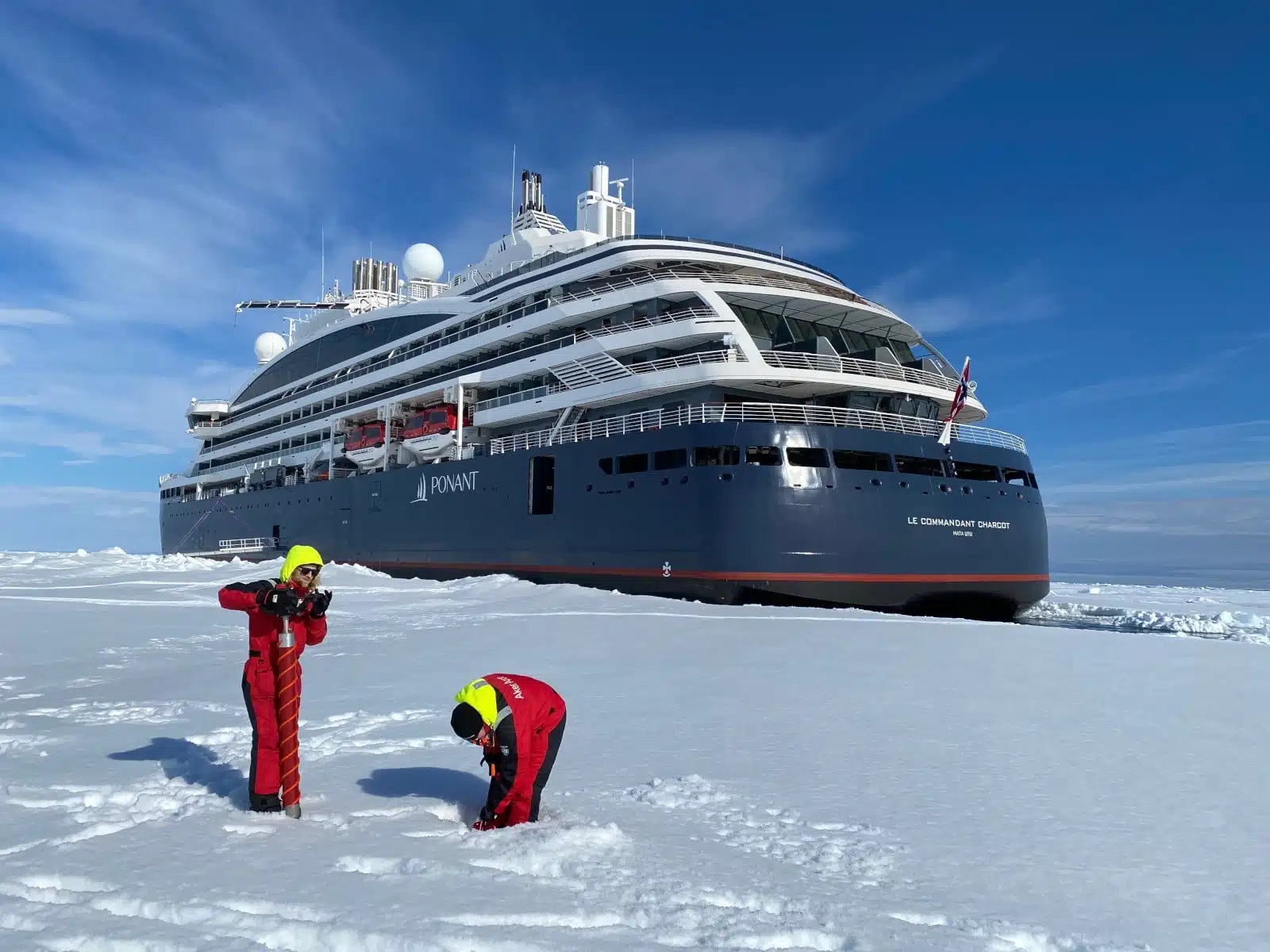
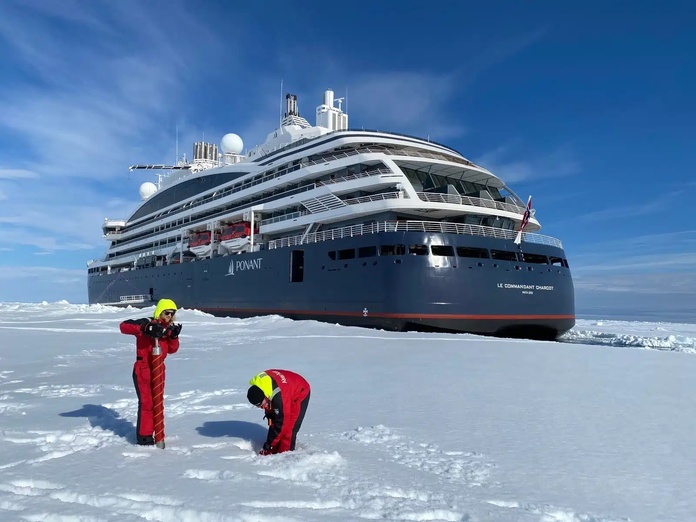


On board the Commandant Charcot, exploration goes beyond landscapes. At the start of May, during a crossing from Brest to Reykjavik, passengers witnessed a series of scientific talks held in the ship’s theater. Climate, biodiversity, plastic pollution, marine mammals, or Arctic sea-ice dynamics: a range of topics that complemented the field experience.
Among the speakers were notably François Galgani, a specialist in plastic pollution, Olive Andrews, an expert on marine mammals, Aymeric Houstin, a conservation ecology researcher, or Vito Vitale, associate research director at the Institute of Polar Sciences.
The stated ambition is clear: to make the expedition not only an observational journey but also a tool for understanding the territories traversed.
Among the speakers were notably François Galgani, a specialist in plastic pollution, Olive Andrews, an expert on marine mammals, Aymeric Houstin, a conservation ecology researcher, or Vito Vitale, associate research director at the Institute of Polar Sciences.
The stated ambition is clear: to make the expedition not only an observational journey but also a tool for understanding the territories traversed.
A floating laboratory at the heart of polar regions
Launched in 2021 under the leadership of Megan Clampitt, the Ponant Sciences program relies primarily on the Commandant Charcot, described as the first luxury polar exploration ship designed from the outset to host scientific activities.
Behind the talks offered to passengers, the Commandant Charcot operates as a genuine scientific platform.
On board, several laboratories host researchers. It is up to the scientists to obtain the necessary permits to carry out their work.
Among the equipment deployed is an oceanographic rosette equipped with Niskin bottles, enabling water sampling at different depths – up to 1,000 meters depending on missions – while recording parameters such as temperature, salinity, or depth.
The data collected are then shared by the scientific community. More than one hundred projects have already been hosted since the program’s launch, yielding around ten scientific publications.
Behind the talks offered to passengers, the Commandant Charcot operates as a genuine scientific platform.
On board, several laboratories host researchers. It is up to the scientists to obtain the necessary permits to carry out their work.
Among the equipment deployed is an oceanographic rosette equipped with Niskin bottles, enabling water sampling at different depths – up to 1,000 meters depending on missions – while recording parameters such as temperature, salinity, or depth.
The data collected are then shared by the scientific community. More than one hundred projects have already been hosted since the program’s launch, yielding around ten scientific publications.
The ‘Science Officers’, New Knowledge Facilitators
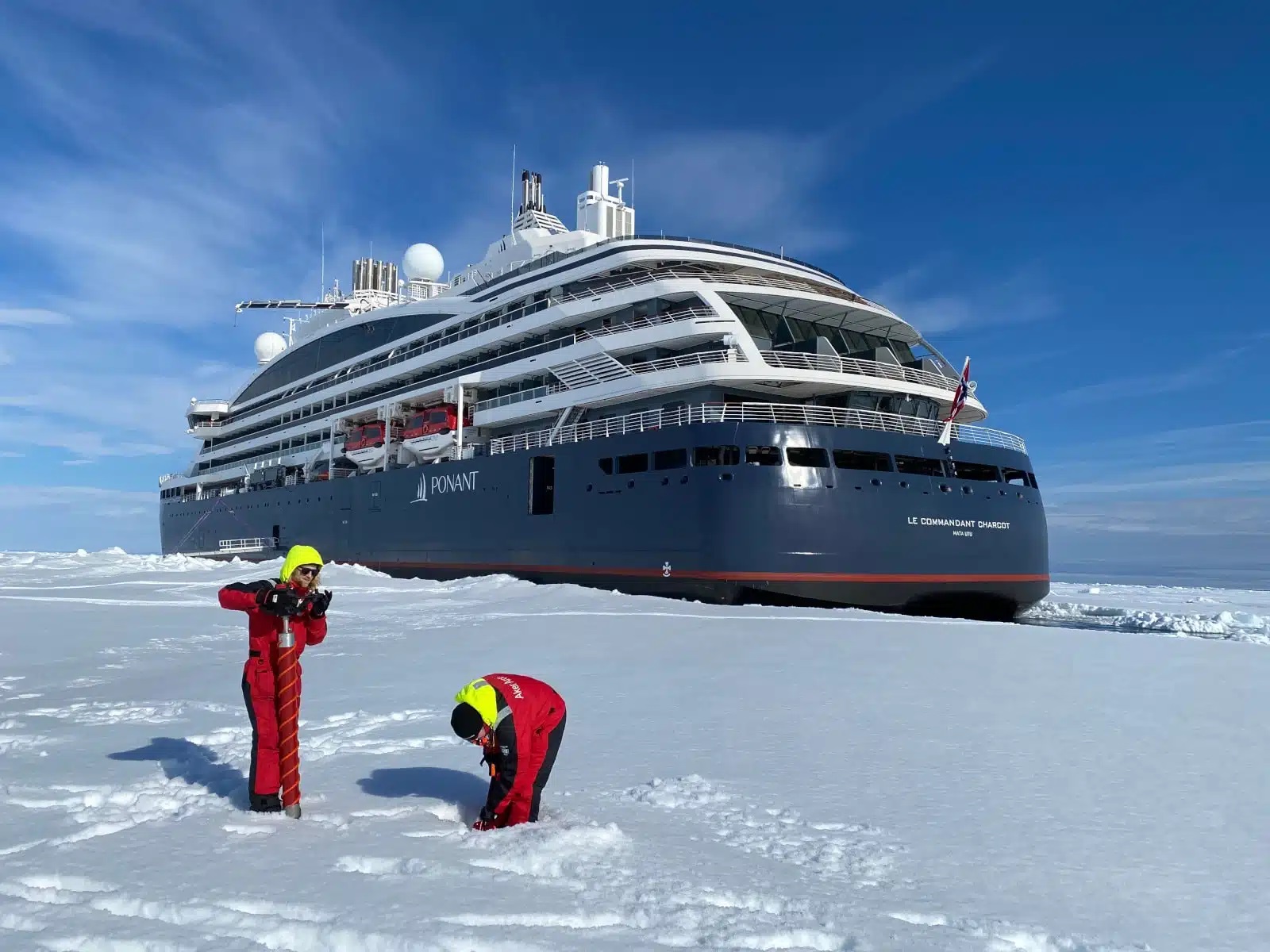

Selon Ponant, plus de 150 chercheurs ont déjà participé à une soixantaine de projets scientifiques depuis le lancement du programme. Les données récoltées alimentent ensuite des travaux partagés avec la communauté scientifique internationale.
Pour faire le lien entre recherche et expérience client, la compagnie a créé un rôle spécifique : celui de science officer.
À mi-chemin entre coordinateur scientifique et médiateur, ce professionnel accompagne les protocoles de recherche, supervise les équipements embarqués et traduit les travaux menés à bord en contenus accessibles aux voyageurs : conférences, présentations ou échanges informels.
Pour faire le lien entre recherche et expérience client, la compagnie a créé un rôle spécifique : celui de science officer.
À mi-chemin entre coordinateur scientifique et médiateur, ce professionnel accompagne les protocoles de recherche, supervise les équipements embarqués et traduit les travaux menés à bord en contenus accessibles aux voyageurs : conférences, présentations ou échanges informels.
The Swap2Zero project on the 2030 horizon
Cette logique dépasse aujourd’hui le seul Commandant Charcot. Sur d’autres navires d’expédition de la flotte, des naturalistes, glaciologues ou spécialistes de la biodiversité interviennent régulièrement lors des itinéraires polaires ou tropicaux.
En Polynésie française, le Paul Gauguin participe également à plusieurs initiatives de sensibilisation autour des écosystèmes marins et des récifs coralliens.
Ponant prépare enfin l’étape suivante avec son projet Swap2Zero, un futur voilier transocéanique à propulsion vélique et piles à combustible, annoncé pour l’horizon 2030 et pensé comme une plateforme ouverte aux travaux sur la décarbonation maritime.
Dans un marché de l’expédition où l’accès aux destinations reculées tend à se banaliser, la science devient progressivement un argument de différenciation.
En Polynésie française, le Paul Gauguin participe également à plusieurs initiatives de sensibilisation autour des écosystèmes marins et des récifs coralliens.
Ponant prépare enfin l’étape suivante avec son projet Swap2Zero, un futur voilier transocéanique à propulsion vélique et piles à combustible, annoncé pour l’horizon 2030 et pensé comme une plateforme ouverte aux travaux sur la décarbonation maritime.
Dans un marché de l’expédition où l’accès aux destinations reculées tend à se banaliser, la science devient progressivement un argument de différenciation.
 Published by Laurent Guéna Journalist – TourMaG.com
 See all articles by Laurent Guéna


Ajouter TourMaG à votre flux Google Actualités