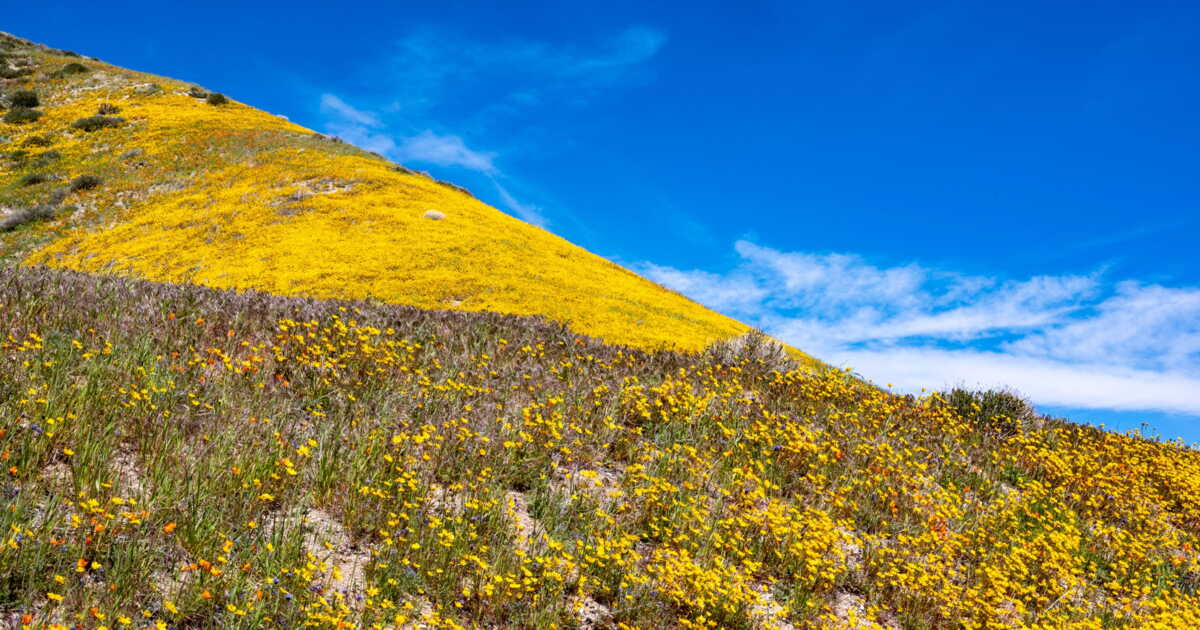
It must be a hallucination. Or a mirage. It’s nearly impossible to reason against this improbable explosion of life in the driest place in all of North America: Death Valley, California.
In this February 2026, the ground remains cracked, as if scorched by extreme drought. And yet, myriads of flowers have bloomed, dusting the mineral expanses with color touches worthy of an impressionist painting: phacelia blossoms in violet hues, primroses in a delicate white, lupines clustered into purple clusters… Not forgetting the local undisputed star, Geraea canescens, nicknamed here desert gold for its petals of a bright yellow.
A Decade-Long Bloom
Surprisingly, this phenomenon, called superbloom (“superbloom”), isn’t so rare: it occurs about once per decade. For this to happen, the seeds of these plants, dormant in the scorching soil, must be sufficiently “watered” to germinate. Like last winter, when more rain fell here in three months (over 6 cm in the autumn) than in an entire year (5 cm on average)! And when it doesn’t rain? Nothing is lost. In Death Valley, not so aptly named, life does not disappear: it waits for its hour.
➤ Article paru dans le magazine GEO n°569, “Se ressourcer en Auvergne”, de juillet 2026.
➤ Vous aimez GEO ? Alors pour ne rien manquer, découvrez nos formules d’abonnement pour recevoir chaque mois GEO chez vous en toute simplicité.