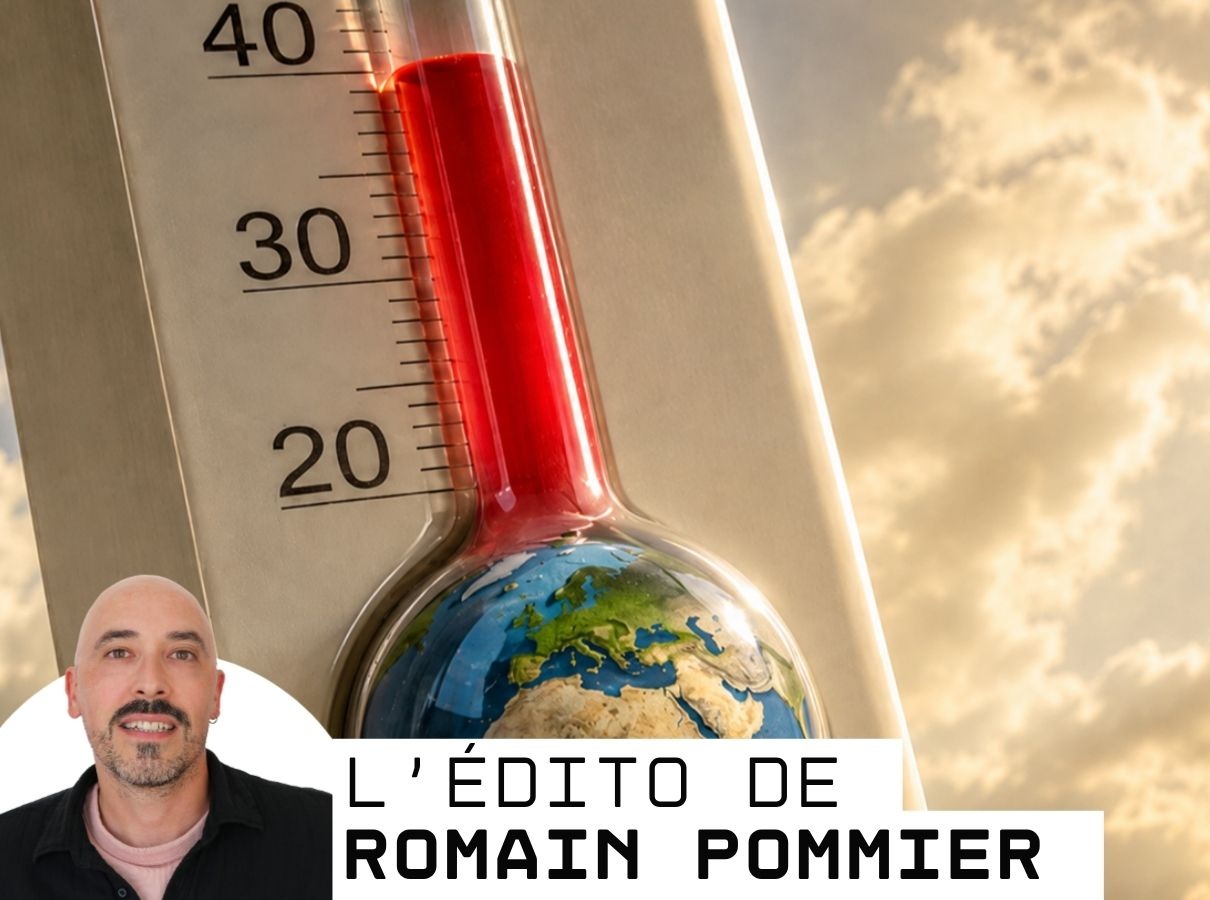


In 2014, to raise awareness about climate change, TF1 attempted a projection exercise during a weather bulletin.
We are August 17, 2050. France is smothered under an oppressive sun, barely veiled.
“Tomorrow morning, temperatures will already be very high, notably in Paris, Perpignan or Nice, with 26 degrees. In the afternoon, we will reach or exceed 40°C: 41 in Strasbourg, 40 in the capital, 42 in Lyon and up to 43 degrees forecast in Nîmes,” announced Evelyne Dhéliat, during a weather bulletin aired after the evening news.
Science fiction? Not at all. Just twelve years earlier, one could see that there was no need to project so far. These temperatures, which used to belong to forecasting, have become reality, even before summer has begun.
As economist Maxime Combes notes, Evelyne Dhéliat made three errors in her forecasts: no, Brittany and the Cotentin will not be spared; no, you won’t have to wait until August to burn on the spot; and no, you shouldn’t wait until 2050 either.
Indeed, by the end of 2026, France is already beating records one after another. It had already reached 37.8 °C at La Couronne in Charente, 37.4 °C in Perpignan and 37.6 °C in Narbonne.
While travel agencies struggle, France burns. And some still prefer to avert their eyes, when they don’t choose to laugh.
We are August 17, 2050. France is smothered under an oppressive sun, barely veiled.
“Tomorrow morning, temperatures will already be very high, notably in Paris, Perpignan or Nice, with 26 degrees. In the afternoon, we will reach or exceed 40°C: 41 in Strasbourg, 40 in the capital, 42 in Lyon and up to 43 degrees forecast in Nîmes,” announced Evelyne Dhéliat, during a weather bulletin aired after the evening news.
Science fiction? Not at all. Just twelve years earlier, one could see that there was no need to project so far. These temperatures, which used to belong to forecasting, have become reality, even before summer has begun.
As economist Maxime Combes notes, Evelyne Dhéliat made three errors in her forecasts: no, Brittany and the Cotentin will not be spared; no, you won’t have to wait until August to burn on the spot; and no, you shouldn’t wait until 2050 either.
Indeed, by the end of 2026, France is already beating records one after another. It had already reached 37.8 °C at La Couronne in Charente, 37.4 °C in Perpignan and 37.6 °C in Narbonne.
While travel agencies struggle, France burns. And some still prefer to avert their eyes, when they don’t choose to laugh.
Tourism: Best-Selling Destinations Will Become Unlivable…
 On his side, Daniel Riolo, a journalist whose humor is increasingly lacking, urged the French to stop “whining“, while asserting “it’s hot, enough already!”
A few hours later, in a classroom in Soustons, in the Landes, the thermometer surged and reached 53 degrees.
We are at the end of May, the students are suffocating, but all it will take is to slip on a T-shirt and open the windows. Seriously? Two very bad pieces of advice in such a situation.
Let us be clear: our industry cannot avoid a reflection on its future, even as crises follow one another, whether for travel agencies or for institutional actors.
To read: Greenhouse gas emissions: tourism must (quickly) act or die?
Because if we do nothing, an entire swath of destinations marketed by distribution, but also countries heavily dependent on tourism, will become unvisitable during the summer period.
“If we do nothing, the South and the Mediterranean basin will be regions comparable to the desert of Africa. In short, this region will no longer be attractive for summer vacations. The sand will be so hot that no one will be able to walk there.
Tourists will not want to stay in their hotel room all day, when there are other places to go out.
If we do nothing, I am not optimistic for this region“, explained a few years ago Wouter Vanneuville, climate adaptation expert at the European Environment Agency.
The clock is ticking. And even if adaptation in Europe is very costly, doing nothing will cost more, economically and in human terms.
… infrastructures will become obsolete
This episode of historical precocity reminds us that destinations are not the only things that are not adapted: our infrastructures are not in a better position.
Last week, SNCF had no choice but to cancel trains.
The carrier explained that this decision was necessary due to the risk of air conditioning failures, because equipment is too old and not robust enough to withstand extreme temperatures.
At the last EDV conference, Jean Castex, the former prime minister, underscored the urgency of the situation.
“I often say that climate-skeptics would be stunned by the evolution observed in just 15 years if they visited the SNCF.
This impact is now considerable. The consequences are not limited to more pronounced climatic phenomena.
We are particularly witnessing a rise in forest fires. Yet, our lines traverse numerous wooded areas, which can have a very significant impact on rail traffic.
There is also a disruption of wildlife and a sharp increase in trees falling onto the network. In ten years, they have multiplied by fourteen“, confided the CEO of SNCF.
The carrier also keeps a close watch on problems with catenaries, power supply, or the overheating of rails. When it is 37 °C, the temperature of the rail can reach 55 °C. At that level, it can warp.
In 2025 already, the new Nantes station had to be closed due to the heat. It has again made headlines last week.
Air travel will not be spared either.
Last week, SNCF had no choice but to cancel trains.
The carrier explained that this decision was necessary due to the risk of air conditioning failures, because equipment is too old and not robust enough to withstand extreme temperatures.
At the last EDV conference, Jean Castex, the former prime minister, underscored the urgency of the situation.
“I often say that climate-skeptics would be stunned by the evolution observed in just 15 years if they visited the SNCF.
This impact is now considerable. The consequences are not limited to more pronounced climatic phenomena.
We are particularly witnessing a rise in forest fires. Yet, our lines traverse numerous wooded areas, which can have a very significant impact on rail traffic.
There is also a disruption of wildlife and a sharp increase in trees falling onto the network. In ten years, they have multiplied by fourteen“, confided the CEO of SNCF.
The carrier also keeps a close watch on problems with catenaries, power supply, or the overheating of rails. When it is 37 °C, the temperature of the rail can reach 55 °C. At that level, it can warp.
In 2025 already, the new Nantes station had to be closed due to the heat. It has again made headlines last week.
Air travel will not be spared either.
Tourism is not the climate’s arch-enemy, but it must question itself!
In 2017, the city of Phoenix, United States, turned into a true furnace. The thermometer exceeded 50 degrees.
“The hotter the air, the less dense it is. Therefore, one must reach a higher takeoff speed. The length of the runway can be a determining factor in achieving that speed. In Phoenix, with this heat wave, air density made takeoffs impossible“, explained Clément Mallet, project manager for mobility and adaptation at Carbone 4, in a previous article.
Global warming will also intensify turbulence.
According to a study by researchers at the University of Reading, these phenomena are becoming more frequent due to warmer air. Today, on a Paris–New York flight, passengers experience an average of 10 minutes of turbulence.
By 2050, that will be more like 20 to 30 minutes.
Here are as many examples as there are to show that our industry is not ready to face this phenomenon that we, humanity, have created. And we have not even spoken about rising sea levels or the dwindling of snow in the mountains… nor about the regulatory risk that could be imposed on companies…
Good news, we still have our fate in our own hands.
And contrary to what a recently posted LinkedIn message by a captain suggested, it is clear that taxing French aviation will not change everything. But it is not either by shifting blame onto others or by minimizing one’s own impact on global warming that we will advance the debate.
With such reasoning, we could have allowed people to keep smoking in restaurants, bars or cafes. After all, one cigarette cannot hurt anyone. Likewise, it would be easier to avoid picking up after Fido’s poop or to refrain from throwing a bottle in the trash…
Of course, it is the sum of individual behaviors that is at stake. Only a broad, global awareness will keep our old Earth breathable.
So no, we should not stop traveling, nor flying. But we must all, collectively, adopt a reasoned behavior, so that this industry remains the powerful lever of emancipation and inclusion, whether in 2050 or beyond.
“The hotter the air, the less dense it is. Therefore, one must reach a higher takeoff speed. The length of the runway can be a determining factor in achieving that speed. In Phoenix, with this heat wave, air density made takeoffs impossible“, explained Clément Mallet, project manager for mobility and adaptation at Carbone 4, in a previous article.
Global warming will also intensify turbulence.
According to a study by researchers at the University of Reading, these phenomena are becoming more frequent due to warmer air. Today, on a Paris–New York flight, passengers experience an average of 10 minutes of turbulence.
By 2050, that will be more like 20 to 30 minutes.
Here are as many examples as there are to show that our industry is not ready to face this phenomenon that we, humanity, have created. And we have not even spoken about rising sea levels or the dwindling of snow in the mountains… nor about the regulatory risk that could be imposed on companies…
Good news, we still have our fate in our own hands.
And contrary to what a recently posted LinkedIn message by a captain suggested, it is clear that taxing French aviation will not change everything. But it is not either by shifting blame onto others or by minimizing one’s own impact on global warming that we will advance the debate.
With such reasoning, we could have allowed people to keep smoking in restaurants, bars or cafes. After all, one cigarette cannot hurt anyone. Likewise, it would be easier to avoid picking up after Fido’s poop or to refrain from throwing a bottle in the trash…
Of course, it is the sum of individual behaviors that is at stake. Only a broad, global awareness will keep our old Earth breathable.
So no, we should not stop traveling, nor flying. But we must all, collectively, adopt a reasoned behavior, so that this industry remains the powerful lever of emancipation and inclusion, whether in 2050 or beyond.