

Destination to be explored as a cultural cornerstone, Catalonia asserts a strong identity marked by traditions, popular festivals, and a rich heritage: Roman ruins, medieval villages, and Gaudí’s modernist masterpieces— every discovery is unique.
And of course, it would be impossible to speak of Catalonia without mentioning its generous and authentic gastronomy, which highlights local products and regional know‑how and has earned it the designation of World Gastronomy Region 2025.
And of course, it would be impossible to speak of Catalonia without mentioning its generous and authentic gastronomy, which highlights local products and regional know‑how and has earned it the designation of World Gastronomy Region 2025.
Contest
A través de los distintos épisodes, we will take you on an exceptional itinerary, blending culture, heritage, gastronomy, natural landscapes, and the Mediterranean art of living.
Extend the adventure by joining the grand quiz now and try to win a trip for two on Section 3 of the Grand Tour of Catalonia, from Lleida to La Seu d’Urgell.
A unique experience to live and to share with your clients!
In second and third prizes, a beautiful book “La Catalogne vue du ciel” by Yann Arthus-Bertrand.
👉 Participate in the contest
Contest dates: February 2 to March 31, 2026.
Extend the adventure by joining the grand quiz now and try to win a trip for two on Section 3 of the Grand Tour of Catalonia, from Lleida to La Seu d’Urgell.
A unique experience to live and to share with your clients!
In second and third prizes, a beautiful book “La Catalogne vue du ciel” by Yann Arthus-Bertrand.
👉 Participate in the contest
Contest dates: February 2 to March 31, 2026.
Episode 1: Welcome to Catalonia!
Let’s embark together on a journey to discover Catalonia through the Grand Tour of Catalonia, som-hi (let’s go in Catalan!).
In this episode, Josefina Mariné, director of the French office of Catalonia Tourism, will first present the destination’s cultural and sporting news.
In 2026, we celebrate the Centenary of Gaudí’s death, a genius of Catalan Modernism, and the 150th anniversary of the birth of Pau Casals, the renowned cellist and peacemaker. Moreover, Barcelona has been named a UNESCO World Capital of Architecture and a recognition by the International Union of Architects, highlighting its exceptional buildings and urban design.
Additionally, in July 2026 we will host an international event: the Grand Start of the Tour de France — Barcelona, Tarragona and Granollers will be stage towns of the Tour de France! A historic moment we can’t wait to live here, on our Catalan soil.
Then, discover the Grand Tour of Catalonia offer — a unique experience designed with regional partners in a framework of sustainability, quality, and authenticity.
This offer allows travelers to discover Catalonia at their own pace, in depth, through more than 300 local experiences blending culture, nature, gastronomy, and traditions.
The Grand Tour of Catalonia can be lived in several ways:
● The emblematic route: a circular itinerary of 13 days and almost 2,000 km, for a complete immersion.
● The 5 thematic stretches: five sections of 5 to 7 stages each, perfect for exploring the region by zones or according to desires.
● The gastronomic version: a tasty itinerary for lovers of Catalan cuisine and terroir.
● The family version: an itinerary designed for family experiences.
● For cycling enthusiasts, the Grand Tour of Catalonia in gravel.
Across five episodes, our Catalonia partners will introduce these 5 stretches that together illustrate the richness and diversity of all of Catalonia.
In this episode, Josefina Mariné, director of the French office of Catalonia Tourism, will first present the destination’s cultural and sporting news.
In 2026, we celebrate the Centenary of Gaudí’s death, a genius of Catalan Modernism, and the 150th anniversary of the birth of Pau Casals, the renowned cellist and peacemaker. Moreover, Barcelona has been named a UNESCO World Capital of Architecture and a recognition by the International Union of Architects, highlighting its exceptional buildings and urban design.
Additionally, in July 2026 we will host an international event: the Grand Start of the Tour de France — Barcelona, Tarragona and Granollers will be stage towns of the Tour de France! A historic moment we can’t wait to live here, on our Catalan soil.
Then, discover the Grand Tour of Catalonia offer — a unique experience designed with regional partners in a framework of sustainability, quality, and authenticity.
This offer allows travelers to discover Catalonia at their own pace, in depth, through more than 300 local experiences blending culture, nature, gastronomy, and traditions.
The Grand Tour of Catalonia can be lived in several ways:
● The emblematic route: a circular itinerary of 13 days and almost 2,000 km, for a complete immersion.
● The 5 thematic stretches: five sections of 5 to 7 stages each, perfect for exploring the region by zones or according to desires.
● The gastronomic version: a tasty itinerary for lovers of Catalan cuisine and terroir.
● The family version: an itinerary designed for family experiences.
● For cycling enthusiasts, the Grand Tour of Catalonia in gravel.
Across five episodes, our Catalonia partners will introduce these 5 stretches that together illustrate the richness and diversity of all of Catalonia.
Credits Episode 1: © apperSTUDIO © Fundació Junta Constructora del Temple Expiatori de la Sagrada Família © Barcelona Turisme © Diputació de Barcelona © Fundació Pau Casals © Patronat de Turisme Costa Brava Girona © Consell Comarcal del Priorat / Joan Capdevila Vallve
Episode 2: From Barcelona to Tarragona, vineyards to the sea taste
In this episode, we are pleased to welcome Cécile Lacroute, head of promotion for the French office of Catalonia Tourism, to discuss the first stretch of the Grand Tour of Catalonia linking Barcelona to Tarragona in 6 stages: culture, spirituality, gastronomy, nature, and relaxation are on the program!
Barcelona, a vibrant Mediterranean city, world capital of Architecture 2026, is the starting point of an unforgettable journey across Catalonia, to Tarragona, the majestic Roman city.
Leaving Barcelona and its Modernist heritage, the road heads to the sacred mountain Montserrat with its millennium-old monastery, symbol of the region, before crossing the spectacular landscapes of the Penedès vineyards, where one can sample Cava and outstanding wines at family estates.
Along the way, travelers will pause in Cardona with its medieval castle, in Solsona to discover its artistic heritage, or in Sitges, a lively seaside town full of charm. Both are renowned for their Carnaval, full of color and festive atmosphere!
In El Vendrell, the music of cellist Pau Casals accompanies the visit like a true soundtrack of the journey.
Finally, the itinerary ends in Tarragona, between golden beaches, Roman culture, and authentic traditions — including calçots, xató and seafood, as well as cultural experiences.
Also discover a spectacular and unique tradition: the Castells of Tarragona, these impressive human towers that electrify the whole city.
Another must: Tàrraco Viva, an immersive festival reviving the grandeur of the Roman era. Visitors discover historical reconstructions, gladiator combats, theatre, music and dance performances, and a living glimpse of daily life in ancient Rome.
And for fans of unusual culinary traditions, discover the calçotada festival of Valls!
🧭Itinerary Section 1: From Barcelona to Tarragona, the vines to the taste of the sea 📍 462 km – 6 stages
→ Barcelona
→ Montserrat
→ El Penedès
→ Costa Barcelona and Sitges
→ Cistercian route (Monastery of Santes Creus)
→ Tarragona
Barcelona, a vibrant Mediterranean city, world capital of Architecture 2026, is the starting point of an unforgettable journey across Catalonia, to Tarragona, the majestic Roman city.
Leaving Barcelona and its Modernist heritage, the road heads to the sacred mountain Montserrat with its millennium-old monastery, symbol of the region, before crossing the spectacular landscapes of the Penedès vineyards, where one can sample Cava and outstanding wines at family estates.
Along the way, travelers will pause in Cardona with its medieval castle, in Solsona to discover its artistic heritage, or in Sitges, a lively seaside town full of charm. Both are renowned for their Carnaval, full of color and festive atmosphere!
In El Vendrell, the music of cellist Pau Casals accompanies the visit like a true soundtrack of the journey.
Finally, the itinerary ends in Tarragona, between golden beaches, Roman culture, and authentic traditions — including calçots, xató and seafood, as well as cultural experiences.
Also discover a spectacular and unique tradition: the Castells of Tarragona, these impressive human towers that electrify the whole city.
Another must: Tàrraco Viva, an immersive festival reviving the grandeur of the Roman era. Visitors discover historical reconstructions, gladiator combats, theatre, music and dance performances, and a living glimpse of daily life in ancient Rome.
And for fans of unusual culinary traditions, discover the calçotada festival of Valls!
🧭Itinerary Section 1: From Barcelona to Tarragona, the vines to the taste of the sea 📍 462 km – 6 stages
→ Barcelona
→ Montserrat
→ El Penedès
→ Costa Barcelona and Sitges
→ Cistercian route (Monastery of Santes Creus)
→ Tarragona
Episode 3: Tarragona – Lleida: Meeting History
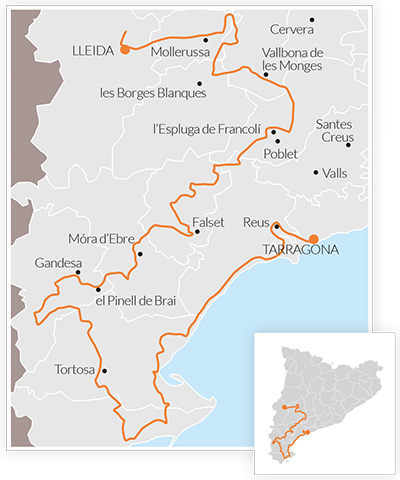
In this episode, we welcome Claire Aubertel from the NjoyCatalonia agency who will take us from the Costa Daurada to the lands of the Ebre and Lleida. An exceptional itinerary, between shimmering seas, tranquil rivers and authentic inland landscapes, meeting millennial traditions and an astonishing natural diversity.
This second stage of the Grand Tour of Catalonia begins in Tarragona and takes you to Reus, cradle of Antoni Gaudí—the genius of Catalan Modernism. In June 2026, we will celebrate the centenary of his passing.
Reus, a true jewel of the Modernist Route, houses treasures such as Casa Navàs or the Pere Mata Institute, not to mention the Gaudí Interpretation Center, an immersive experience essential to understand the artist’s universe.
Then, the excitement continues with PortAventura World!
An essential stop for families and thrill-seekers, where shows, attractions and themed lands plunge visitors into an adventurous world. The park celebrated its 30th anniversary in 2025 — the perfect moment to rediscover the realm of Woody Woodpecker and many other iconic worlds.
Next, head to the Costa Daurada coastline: savor the sea cuisine in Cambrils, unwind on the beaches of Salou, then explore the Ebre delta on foot, by bike, by canoe, or by boat. Between golden beaches, rice fields, salt marshes, flamingos and preserved nature, the escape is total.
The route then penetrates inland along the Ebre, amidst millennial olive groves, orchards and vineyards. You will discover the wild nature of the Ports massif and make a mandatory stop in the “cathedrals of wine” of Terra Alta and Priorat. These monumental wine cellars owe their nickname to a spectacular architecture inspired by Gothic cathedrals — soaring vaults, imposing pillars and majestic arches. It feels like being in a real cathedral… but filled with wine casks, offering a visually and sensorially unforgettable experience.
Explore the Catalan Cistercian treasures, with Poblet Monastery at the pinnacle, a UNESCO World Heritage Site.
The journey ends in Lleida, the agricultural capital of Catalonia, famed for its welcoming atmosphere and its Aplec del Caragol, a popular gastronomic festival where every spring 13 tonnes of snails are tasted in a festive and authentic ambiance!
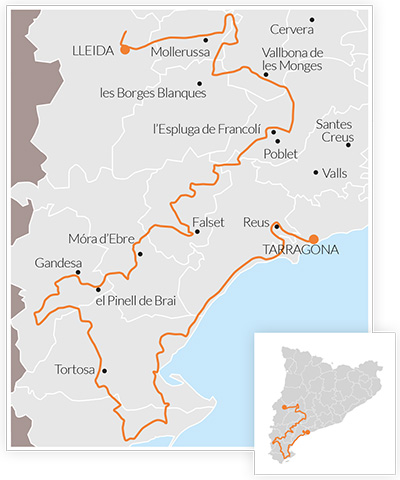
🧭Itinerary Section 2: From Tarragona to Lleida, in search of history 📍 418 km – 7 stages
→ Tarragona Roman
→ Reus
→ Delta de l’Ebre Natural Park
→ Modernist cellars
→ El Priorat
→ Cistercian route (Poblet Monastery and Vallbona de les Monges)
→ Lleida
This second stage of the Grand Tour of Catalonia begins in Tarragona and takes you to Reus, cradle of Antoni Gaudí—the genius of Catalan Modernism. In June 2026, we will celebrate the centenary of his passing.
Reus, a true jewel of the Modernist Route, houses treasures such as Casa Navàs or the Pere Mata Institute, not to mention the Gaudí Interpretation Center, an immersive experience essential to understand the artist’s universe.
Then, the excitement continues with PortAventura World!
An essential stop for families and thrill-seekers, where shows, attractions and themed lands plunge visitors into an adventurous world. The park celebrated its 30th anniversary in 2025 — the perfect moment to rediscover the realm of Woody Woodpecker and many other iconic worlds.
Next, head to the Costa Daurada coastline: savor the sea cuisine in Cambrils, unwind on the beaches of Salou, then explore the Ebre delta on foot, by bike, by canoe, or by boat. Between golden beaches, rice fields, salt marshes, flamingos and preserved nature, the escape is total.
The route then penetrates inland along the Ebre, amidst millennial olive groves, orchards and vineyards. You will discover the wild nature of the Ports massif and make a mandatory stop in the “cathedrals of wine” of Terra Alta and Priorat. These monumental wine cellars owe their nickname to a spectacular architecture inspired by Gothic cathedrals — soaring vaults, imposing pillars and majestic arches. It feels like being in a real cathedral… but filled with wine casks, offering a visually and sensorially unforgettable experience.
Explore the Catalan Cistercian treasures, with Poblet Monastery at the pinnacle, a UNESCO World Heritage Site.
The journey ends in Lleida, the agricultural capital of Catalonia, famed for its welcoming atmosphere and its Aplec del Caragol, a popular gastronomic festival where every spring 13 tonnes of snails are tasted in a festive and authentic ambiance!
🧭Itinerary Section 2: From Tarragona to Lleida, in search of history 📍 418 km – 7 stages
→ Tarragona Roman
→ Reus
→ Delta de l’Ebre Natural Park
→ Modernist cellars
→ El Priorat
→ Cistercian route (Poblet Monastery and Vallbona de les Monges)
→ Lleida
Credits Episode 3: © Rafa Pérez – ACT © Consell Comarcal del Priorat / Joan Capdevila Vallve © Consell Comarcal del Priorat © Coral Tarrés © Patronat Municipal de Turisme de Salou © Manel R. Granell / Tarragona Turisme © Jaume Boldú / Tarragona Turisme © Tarragona Turisme © Institut per al Desenvolupament de les Comarques de l’Ebre (IDECE) © Turisme de les Terres de l’Ebre © Tortosa Turisme © Turisme de Cambrils © Patronat de Turisme Costa Daurada © PortAventuraEntertainmentSAU © Consell Comarcal de l’Urgell © Patronat de Turisme de la Diputació de Lleida
Episode 4: From Lleida to La Seu d’Urgell: Close to the Sky
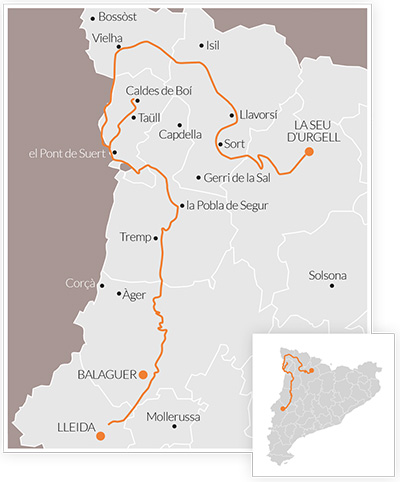
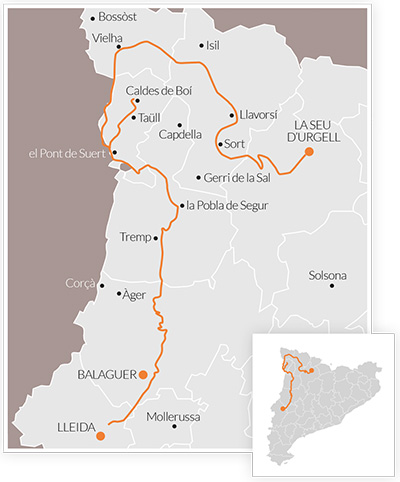
In this episode, we welcome Sofia Gonzalez from the Directorate General of Tourism, who guides us through the Catalan plains to the majestic Pyrenees. A inspiring and refreshing journey where culture, preserved nature, starry skies, and outdoor sports come together to appeal to adventure and discovery lovers.
Start with Lleida, an inland city that captivates with its authenticity and its rich historical heritage. Dominated by the majestic former Seu Vella Cathedral, the city offers an exceptional panorama over the Segrià plain. Its historic center, rural traditions, and its local gastronomy — wines of Costers del Segre, olive oil, and regional products — make for a charming stop.
Continue to the Montsec Astronomical Park, an exceptional site certified Starlight, ideal for observing a starry sky among the purest in Europe.
Then discover the Romanesque churches of the Vall de Boí, UNESCO World Heritage, true architectural treasures of the 11th and 12th centuries. These monuments offer a unique blend of medieval history, Romanesque art, and spectacular mountain landscapes.
Then head to the Val d’Aran, tucked in the Catalan Pyrenees at the French border. This valley offers an exceptional playground year-round: skiing and snowboarding at Baqueira-Beret, hiking, mountain biking, rafting or simple walks in its picturesque villages such as Vielha, Arties or Bagergue, with stone houses and slate roofs. The valley also hosts protected areas, including the National Park of Aigüestortes and Estany de Sant Maurici, with its glacial lakes and majestic peaks.
The local gastronomy completes the experience: artisanal cheeses, mountain charcuterie, stews, game, and honeys from the Pyrenees will awaken your senses at every step. Not to mention traditional festivals, like the annual celebrations of Arties and Aranese folklore, which make the valley vibrate.
This unique journey will finally lead you to La Seu d’Urgell, the ideal gateway to continue your cultural and natural exploration of Catalonia.
🧭Itinerary Section 3: From Lleida to La Seu d’Urgell, close to the sky 📍 357 km – 5 stages
→ Lleida
→ Mont-rebei Gorges
→ National Park of Aigüestortes and Estany de Sant Maurici
→ Romanesque art of the Vall de Boí
→ Val d’Aran
→ La Seu d’Urgell
Start with Lleida, an inland city that captivates with its authenticity and its rich historical heritage. Dominated by the majestic former Seu Vella Cathedral, the city offers an exceptional panorama over the Segrià plain. Its historic center, rural traditions, and its local gastronomy — wines of Costers del Segre, olive oil, and regional products — make for a charming stop.
Continue to the Montsec Astronomical Park, an exceptional site certified Starlight, ideal for observing a starry sky among the purest in Europe.
Then discover the Romanesque churches of the Vall de Boí, UNESCO World Heritage, true architectural treasures of the 11th and 12th centuries. These monuments offer a unique blend of medieval history, Romanesque art, and spectacular mountain landscapes.
Then head to the Val d’Aran, tucked in the Catalan Pyrenees at the French border. This valley offers an exceptional playground year-round: skiing and snowboarding at Baqueira-Beret, hiking, mountain biking, rafting or simple walks in its picturesque villages such as Vielha, Arties or Bagergue, with stone houses and slate roofs. The valley also hosts protected areas, including the National Park of Aigüestortes and Estany de Sant Maurici, with its glacial lakes and majestic peaks.
The local gastronomy completes the experience: artisanal cheeses, mountain charcuterie, stews, game, and honeys from the Pyrenees will awaken your senses at every step. Not to mention traditional festivals, like the annual celebrations of Arties and Aranese folklore, which make the valley vibrate.
This unique journey will finally lead you to La Seu d’Urgell, the ideal gateway to continue your cultural and natural exploration of Catalonia.
🧭Itinerary Section 3: From Lleida to La Seu d’Urgell, close to the sky 📍 357 km – 5 stages
→ Lleida
→ Mont-rebei Gorges
→ National Park of Aigüestortes and Estany de Sant Maurici
→ Romanesque art of the Vall de Boí
→ Val d’Aran
→ La Seu d’Urgell
Credits Episode 4: © Area de Turisme del Consell Comarcal de l’Urgell © Oficina de Turisme del Berguedà © Oficina de Turisme Val d’Aran © Turisme de la Seu © TN Produccions / Arxiu Patronat de Turisme de la Diputació de Lleida © Patronat de Turisme de la Diputació de Lleida © Turisme (visitjussà) del Consell comarcal del Pallars Jussà
Episode 5: From La Seu d’Urgell to Figueres: Ode to Nature
In this episode, we are pleased to welcome Marinel·la Mosquera from the Pedratour agency, who will present the fourth stretch of the Grand Tour of Catalonia, a stage rich in landscapes, culture and emotion.
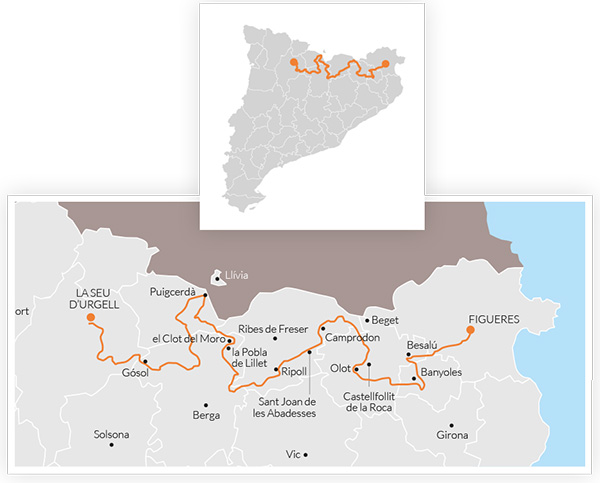
The route starts in La Seu d’Urgell, a charming town at the confluence of two rivers, dominated by the Cadí mountain range. From there, the itinerary heads east and crosses the Catalan Pyrenees, skirting the spectacular Cadí-Moixeró Natural Park with the “forked” Pedraforca massif, a true natural jewel; this park links the Cadí and Moixeró ranges, offering a setting of majestic mountains, green forests, deep gorges and traditional villages.
A perfect site for travelers seeking nature, authenticity and outdoor activities, with numerous hiking trails accessible to all.
Along the way, travelers will visit the Ripoll Monastery, a masterpiece of Catalan heritage and a true symbol of Catalonia’s origins.
Then, head to the Garrotxa volcanic zone natural park, a unique space in Europe, where nearly 40 volcanoes and lush forests offer a fascinating landscape.
From the air, a hot air balloon flight over Olot’s volcanoes guarantees an unforgettable moment! Don’t miss the Espai Cràter, an immersive museum housed in an old crater, perfect for understanding the region’s geological secrets and tasting volcanic cuisine with products from fertile volcanic lands, with unique flavors.
The journey continues through the medieval villages of Gósol, Santa Pau, Besalú, true Catalan postcard towns where history and charm permeate every alley.
Finally, the route ends in Figueres, Salvador Dalí’s birthplace.
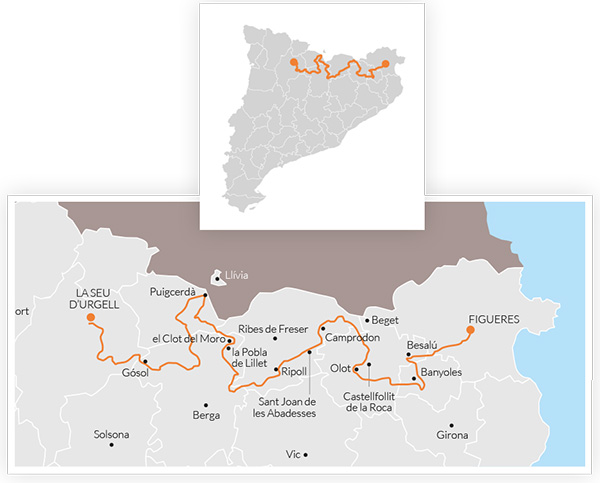
🧭Itinerary Section 4: From La Seu d’Urgell to Figueres, ode to nature 📍 357 km – 5 stages
→ La Seu d’Urgell
→ Pedraforca
→ Pittoresque Pyrenean villages
→ Garrotxa volcanic zone
→ Besalú
→ Figueres
The route starts in La Seu d’Urgell, a charming town at the confluence of two rivers, dominated by the Cadí mountain range. From there, the itinerary heads east and crosses the Catalan Pyrenees, skirting the spectacular Cadí-Moixeró Natural Park with the “forked” Pedraforca massif, a true natural jewel; this park links the Cadí and Moixeró ranges, offering a setting of majestic mountains, green forests, deep gorges and traditional villages.
A perfect site for travelers seeking nature, authenticity and outdoor activities, with numerous hiking trails accessible to all.
Along the way, travelers will visit the Ripoll Monastery, a masterpiece of Catalan heritage and a true symbol of Catalonia’s origins.
Then, head to the Garrotxa volcanic zone natural park, a unique space in Europe, where nearly 40 volcanoes and lush forests offer a fascinating landscape.
From the air, a hot air balloon flight over Olot’s volcanoes guarantees an unforgettable moment! Don’t miss the Espai Cràter, an immersive museum housed in an old crater, perfect for understanding the region’s geological secrets and tasting volcanic cuisine with products from fertile volcanic lands, with unique flavors.
The journey continues through the medieval villages of Gósol, Santa Pau, Besalú, true Catalan postcard towns where history and charm permeate every alley.
Finally, the route ends in Figueres, Salvador Dalí’s birthplace.
🧭Itinerary Section 4: From La Seu d’Urgell to Figueres, ode to nature 📍 357 km – 5 stages
→ La Seu d’Urgell
→ Pedraforca
→ Pittoresque Pyrenean villages
→ Garrotxa volcanic zone
→ Besalú
→ Figueres
Credits Episode 5: © Turisme Garrotxa © Patronat de Turisme Costa Brava Girona © Oficina de Turisme de Besalú – vadobuch © Delit – Agència d’Innovació i desenvolupamnt de la Garrotxa © Associació d’Hostalatge de la Garrotxa © Domènec Fernández – Diputació de Barcelona
Episode 6: From Figueres to Barcelona: From Surrealism to Modernism
In this final episode, we are delighted to welcome Daniel Punseti, founder of the Camí de Ronda, to cap off the Grand Tour of Catalonia in style.
Beginning in Figueres, this fifth stretch extends the journey into Salvador Dalí’s surreal universe. Travelers will discover his birthplace home, retracing his beginnings, then the famous Dalí Theatre‑Museum, conceived by the artist himself — an iconic and essential place for any art and culture lover.
The route then leads to Cadaqués, a beautiful whitewashed village facing the Mediterranean, surrounded by mountains and bathed in a unique light. Nearby, the Portlligat and Púbol Dalí houses, true sources of inspiration for Catalan genius, invite you to dive into his imagination and daily life.
Before reaching the mineral landscapes of Cap de Creus, a stop at the Monastery of Sant Pere de Rodas is a must, a spectacular Romanesque ensemble overlooking the Port de la Selva: between monastic history, wine culture of the Empordà, and panoramas swept by the tramontane, the visit offers a timeless interlude.
The road continues to Cap de Creus, the easternmost point of the Iberian Peninsula, where the Pyrénées meet the Mediterranean. Classified as a Natural Park, this spectacular site stands out for its wind-sculpted cliffs, hidden coves, and crystal-clear waters, hosting an exceptional marine biodiversity.
Visitors can reach the Cap de Creus lighthouse to admire a breathtaking panoramic view, or follow the coastal paths leading to natural gems such as Cala Culip or Cala Jugadora.
The itinerary then runs along the Costa Brava, famous for its fishing villages and coastal trails overlooking the sea. It leads to Girona, a charming medieval city with colorful lanes and the Cathedral of Santa Maria, one of Catalonia’s most impressive. Every May, the city dresses in thousands of floral arrangements for the Temps de Flors festival, a must for travelers.
Halfway, visitors can stop in the medieval villages of Peratallada, Pals or La Bisbal d’Empordà, before reaching Vic, then cross the Montseny massif, a Biosphere Reserve, to finish the journey on the beaches and ports of the Costa Barcelona.
The apex of this Grand Tour of Catalonia is, of course, Barcelona, a cosmopolitan and creative capital where modernism, lifestyle, and Mediterranean energy mingle.
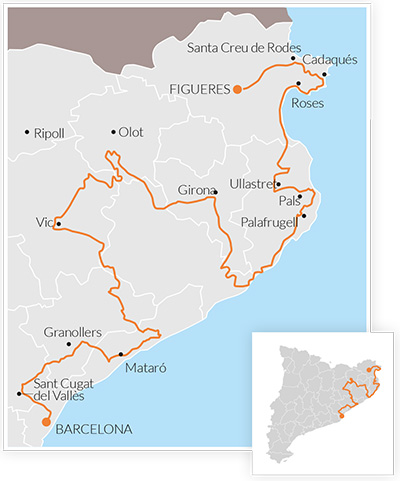
🧭Itinerary Section 5: From Figueres to Barcelona, from Surrealism to Modernism 📍 525 km – 7 stages
→ Figueres
→ Cap de Creus Natural Park
→ Cadaqués and Portlligat
→ Old interior medieval towns
→ Girona
→ Vic
→ Montseny Natural Park
→ Costa Barcelona: Modernism and colonist villages
→ Barcelona
Beginning in Figueres, this fifth stretch extends the journey into Salvador Dalí’s surreal universe. Travelers will discover his birthplace home, retracing his beginnings, then the famous Dalí Theatre‑Museum, conceived by the artist himself — an iconic and essential place for any art and culture lover.
The route then leads to Cadaqués, a beautiful whitewashed village facing the Mediterranean, surrounded by mountains and bathed in a unique light. Nearby, the Portlligat and Púbol Dalí houses, true sources of inspiration for Catalan genius, invite you to dive into his imagination and daily life.
Before reaching the mineral landscapes of Cap de Creus, a stop at the Monastery of Sant Pere de Rodas is a must, a spectacular Romanesque ensemble overlooking the Port de la Selva: between monastic history, wine culture of the Empordà, and panoramas swept by the tramontane, the visit offers a timeless interlude.
The road continues to Cap de Creus, the easternmost point of the Iberian Peninsula, where the Pyrénées meet the Mediterranean. Classified as a Natural Park, this spectacular site stands out for its wind-sculpted cliffs, hidden coves, and crystal-clear waters, hosting an exceptional marine biodiversity.
Visitors can reach the Cap de Creus lighthouse to admire a breathtaking panoramic view, or follow the coastal paths leading to natural gems such as Cala Culip or Cala Jugadora.
The itinerary then runs along the Costa Brava, famous for its fishing villages and coastal trails overlooking the sea. It leads to Girona, a charming medieval city with colorful lanes and the Cathedral of Santa Maria, one of Catalonia’s most impressive. Every May, the city dresses in thousands of floral arrangements for the Temps de Flors festival, a must for travelers.
Halfway, visitors can stop in the medieval villages of Peratallada, Pals or La Bisbal d’Empordà, before reaching Vic, then cross the Montseny massif, a Biosphere Reserve, to finish the journey on the beaches and ports of the Costa Barcelona.
The apex of this Grand Tour of Catalonia is, of course, Barcelona, a cosmopolitan and creative capital where modernism, lifestyle, and Mediterranean energy mingle.
🧭Itinerary Section 5: From Figueres to Barcelona, from Surrealism to Modernism 📍 525 km – 7 stages
→ Figueres
→ Cap de Creus Natural Park
→ Cadaqués and Portlligat
→ Old interior medieval towns
→ Girona
→ Vic
→ Montseny Natural Park
→ Costa Barcelona: Modernism and colonist villages
→ Barcelona
Credits Episode 6: © Ajuntament del Port de la Selva – visual13 © Ajuntament de Besalú © Ajuntament de Santa Maria de Palautordera © Ajuntament de Forallac © Barcelona Turisme © Patronat de Turisme Costa Brava Girona © Oficina de Turisme de Vic © Ajuntament de Torroella de Montgrí © Daniel Punseti – Patronat de Turisme Costa Brava Girona © Oficina de Turisme del Port de la Selva © Oficina Municipal de Turisme de Blanes © Ajuntament de Figueres © Oficina Municipal de Turisme de Pals © Diputació de Barcelona © Albert Miró – Diputació Barcelona © Domènec Fernández – Diputació de Barcelona
Contact Catalonia Tourism


Tourisme de la Catalogne, 50 rue Saint-Ferdinand, 75017 Paris
Contact :
Cécile Lacroute
Responsable promotion
Email : [email protected] – [email protected]
Téléphone : +33 6 77 95 76 53
Site web : https://www.catalunya.com/fr
Contact :
Cécile Lacroute
Responsable promotion
Email : [email protected] – [email protected]
Téléphone : +33 6 77 95 76 53
Site web : https://www.catalunya.com/fr
 |
 |