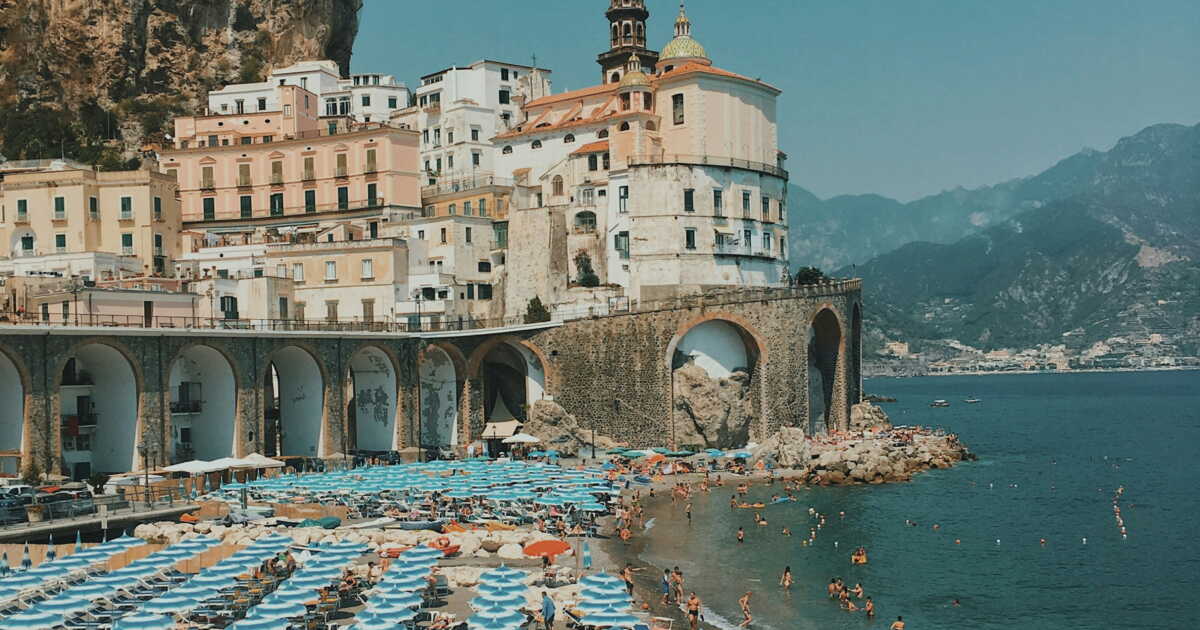
Along nearly 8,000 kilometers of the Italian coast, parasols and sunbeds line up with near-military precision. Every fifty meters, the establishments change, and the shades of the beach furniture do as well. These “bathhouses” or “lidos”, more formally known as seaside concessions, embody an entire lifestyle: sand raked at dawn, cocktails served to music—often Italo disco—and spots rented at astronomical prices depending on how close to the water the client wishes to be.
But this meticulously crafted postcard hides a harsher reality, that of a country where nearly half of the coastline is governed by private interests, relegating the “public beaches” (spiagge libere in Italian) to less attractive corners of the boot, often without restrooms or supervision.
Sea Free: Facing the Headwinds
To combat this massive privatization, a citizen movement has emerged in recent years under the banner Mare Libero (literally, “Sea Free”). Danilo Ruggiero, head of the campaign, tells The Guardian, on Sunday, July 19, of a profound transformation of the country’s beaches, turned into “small seaside resorts” with pools, parking lots, and even clothing shops and gyms inside the complexes. He himself lives in Ostia, near Rome, where 80% of the coastline belongs to what he affectionately calls “the United States of the Lidos”.
All around these private zones, walls, fences, or hedges have been erected to guarantee privacy for those who pull out the wallet, blocking the view of the sea for residents and tourists who want to enjoy the landscape for kilometers.
Only 5% of public beaches in Naples
In the northern part of the Gulf of Naples, the young mayor of Bacoli, Josi Gerardo Della Ragione, 39, has gained national notoriety by fighting tooth and nail against the “profiteurs” of the beaches. “Until recently, our beaches were crowded with illegal huts, barbed wire, gates, and intercoms”, the mayor told the British paper. It then took ringing an intercom to be known by the site manager to be allowed onto the warm sand. In Campania, private concessions account for 70%. They rise to 95% in Naples itself.
The mayor did not hesitate to send in bulldozers to demolish warehouses illegally built on public land. “It is evident that the public domain seized by force and intimidation will be defended by force and intimidation. Once, we even came across an official armed with a chainsaw, heading toward municipal workers”, recounts Josi Gerardo Della Ragione.
The Mafia’s Shadow and the Lure of Profit
The struggle is not only a tourism issue. The local mafia is involved as well. For a long time, the Camorra thrived on the lucrative yet opaque management of these seaside establishments. Several properties in Bacoli were confiscated from mafia clans, such as the Pariante family, to be returned to the public, like Villa Ferretti, which has overlooked the Gulf of Pozzuoli since the 19th century.
Not far away, Miseno beach remains entirely occupied by complexes belonging to the army, the navy, or the customs service, representing nearly 100,000 square meters reserved for exclusive use. “The sum of individual interests is always less than the common good”, laments Josi Gerardo Della Ragione.
Since 2006, Brussels has required that coastal concessions in the European Union be allocated through transparent tenders, but successive Italian governments have extended the deadline and repeatedly postponed it. For concession defenders, such as Antonio Capacchione, president of the seaside operators’ union, these establishments provide safety for their clients because lifeguards are mandatory, something not always guaranteed in Italy. For Mare Libero militants, this argument, minimal compared to the scale of profits, cannot stand on its own.