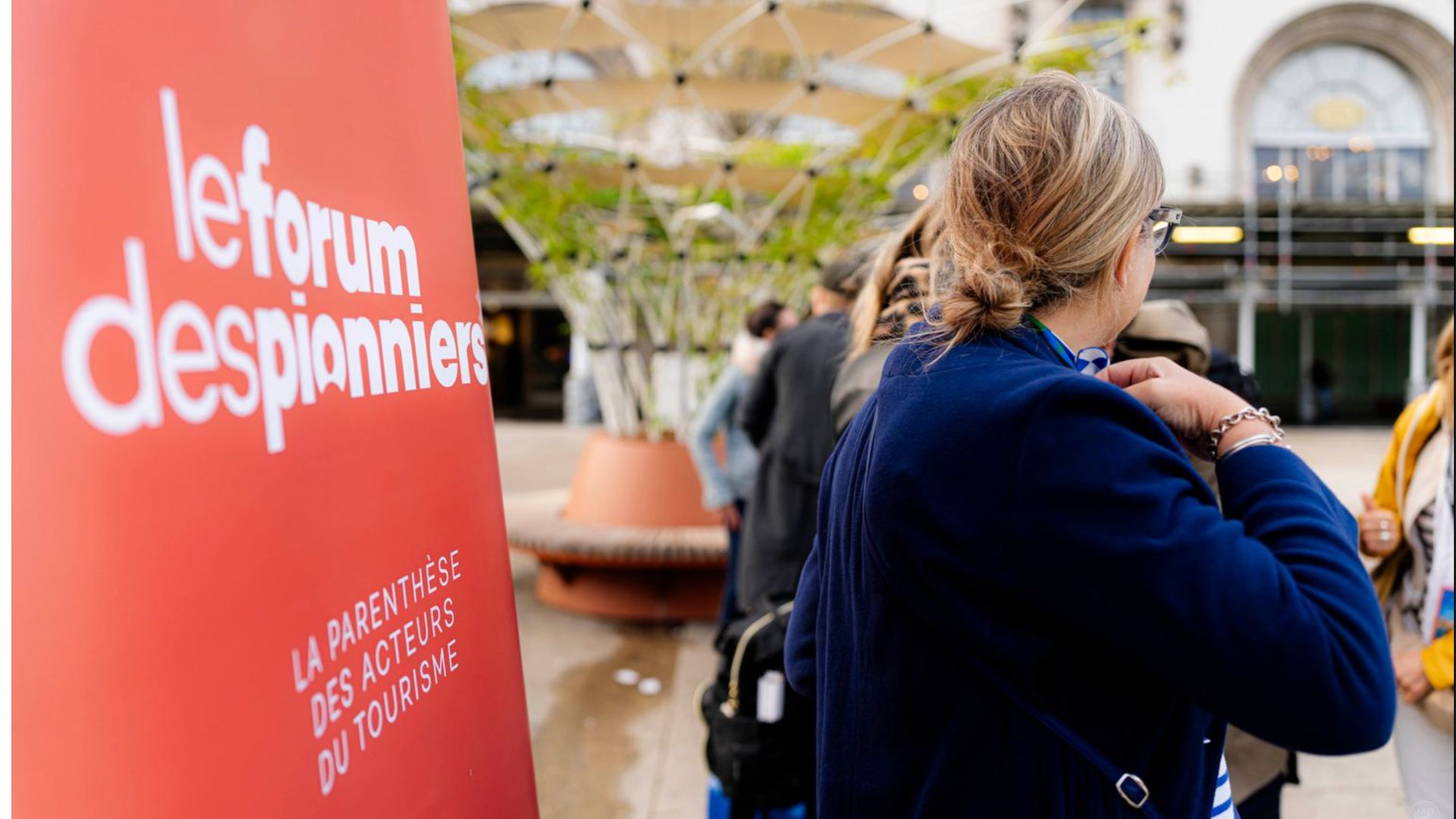


Travelers’ behaviors have never seemed so fluid.
Between late bookings, the search for security, new expectations regarding the experience, and evolving digital practices, tourism players must learn to cope with demand that is increasingly unpredictable.
In the face of this growing instability, the Forum des Pionniers 2026 aims to “steer the uncertain”.
A theme that signals the shift from a reactive logic to a forward-looking one, and the construction of scenarios for sector professionals.
Between late bookings, the search for security, new expectations regarding the experience, and evolving digital practices, tourism players must learn to cope with demand that is increasingly unpredictable.
In the face of this growing instability, the Forum des Pionniers 2026 aims to “steer the uncertain”.
A theme that signals the shift from a reactive logic to a forward-looking one, and the construction of scenarios for sector professionals.
Understanding the market through diverse perspectives
For Bruno Abenin, Commercial Director at Travel Evasion and co-organizer of the event, the main challenge is not a single reading of this uncertainty, but the confrontation of viewpoints.
“The theme is one thing, but what’s truly valuable are the exchanges and how each person perceives the market,” he explains. “A tech player, a tour operator, an incoming operator or a carrier don’t read the same issues in the same way. And it is precisely this diversity that makes the Forum so rich.”
In a sector where crises are not felt at the same pace across professions, he emphasizes the importance of dialogue among varied experiences: “Some are facing their first crisis, others their tenth. The point is to pool all of this and understand what everyone actually does with the uncertainty.”
“The theme is one thing, but what’s truly valuable are the exchanges and how each person perceives the market,” he explains. “A tech player, a tour operator, an incoming operator or a carrier don’t read the same issues in the same way. And it is precisely this diversity that makes the Forum so rich.”
In a sector where crises are not felt at the same pace across professions, he emphasizes the importance of dialogue among varied experiences: “Some are facing their first crisis, others their tenth. The point is to pool all of this and understand what everyone actually does with the uncertainty.”
Artificial intelligence, a new driver of decision-making
AI is now present in risk monitoring, customer relations, offer production, and corporate management, and it is no longer merely a tool for automation.
It gradually influences how organizations analyze their environment, make decisions, and anticipate market evolutions.
For tourism leaders, the challenge goes well beyond technology. What place should AI-generated recommendations have? How can human judgment be preserved in a context where predictive tools are becoming more precise?
And how can teams be guided through these transformations? All these questions will feed the discussions among the 130 decision-makers gathered in Egypt, in workshops and experience-sharing sessions.
It gradually influences how organizations analyze their environment, make decisions, and anticipate market evolutions.
For tourism leaders, the challenge goes well beyond technology. What place should AI-generated recommendations have? How can human judgment be preserved in a context where predictive tools are becoming more precise?
And how can teams be guided through these transformations? All these questions will feed the discussions among the 130 decision-makers gathered in Egypt, in workshops and experience-sharing sessions.
An immersive experience to fuel strategic thinking
The Forum des Pionniers goes beyond theoretical content. It relies on an immersive format designed to foster exchanges and to encourage reflection.
The Nile cruise, from Luxor to Aswan, provides the event’s through-line, with key stops such as the Valley of the Kings, Kom Ombo and Philae temples.
The program concludes in Cairo with visits to the pyramids of Giza, the Sphinx, and the Grand Egyptian Museum.
Working sessions alternate with workshops, round tables, and informal moments crafted to enhance the quality of dialogue among decision-makers. This relational dimension lies at the heart of the setup.
The Nile cruise, from Luxor to Aswan, provides the event’s through-line, with key stops such as the Valley of the Kings, Kom Ombo and Philae temples.
The program concludes in Cairo with visits to the pyramids of Giza, the Sphinx, and the Grand Egyptian Museum.
Working sessions alternate with workshops, round tables, and informal moments crafted to enhance the quality of dialogue among decision-makers. This relational dimension lies at the heart of the setup.
Egypt, a mirror of global tourism transformations
Choosing Egypt as the hosting destination gives a special resonance to this edition.
The country now concentrates a large portion of international tourism dynamics: a strong post-crisis rebound with almost 19 million visitors in 2025, accelerated modernization of infrastructure, upgrading of offerings, and major projects like the Grand Egyptian Museum.
Yet this growth takes place in a demanding environment. Egypt must contend with intense regional competition, sensitivity to geopolitical contexts, and a heavy dependence on air connectivity. It thus illustrates a model in perpetual transformation, where performance depends as much on attractiveness as on adaptability.
For Bruno Abenin, the gap between perception and reality remains significant. “I think people will be surprised by the world that exists in Egypt today,” he notes. “In Cairo, on the Nile, at the sites, there are crowds. Many tourists, from all nationalities.”
The Egypt expert adds: “Hotels are full, boats are sailing, sites are functioning normally. If you listen to some media, we sometimes have a distorted image of the destination.”
Beyond the exchanges among decision-makers and reflections on the sector’s major shifts, this 24th edition of the Pioneer Forum also carries a simpler ambition: to present a destination in its real context.
The country now concentrates a large portion of international tourism dynamics: a strong post-crisis rebound with almost 19 million visitors in 2025, accelerated modernization of infrastructure, upgrading of offerings, and major projects like the Grand Egyptian Museum.
Yet this growth takes place in a demanding environment. Egypt must contend with intense regional competition, sensitivity to geopolitical contexts, and a heavy dependence on air connectivity. It thus illustrates a model in perpetual transformation, where performance depends as much on attractiveness as on adaptability.
For Bruno Abenin, the gap between perception and reality remains significant. “I think people will be surprised by the world that exists in Egypt today,” he notes. “In Cairo, on the Nile, at the sites, there are crowds. Many tourists, from all nationalities.”
The Egypt expert adds: “Hotels are full, boats are sailing, sites are functioning normally. If you listen to some media, we sometimes have a distorted image of the destination.”
Beyond the exchanges among decision-makers and reflections on the sector’s major shifts, this 24th edition of the Pioneer Forum also carries a simpler ambition: to present a destination in its real context.