The rough road winds between the green hills of Antioquia, in the northwest of Colombia, before reaching Finca Maracay. The house, built nearly 90 years ago, seems frozen in time. Its rammed-earth walls, a plaster mix of earth, straw and mud, its guadua framework (a giant bamboo nicknamed the ‘natural iron’), and its clay tile roof bear witness to the region’s traditional architecture.
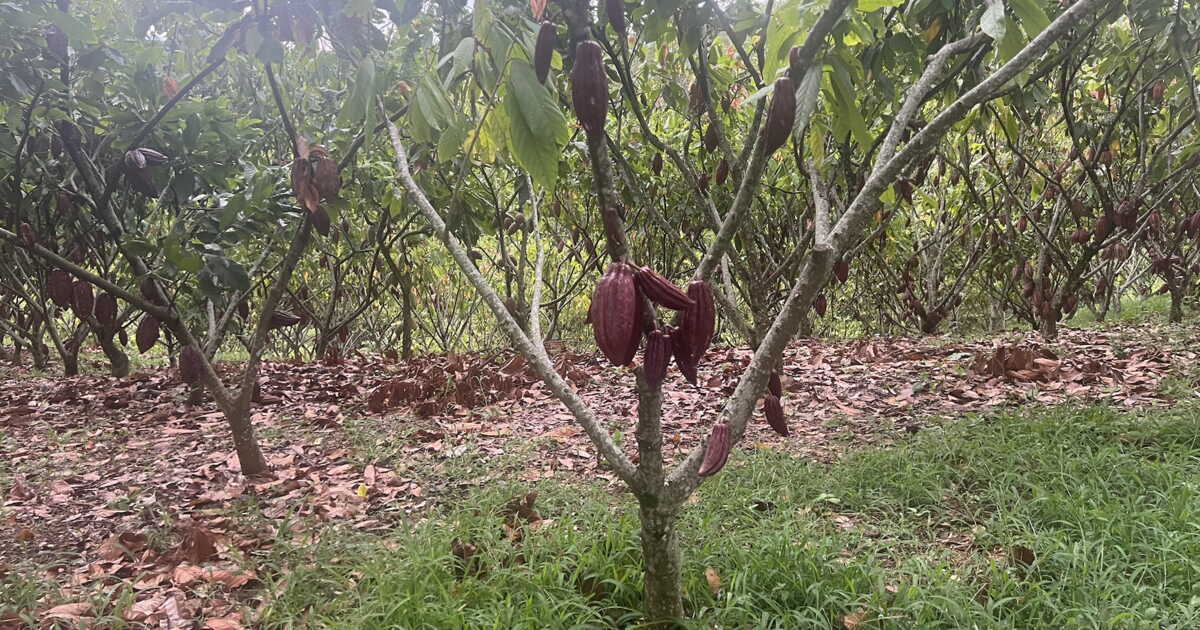
Here, cocoa is everywhere. Pods hang directly from the trunk, displaying yellow, orange, or deep red hues. Inside, dozens of beans are protected by a white, juicy, and sweet pulp called the mucilage. For a layperson, it is hard to imagine that this fruit will give birth to one of the most widely consumed foods in the world.
The cacao “requires a precise cut”
At Finca Maracay, Criollo and Trinitario bean varieties are harvested twice a year. “The harvest requires a precise base cut with scissors to preserve the tree, while the harvested pods are split manually to extract the beans encased in mucilage”, explains Diana, the director of Finca Maracay. The mucilage is the white, sweet flesh that surrounds the cacao beans.
The farm claims a “clean, pesticide-free management”. To naturally limit diseases such as Phytophthora or Moniliopsis, the producers prioritize tree maintenance and pruning over chemical treatments.
After the harvest comes the fermentation stage. The beans, still wrapped in their mucilage, are left to ferment before drying. This transformation develops the first aromas of chocolate.

How roasting changes the flavor of cacao beans
“Then, we begin the roasting process. We leave the beans for about 45 minutes at a medium-low temperature until they reach 115 °C”, explains Luis, a guide at Finca Maracay. The heat gradually makes the outer shell crack. “Until the shell separates from the kernel, we obtain our first derivative: cacao nibs”, he continues.
These roasted bean fragments already constitute a product in their own right. Biting them softly, they reveal a powerful bitterness, quickly followed by roasted notes reminiscent of hazelnuts or dried fruits. Rich in antioxidants, they are today used in granola, pastries, or simply enjoyed as they are.
The next stage in turning cacao into chocolate takes place in a cast-iron manual mill. “It’s the grandmother’s traditional machine, where we grind arepas, coffee… We pour in the nibs and we immediately see them transform into a paste. The friction is immediate”, explains the guide. Without adding a drop of water or fat, the solid fragments become a smooth, dark, glossy paste. The pressure and heat naturally release the cocoa butter contained in the beans. “This means there is a lot of cocoa butter. We obtain here a 100% chocolate”, adds Luis.

How to turn cacao paste into chocolate to enjoy?
The paste coming out of the mill is still chunky. To obtain chocolate as we know it, it is transferred to a refiner equipped with stone wheels. “We pass it through our refiner to make the chocolate creamy. We refine it for 36 consecutive hours. The longer we leave it, the creamier and smoother our chocolate becomes. It is also at this stage that we add sugar and determine the cacao percentage”, continues Diana.
This step transforms the texture of the chocolate. The particles become finer and finer until they disappear under the tongue. It is also here that the different cacao percentages printed on packaging are born. From this same cacao liquor, the industry extracts two essential ingredients:
- cocoa powder
- and cocoa butter, sought after by chocolatiers, the cosmetics industry and pharmaceuticals
“It’s like filtering this liquor through a press; the butter is extracted and the cacao remains separate”, continues Luis.
Transforming cacao into a chocolate bar
Before taking the form of a bar, the chocolate must still pass through one last step, perhaps the most technical, tempering. “This is a very important part to ensure our bars are crunchy and shiny. We must raise the chocolate to 45 °C, then bring it down to 34 °C and finally work it at 28 °C”, details Luis.
Three methods enable this perfect crystallization:
- tabling on a marble slab,
- an inverted bain-marie,
- seeding, which involves incorporating about 1% already crystallized cocoa butter.
This step is crucial because if the temperature is not perfectly controlled, the bar loses its luster, becomes chalky or brittle. When it succeeds, it presents a shiny surface, unmolds easily and produces the characteristic “snap”, the dry crack sought by all chocolatiers. From the mountains of Antioquia, the chocolate leaves the Amazon to find its place on our shelves, allowing everyone to taste this Colombian treasure.