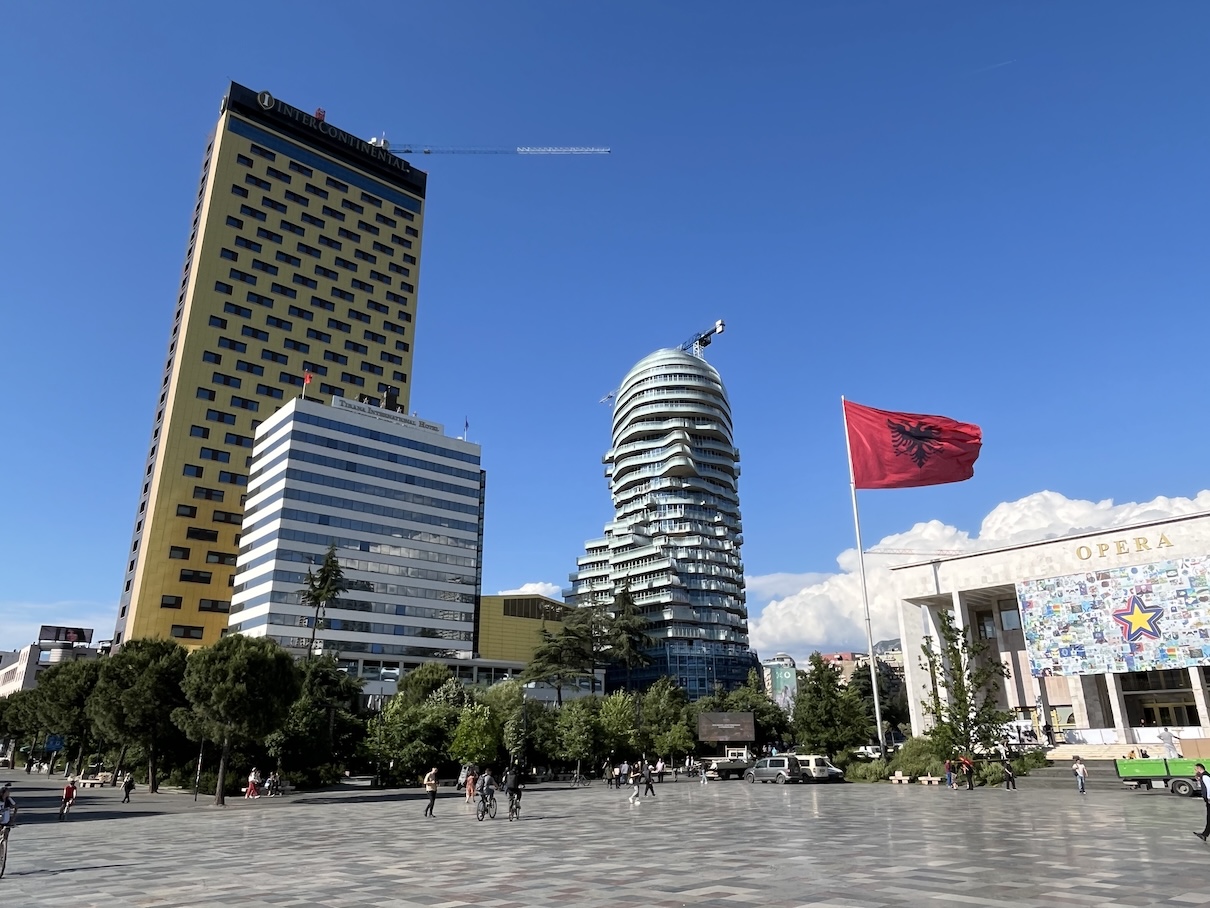


Tirana and its 900,000 inhabitants, almost a third of the country’s population, is a diverse capital. In response to the modernist buildings of the 1930s and the postwar communist era, futuristic structures are meant to place the capital firmly in the 21st century.
The result is an eclectic architecture. In the center, the pedestrian square Skanderbeg, the national hero ubiquitous across the country, is represented here by a statue on horseback, embodying this ramshackle urbanism.
The National History Museum and its large 1980s façade mosaic, the Palace of Culture (1963), the Bank of Albania (1938) or the Et’hem Bey Mosque (late 18th century), sit alongside the new InterContinental hotel and the futuristic Tirana’s Rock tower, whose profile draws the face… of Skanderbeg.
The result is an eclectic architecture. In the center, the pedestrian square Skanderbeg, the national hero ubiquitous across the country, is represented here by a statue on horseback, embodying this ramshackle urbanism.
The National History Museum and its large 1980s façade mosaic, the Palace of Culture (1963), the Bank of Albania (1938) or the Et’hem Bey Mosque (late 18th century), sit alongside the new InterContinental hotel and the futuristic Tirana’s Rock tower, whose profile draws the face… of Skanderbeg.
House of Leaves, former headquarters of the secret police
The grim period of Enver Hoxha’s communist dictatorship is laid bare at the House of Leaves. The former headquarters of the Sigurimi, the “Albanian Stasi,” reveals the full arsenal of repression, surveillance, and propaganda implemented by the Albanian state at the height of its paranoia.
In the evening, one can enjoy the vibrancy and Albanian cuisine in one of the many bars and restaurants in the Pazari i Ri and Blloku districts, festive and Westernized.
In the evening, one can enjoy the vibrancy and Albanian cuisine in one of the many bars and restaurants in the Pazari i Ri and Blloku districts, festive and Westernized.
Citadel of Kruja
Located about 40 kilometers north of the capital, the town of Kruja enchants with its amphitheater-like position on the mountainside. Its fortress is believed to be the birthplace of the hero Skanderbeg, who fiercely resisted the Ottomans in the 15th century.
Rebuilt in the 1980s, it houses a large museum dedicated to the warlord and offers a splendid view over the Adriatic. People also visit Kruja for the bazaar, where a few craftsmen still fashion, in the old way, leather shoes and felt hats.
Rebuilt in the 1980s, it houses a large museum dedicated to the warlord and offers a splendid view over the Adriatic. People also visit Kruja for the bazaar, where a few craftsmen still fashion, in the old way, leather shoes and felt hats.
Shkodra, fascinating national photography museum
80 kilometers further north lies Shkodra. This city of about 150,000 inhabitants, situated 30 kilometers from the Adriatic Sea, is bordered by its namesake lake, adjacent to Montenegro.
It offers a double appeal: firstly its Rozafa fortress, built in the 14th century by the Venetians, whose ruins crown a hilltop across 200 hectares, and secondly the pedestrian bustle of Idromeno and Gjuhadol streets, with their numerous café terraces. Here one also visits the fascinating Marubi National Photography Museum, named after the family that documented Albanian society across three generations.
At the same latitude as Tirana, Durrës is, like all ports, a complex and eclectic city. Albania’s second city, it carries traces of Greek, Roman, Byzantine, Angevin, Venetian, and Ottoman rule, and it has long been a terminus for caravan routes from the East.
It is therefore by exploring the archaeology that one discovers it, visiting the 15,000-seat Roman amphitheatre tucked into the city, the remnants of its walls, and the Archaeological Museum, a thorough synthesis of all these eras.
It offers a double appeal: firstly its Rozafa fortress, built in the 14th century by the Venetians, whose ruins crown a hilltop across 200 hectares, and secondly the pedestrian bustle of Idromeno and Gjuhadol streets, with their numerous café terraces. Here one also visits the fascinating Marubi National Photography Museum, named after the family that documented Albanian society across three generations.
At the same latitude as Tirana, Durrës is, like all ports, a complex and eclectic city. Albania’s second city, it carries traces of Greek, Roman, Byzantine, Angevin, Venetian, and Ottoman rule, and it has long been a terminus for caravan routes from the East.
It is therefore by exploring the archaeology that one discovers it, visiting the 15,000-seat Roman amphitheatre tucked into the city, the remnants of its walls, and the Archaeological Museum, a thorough synthesis of all these eras.
Crown Plaza Hotel in Durrës
In the midst of a tourist boom, the city, well connected to Italy and the port of Bari by numerous ferries, is set to welcome a marina soon as new hotels rise along the coast, such as the Crown Plaza, recently opened on the seafront.