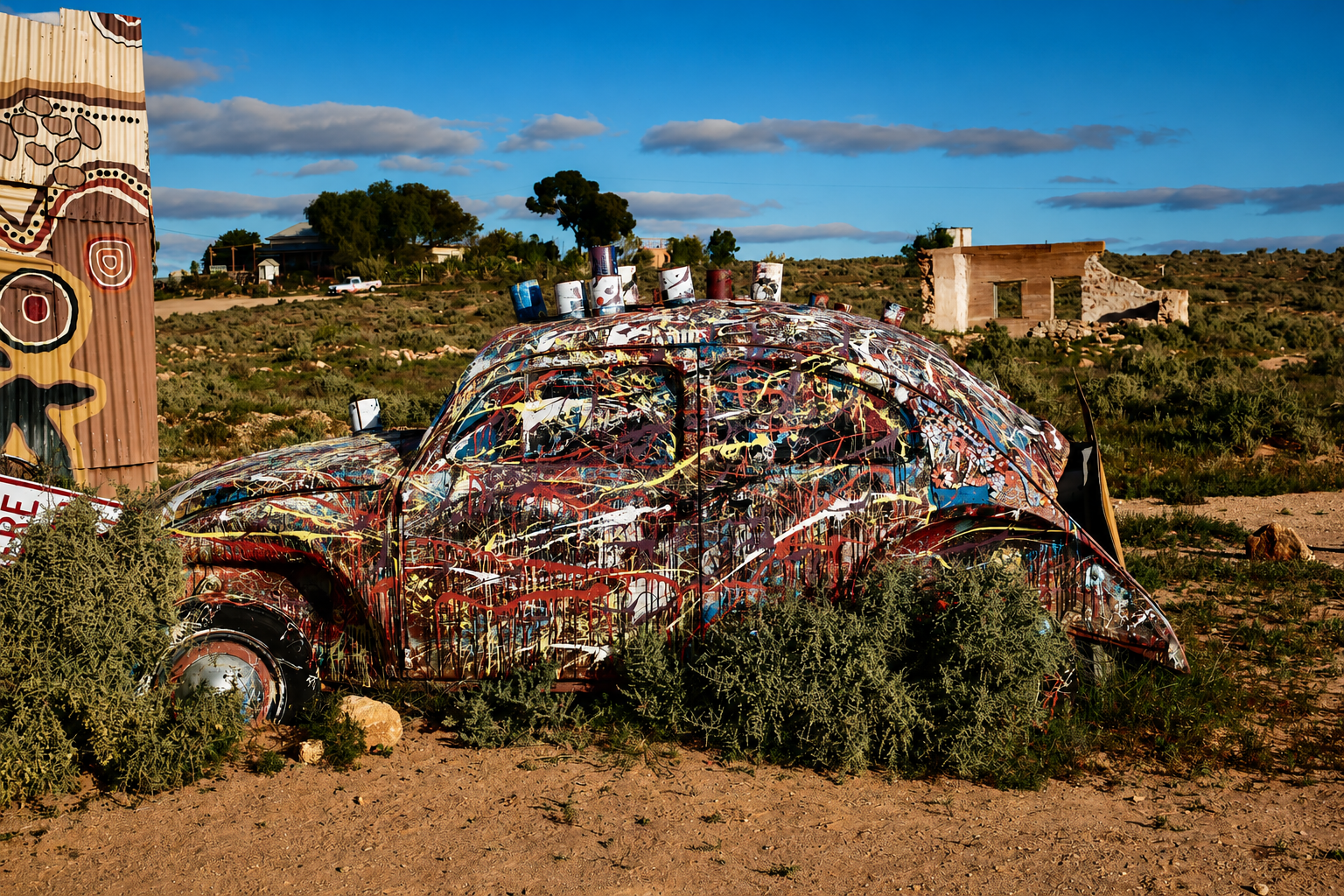
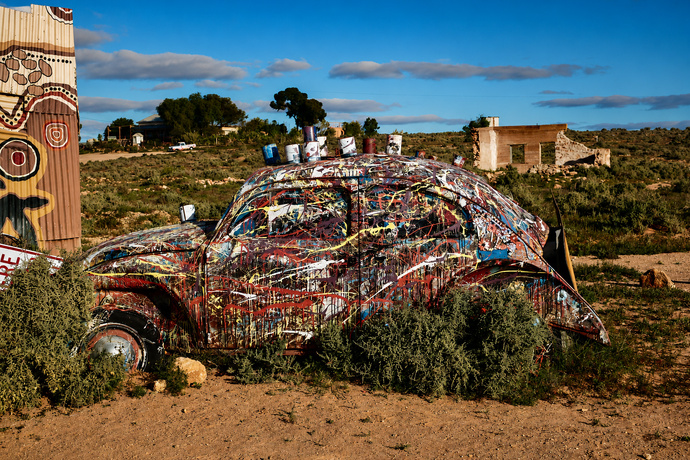


Silverton, end of day. The golden light brushes the corrugated sheets of a hangar painted in every color. An old bicycle rests against the wall. On the sign, two round-eyed emus stand guard: John Dynon Gallery. Open.
Inside, everything is painting. The walls, the beams, the objects, down to the smallest handle. In the middle of this universe, John Dynon, 72, wears a plaid shirt from the Mundi Mundi Bash and the calm smile of someone who has nothing left to prove.
« I am the mayor, the sheriff and the town », he says with a laugh.
He is not exaggerating by half. Born in Broken Hill and settled in Silverton for about forty years, John has become one of the faces of this village that history almost erased. For it is here, even before the rise of Broken Hill, that the first veins of silver, lead and zinc drew miners and fortune-seekers. It is also in this region that BHP was born, which later became one of the world’s mining giants.
Then the great vein was discovered further east. Men left, businesses closed, houses were sometimes dismantled to be rebuilt elsewhere. Silverton slowly emptied until it became almost a ghost town.
« And then the artists took it back », sums up John.
He is among them, but his path to painting is not a salon vocation. John worked underground, in the mines. He also lost many friends there.
« I wanted to get out. I knew how to draw. So I started painting, and I got out. »
The sentence is simple, without pathos. For him, art was not a hobby. It was an exit door, a way to leave the mine’s night without leaving the region that had shaped him.
I ask him if he still flees something when he paints. He smiles.
« Probably. We all run from something, right? I’m 72 and I’m still inspired. »
In a corner of the gallery, a few motorcycles recall another Silverton story. When Mad Max 2 was shot in the surrounding plains, in the early 1980s, the production sought riders. All his friends obtained roles. Not him. John was working a three-shift regime at the mine and could not free himself. The motorcycles remained in the gallery, as a wink to that missed opportunity and to this other life of the village, which over the years became a cinema-ready backdrop.
Before leaving, I ask him what he would tell a French traveler to tempt them to come here.
He does not hesitate.
« The story. And the most beautiful of landscapes. The colors, the sunrises and sunsets. »
Inside, everything is painting. The walls, the beams, the objects, down to the smallest handle. In the middle of this universe, John Dynon, 72, wears a plaid shirt from the Mundi Mundi Bash and the calm smile of someone who has nothing left to prove.
« I am the mayor, the sheriff and the town », he says with a laugh.
He is not exaggerating by half. Born in Broken Hill and settled in Silverton for about forty years, John has become one of the faces of this village that history almost erased. For it is here, even before the rise of Broken Hill, that the first veins of silver, lead and zinc drew miners and fortune-seekers. It is also in this region that BHP was born, which later became one of the world’s mining giants.
Then the great vein was discovered further east. Men left, businesses closed, houses were sometimes dismantled to be rebuilt elsewhere. Silverton slowly emptied until it became almost a ghost town.
« And then the artists took it back », sums up John.
He is among them, but his path to painting is not a salon vocation. John worked underground, in the mines. He also lost many friends there.
« I wanted to get out. I knew how to draw. So I started painting, and I got out. »
The sentence is simple, without pathos. For him, art was not a hobby. It was an exit door, a way to leave the mine’s night without leaving the region that had shaped him.
I ask him if he still flees something when he paints. He smiles.
« Probably. We all run from something, right? I’m 72 and I’m still inspired. »
In a corner of the gallery, a few motorcycles recall another Silverton story. When Mad Max 2 was shot in the surrounding plains, in the early 1980s, the production sought riders. All his friends obtained roles. Not him. John was working a three-shift regime at the mine and could not free himself. The motorcycles remained in the gallery, as a wink to that missed opportunity and to this other life of the village, which over the years became a cinema-ready backdrop.
Before leaving, I ask him what he would tell a French traveler to tempt them to come here.
He does not hesitate.
« The story. And the most beautiful of landscapes. The colors, the sunrises and sunsets. »
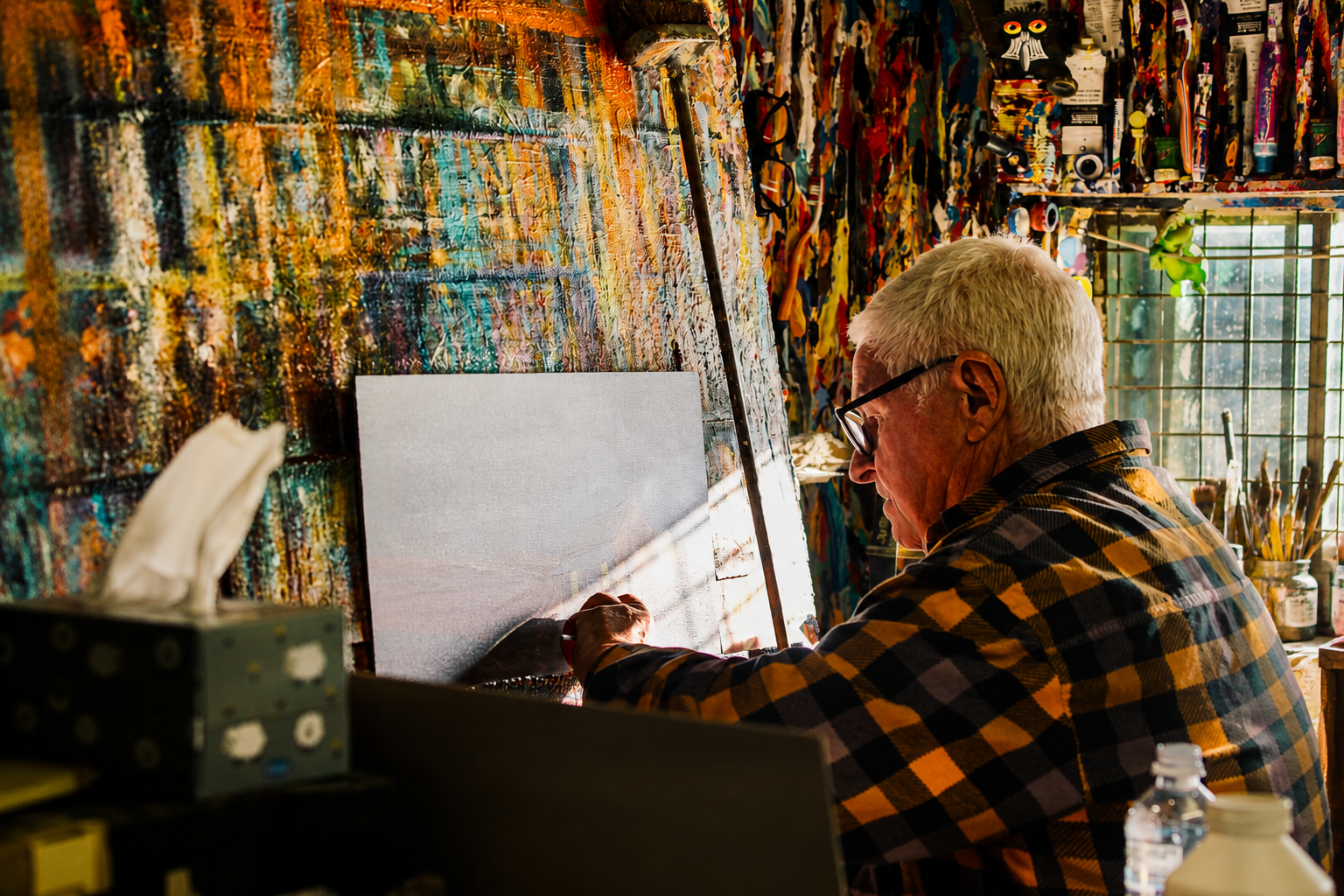

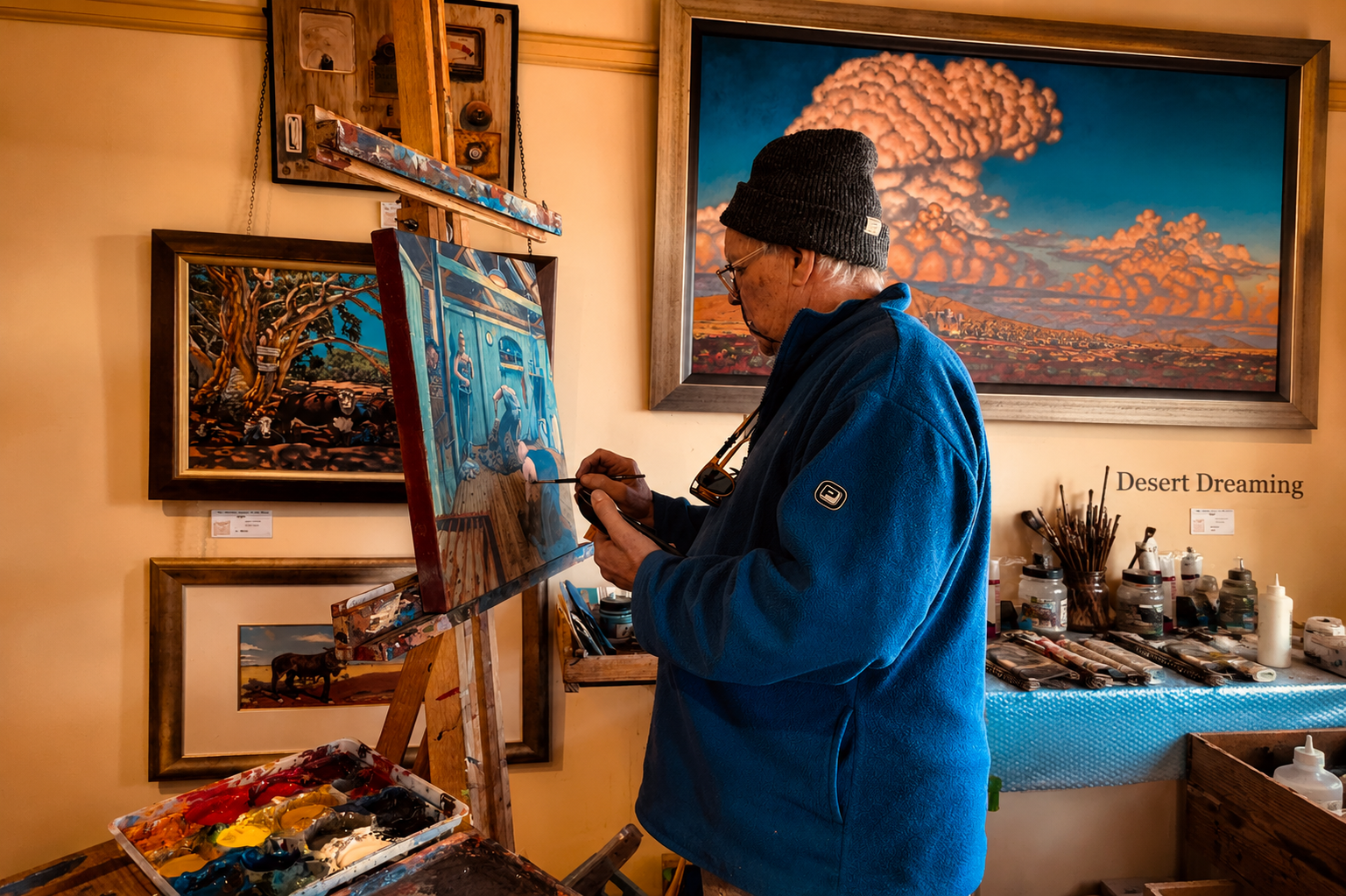
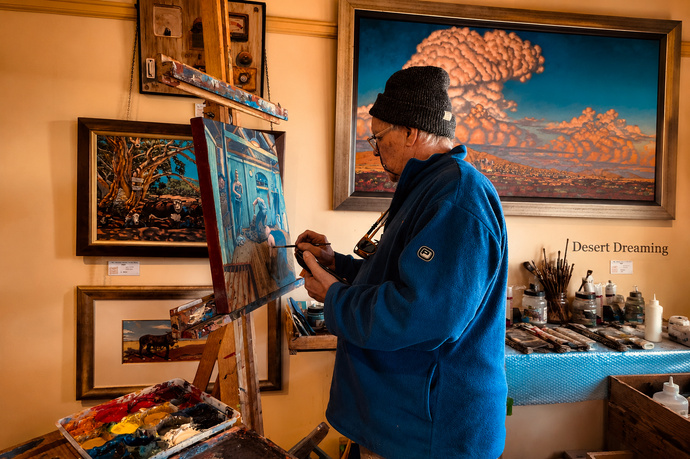
A few steps from there, another workshop tells a different way of living Silverton. Michael Jones, cap firmly set on his head in the chilly morning air, works standing before his easel, brush in hand.
On the canvas, a shearing scene takes shape: a blue shed, shearers bent over the sheep, the light descending between the corrugated sheets. Around him, the walls speak of the bush. A monumental stormy sky above the plain, red gum trees, cattle seeking shade, and landscapes where the human presence always seems tiny in the face of the vast space.
Why paint?
Michael does not search for words.
« It’s my religion. It’s like breathing. I have to do it. »
What he paints, he says, is the life of the bush. He chronicles its gestures, its animals, its trades, its trees and the changes of light. His paintings do not seek to beautify the land. They aim to preserve its memory, to capture what sometimes disappears before we have understood its importance.
And Silverton, what makes it so special?
« The landscape and the light. The light that hits the land, the trees, the animals. »
John Dynon began painting to escape the mine. Michael Jones paints because he could not live otherwise. Two men, two stories, two ways of explaining why artists found here far more than a backdrop.
In this village of a few dozen inhabitants, art is not a Sunday pastime. It has become the language of the place, its trade, its second life after money, lead and zinc… and the Mad Max filming…
The mine had built Silverton, then almost emptied it. The painters gave back its colors.
Photos : © Sébastien Cros / WeTravelAustralia™