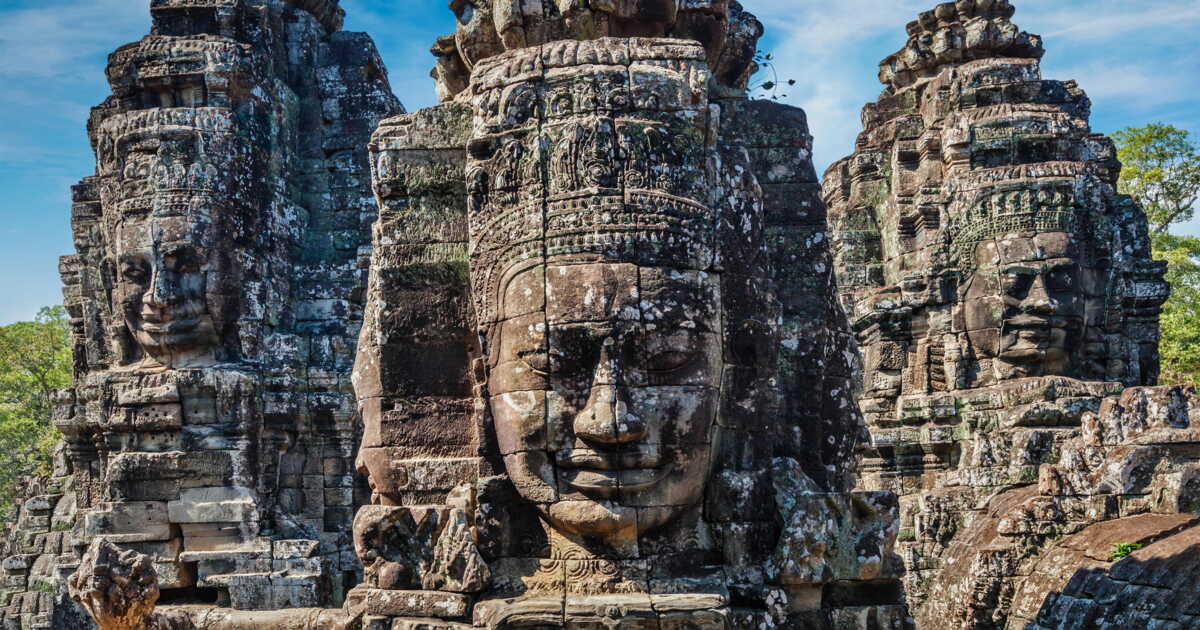
It’s a journey that leaves a lasting imprint. For no one escapes the enchantment of the world’s greatest archaeological site, with its hundreds of temples spread across 402 square kilometers (four times the area of inner Paris). Angkor denotes above all a megacity—the religious, economic, and political heart of an empire of builders that shone from the 9th to the 14th century through its refinement and its audacity. To erect the single temple of Angkor Wat, five million tons of sandstone were required—a mass comparable to the Great Pyramid of Khufu in Egypt. Between olive-hued lakes, colossal carved faces, bas-reliefs of dancers and mythical animals, every detail responds to cosmic codes where the influences of Hinduism and Buddhism intertwine…
The Secrets of Angkor
And this sanctuary is nothing like a museum. The Cambodians practice prayers and rituals there; everywhere in the corridors monks light incense—a continuity that gives these places their soul. When you go there early in the morning, aboard a tuk-tuk, you feel like Henri Mouhot, the man who introduced the site to Europe in the 19th century. Then you wander along the two circuits of the archaeological park, classified in 1925, to admire the most famous edifices. You should stay here for at least three days, ideally five, to stroll through the less-known temples, sometimes nearly deserted, and to experience unprecedented moments. And to enjoy a pleasant surprise: Siem Reap, a friendly and creative city with a living craft heritage inherited from Angkor’s golden age. Enjoy your discovery!
Our tips for a serene visit
Entrance Pass: how does it work?
Nominal with photo, the pass, valid for one, three or seven days, is often purchased online or via the Angkor Pass app. But the paper pass, adorned with a beautiful image of the site and written in Khmer, makes for a far nicer souvenir! To obtain it, head to the central gate of the archaeological park, 4 km from Siem Reap. Preferably the day before, after 16:45, to enjoy an extra evening: with the pass dated for the next day, you can enter Angkor the same evening without it counting as a day! angkorenterprise.gov.kh
The time needed to explore without stressing
Plan for three days to cover the two main routes (the Small Circuit, 17 km, and the Grand Circuit, 26 km), plus a few outlying sites. Four to five days is better! And abandon the idea of seeing everything. Even Angkor Wat alone deserves three to four hours to wander the galleries with their 800 metres of carved reliefs.
Crowd-busting tips
To visit Bayon, in Angkor Thom, go at 7:30 am. For an hour you’ll be one-on-one with nearly 200 faces with enigmatic smiles. For Angkor Wat, have an early lunch, then head there from noon, in a relaxed mood. As for Ta Prohm, temple built in 1186 by Jayavarman VII in memory of his mother, and entangled by the roots of giant fig trees, aim for late afternoon. Best entry: the East Gate, often neglected.
Tuk-tuk, user guide
For 20 to 30 dollars per day, and a maximum of four passengers, it’s the most practical way to explore the site. The tuk-tuk picks you up at the hotel in the morning, waits in front of each temple, and brings you back in the evening. To choose your driver, nothing beats a little interview on the sidewalks of Siem Reap. To verify that he speaks a bit of English, or even French—there are some! A 5-dollar supplement for very early departures.
Interactive maps to see everything without getting lost
The official Angkor Pass app is very well made, with its interactive map showing all the temples, the hours, and explanatory notes (in English). Another essential: The Map, a very clear paper plan, equipped with a useful chronological timeline, distributed free of charge in hotels, cafés, etc. On the map, a QR code links to a digital version, which is full of “good tips.” themapcambodia.com
They helped us produce this report
Specialists in Cambodia, Les Maisons du Voyage invite you to follow in the footsteps of our reporters, with a thirteen-day and ten-night itinerary, from 2835 euros (flights, accommodations, visits and a French-speaking guide included). From Kampot to Siem Reap, far from the beaten paths, this journey recounts the glorious hours of the gods-king of Angkor. On the program: lesser-known archaeological sites, isolated villages with ancestral traditions, and encounters with the Khmer people, who are reconnecting with their priceless heritage. Committed to responsible tourism, the local partner ensures that each trip benefits Cambodian communities and the preservation of the heritage. maisonsduvoyage.com
➤ Article published in GEO magazine No. 570, “Cambodia,” August 2026.
➤ Do you love GEO? Then to miss nothing, discover our subscription plans to receive GEO at your home every month with ease.