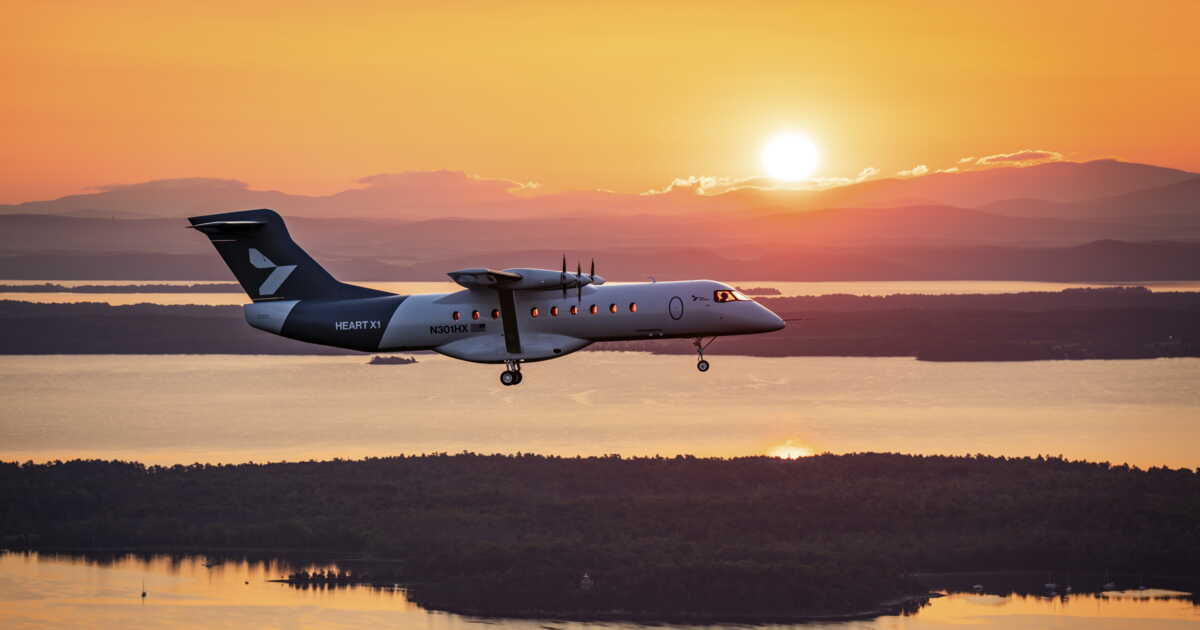
Will tomorrow’s airplanes soon be electric? Heart Aerospace has taken a significant step toward that future by successfully flying what it calls the world’s largest all‑electric jet for the first time. In a press release issued Thursday, August 13, the Los Angeles–based company disclosed that its X1 completed its inaugural 27‑minute test flight the day before from a regional airport north of the state of New York.
The aircraft measures 23 meters in length with a wingspan of 32 meters and weighs over 11,340 kg. This makes it the largest aircraft ever to fly powered entirely by batteries. The flight was piloted by a single pilot and carried no passengers on board. The vehicle climbed to an altitude of 1,100 feet (about 335 m), and its all‑electric propulsion system delivered more than one megawatt of power.
A first demonstration in service of a commercial ambition
Even with that power, the entire flight reportedly cost only about $5 in electricity (excluding operating costs, maintenance and battery degradation), according to Heart Aerospace. “With the first flight of the X1, Heart Aerospace has demonstrated that electric flight at the scale of a commercial airliner is possible”, said Anders Forslund, founder and CEO of the company.
Si ce vol d’essai représente une avancée dans le milieu des avions électriques, le X1 n’est pas destiné à transporter des passagers. Il s’agit d’un prototype de démonstration grandeur nature conçu pour valider les technologies, l’aérodynamique et les performances de vol en vue du développement d’un autre appareil développé par Heart Aerospace : l’ES-30.
Ce dernier vise une réduction de plus de 40 % des coûts d’exploitation par rapport aux avions régionaux conventionnels. L’entreprise mise sur la réduction des coûts énergétiques, une baisse du nombre de pièces mécaniques à entretenir et une dépendance amoindrie aux prix du kérosène.
Ces derniers temps, les coûts du carburant d’aviation ont bondi en raison des tensions au Moyen-Orient. Selon un communiqué daté du mois de juin du Bureau des statistiques des transports, les coûts du carburant d’aviation des compagnies aériennes américaines ont augmenté de 26,2 % en avril par rapport à mars. L’ES-30 a déjà suscité l’intérêt de grandes compagnies comme United Airlines, Air Canada et JSX.

What are the limits of 100% electric aviation?
While this initial flight is encouraging news, the technological constraints of a fully electric aircraft also exist, as Popular Science notes. In all‑electric mode, the X1 can fly only roughly 200 km. That range is insufficient for most regional commercial routes. That is why the ES‑30 will, in turn, be a hybrid.
It will rely on a supplementary internal combustion engine to extend its range to more than 800 km. Another reality? Unlike conventional airplanes that shed weight by burning fuel, the batteries of an electric aircraft weigh the same at takeoff and landing. Other companies such as Rolls‑Royce, Harbour Air or Joby Aviation are also pursuing hybrid aircraft.