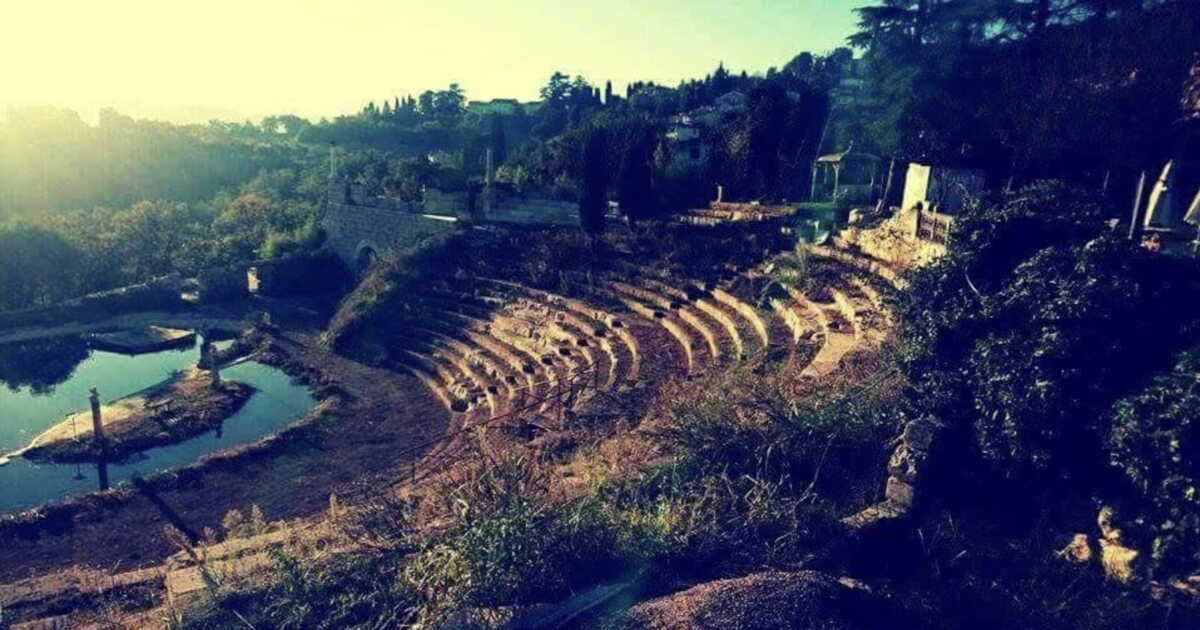
In the hills of Veneto, an astonishing archaeological site drew visitors with its tiered seating, its columns, and its basin. Presented as an ancient Greek theater discovered after a landslide, it seemed too good to be true. For this setting, supposedly more than 2,000 years old, it had in fact been built… in the twenty-first century. After a long legal battle, its owner has just been sentenced to prison.
An Entirely Manufactured Ancient Theater
A few kilometers south of Vicenza, the site perched on a wooded slope in the municipality of Arcugnano seemed straight out of Antiquity. Since 2014, visitors could walk along fan-shaped seating, observe columns and statues, and even admire a small water feature dug at the center of the complex. The owner, Franco Malosso, claimed to have discovered the remains after a landslide on this site, for which he claimed legal ownership through a company based in the British Virgin Islands. Since then, he presented the place as the remains of a Greek theater more than two millennia old.
Franco Malosso organized guided tours and gave the site several names, including “Anfiteatro Berico” and “Anfiteatro Marittimo Berico”. Tickets were sold to visitors, with prices reaching up to 40 euros. Private tours were also offered for 600 euros for 45 minutes. The site even hosted concerts and performances. Yet several details should have raised suspicions. The site initially bore little resemblance to an amphitheater.
While an amphitheater is oval or elliptical in shape, the seating of the “Anfiteatro Berico” was arranged in a half-circle, which corresponds to a theater. The hypothesis of a Greek edifice was also unlikely in this region, as Greek colonies of antiquity did not extend to northern Italy. And above all, the materials used betrayed a recent construction: the seating had been built with stone recently quarried in the Apulia (Puglia) region and cement, while a retaining wall had even been coated with polystyrene.
The investigators did not need lengthy inquiries. During an inspection conducted in October 2016, the specialists immediately understood they were dealing with an imitation. Lieutenant Colonel Giuseppe Marseglia, head of the Carabinieri’s Art Protection Unit in Lombardy, described the attempt as “truly obscene”, in remarks reported by CNN. According to him, in 25 years of service, he had never seen an entire archaeological site manufactured in this way.
Visitors Convinced by the Tale
Perhaps the most surprising aspect was the reception of the faux theater. All eight TripAdvisor reviews gave it five stars. Some visitors described it as “an enchanting place” or as “a world beyond space and time”. This apparent credulity could be partly explained by the staging imagined by Franco Malosso. He claimed, for instance, that the site had been frequented by Julius Caesar, Cleopatra, and even… Juliet Capulet, the fictional character from Romeo and Juliet created by William Shakespeare.
The workers hired to carry out the work had, according to reports, been instructed to give the new constructions an aged appearance. For archaeologist Darius Arya, director of Ancient Rome Live, the affair is particularly hard to understand. “The very idea is insane”, he told CNN, describing the project as “diabolical” and “terrible”. He also notes that genuine archaeological digging cannot be carried out on the fly: “You do not have the right to dig up antiquities in your garden. They must be declared, they are the subject of an inquiry, then they are excavated.”
Italian justice ultimately convicted Franco Malosso in 2019 for several offenses, including the falsification of works of art, construction without permits, and the destruction of a protected landscape. After several appeals, the Court of Cassation confirmed the conviction this year. He is now serving a sentence of 28 months in prison, along with a 3,000-euro fine and 3,500 euros in legal fees. As for the faux theater, built on land within the protected Berici Hills landscape, it must be demolished. An especially ironic situation: to erase this vestige that was not one, a genuine excavation will have to be carried out first.