On the west coast of Australia, a vast coral reef stretches just a few meters from the shore, in waters of spectacular clarity. Much less known than the Great Barrier Reef that borders Queensland, Ningaloo Reef is by no means a supporting act: listed as a UNESCO World Heritage site, it harbors exceptional marine biodiversity and hosts each year some of the planet’s largest animals. Between desert, cliffs and turquoise lagoon, the spectacle unfolds both beneath the surface and on land, as we were able to observe during a report last June.
A coral reef perched at the edge of the desert
To discover Ningaloo Reef, one must head to the extreme northwest of Western Australia. The reef runs along the coast for hundreds of kilometers, from the vicinity of Coral Bay to Exmouth, at the entrance to Cape Range. Here, the landscape seems built around a striking contrast: on one side, the aridity and ochre reliefs of the peninsula; on the other, an intense blue ocean in which lies one of the world’s largest fringing reefs. The site is part of the vast Ningaloo Coast, listed as a UNESCO World Heritage site since 2011.
The term “barrier” requires clarification, however. Unlike the Great Barrier Reef, which is sometimes many tens of kilometers from shore, Ningaloo is a fringing reef: it grows directly along the coast, with a shallow lagoon between the shore and parts of the reef. This proximity is also a large part of its appeal for travelers. In some places, you only need to swim a few meters from the beach to find yourself above the corals and tropical fish, with just a mask and a snorkel. The shallow waters allow observing a multitude of shapes and colors without necessarily heading far for a dive.
And this reef is far from being merely decorative. UNESCO records more than 300 coral species, about 650 mollusk species, around 600 crustacean species, and more than 700 reef fish species. Among them are clownfish, parrotfish, butterflyfish, surgeonfish, angelfish, groupers and wrasses, but also barracudas that move above the reef. The site also counts more than 1,000 algae species. Alongside this underwater richness are sea turtles, marine mammals and numerous species of sharks and rays.
This concentration of life is explained in particular by Ningaloo’s geography and oceanography. Offshore, deep, nutrient-rich waters upwell toward the continental shelf, fueling the reef’s productivity. The Ningaloo Marine Park includes depths of up to 500 meters, with underwater canyons that could promote the upwelling of these cold, nutrient-rich waters.
The result is a highly productive ecosystem, set against a land environment just as remarkable. Behind the coast rises Cape Range, a limestone massif carved with gorges and canyons, while its subsurface hosts a vast network of caves and underground rivers. The Ningaloo Coast thus protects a broader whole than a reef: the interconnection between marine life, desert shoreline and the underground world makes its singularity.
When the giants of the ocean arrive at Ningaloo
But if there is a reason to come to Ningaloo, it is also because the reef functions as a vast migratory layover. Through the seasons, visitors change and the waters fill with silhouettes that grow ever larger.
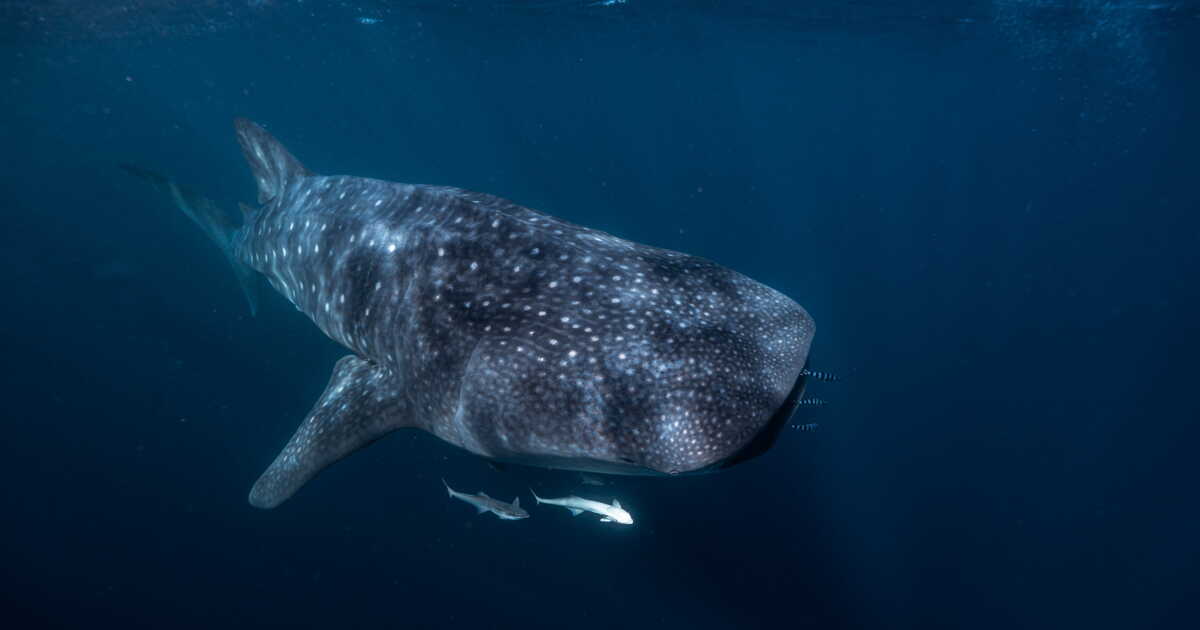
The most famous of these travelers is undoubtedly the whale shark. Each year, after the massive coral spawning period, a substantial amount of food becomes available in the reef waters. From roughly March to July, the world’s largest fish gather there to feed. UNESCO estimates that 300 to 500 whale sharks can gather each year off Ningaloo, which constitutes the largest documented gathering of this species. Most individuals observed at Ningaloo are, however, juveniles or subadults of about six to eight meters, still far from the maximum size (up to 18 meters) that the species can reach.
Despite their impressive size, these giants are perfectly harmless to humans, feeding mainly on plankton and small organisms filtered as they swim with their mouths open. Ningaloo is one of the few places in the world where you can swim with them under highly supervised and ethical conditions. Tours are conducted in small groups, at a regulated distance, never feeding the animals to attract them, so that this encounter does not disturb their natural behavior.
Then, when whale sharks begin to become less numerous, another procession of giants crosses the region. Humpback whales migrate through Ningaloo each year, traveling between their feeding grounds in the southern high latitudes and their northern breeding grounds. These cetaceans of around 15 meters pass through the marine park on their northbound journey, and again on their return south.
Unlike whale sharks, which mainly come to take advantage of a seasonal abundance of food, humpback whales thus use Ningaloo as a waypoint on a much longer route. Depending on the season, you may glimpse moving adults, groups gathering at the surface, or females with their young. From August onward, certain excursions also allow swimming beside them, a similarly well-regulated experience by authorized operators.
And the parade of giants does not stop there. The park also serves as a feeding area for other cetaceans, such as pygmy blue whales, which can reach about twenty meters. Reef manta rays about four meters across also frequent Ningaloo, both in the shallow waters of the lagoon and outside the reef. As for dugongs, these marine herbivores about three meters long and over 400 kg find in the calm and shallow lagoon waters favored feeding grounds. They feed notably on seagrass beds that develop on the sandy bottoms of the lagoon and can also use the area for reproduction, giving birth and raising their young. The coastal and offshore waters also host several dolphin species, including the bottlenose dolphin, the long-beaked dolphin, and the Electre dolphin.
To add to this diversity are several species of marine turtles, notably green, hawksbill and loggerhead turtles, which use the reef and its surroundings at different stages of their life cycles. UNESCO estimates about 10,000 nests laid each year along the coast.
At Ningaloo, the spectacle thus changes with the seasons and the depths: corals, tropical fish, turtles, rays and large animals take turns in a single ecosystem. It is this exceptional concentration of marine life, combined with the beauty of the reef and the landscapes that surround it, that makes the site’s uniqueness.