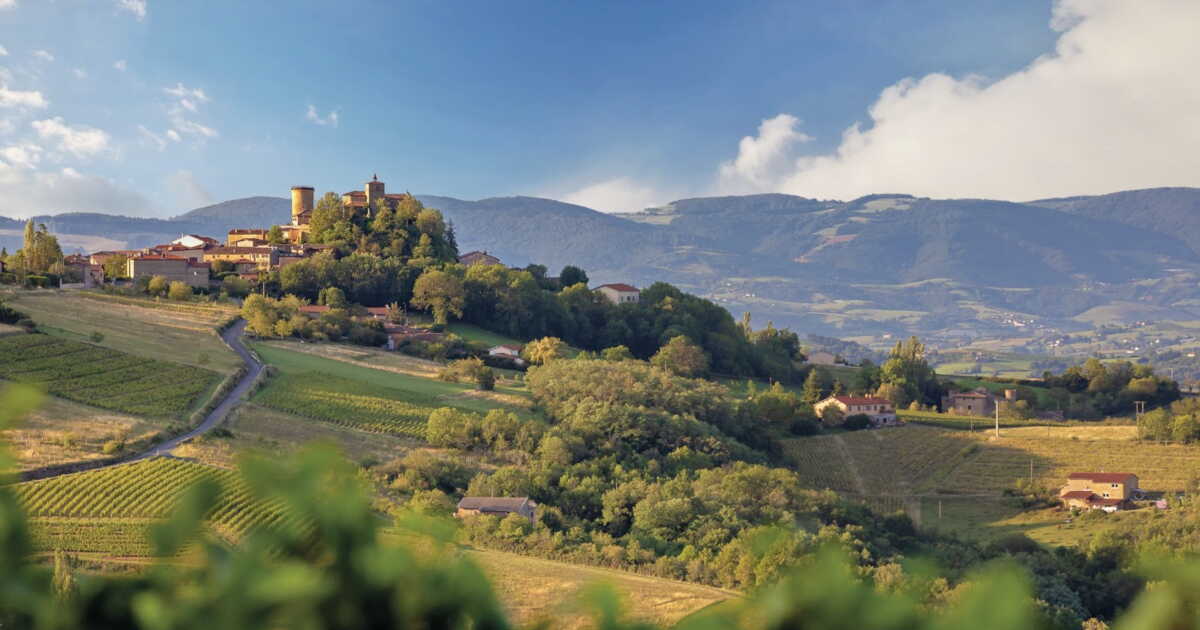
It is a refrain we chant on the third Thursday of every November: “Beaujolais nouveau has arrived!” From the cafés of Montmartre to Tokyo’s wine bars, glasses are raised as we discuss its aromas with a grave air of banana notes or hints of English candy. If the Beaujolais name is celebrated beyond French borders, it is indeed thanks to its primeur wine.
But this territory roughly 60 kilometers long by 20 wide, tucked against the right bank of the Saône and stretching from Solutré Rock in the north to the foothills of the Lyonnais in the south, offers surprises beyond wine! In addition to twelve renowned appellations and bold winemakers, it houses one of the richest geologies in France, hailed by the UNESCO Global Geopark label. A spread of mineral treasures whose most luminous expression can be seen in its southern part, punctuated by honey-colored villages: the land of the Golden Stones.
Belleville-en-Beaujolais offers an ideal gateway to begin this journey. There you can visit the Romanesque Notre-Dame abbey, dating from the 12th century, and the admirable Hôtel-Dieu. “There, medicine was practised from the 18th century until 1950, before the buildings were used as a hospice”, explains the cultural mediator Valérie Jacquet-Deschamps in front of the woodwork of an apothecary cabinet filled with ceramic pots and blown glass vials.
Further south, at Villefranche-sur-Saône, the historic capital exudes an elegance that seems to come from elsewhere. In the 16th century, François I, returning from Italy, brought architects from there. Merchants and notable people then had Renaissance-inspired residences built. Following the traverses of Rue Nationale, one discovers the house of Claude Gaspard, a wealthy merchant and alderman of Villefranche at the turn of the 15th and 16th centuries, the Court Henri IV with a remarkable spiral staircase encased by columns, as well as a wooden house with a splendid exterior Gothic gallery in carved oak.
On the Road to the Golden Cities
Further south, there is Anse and its Château des Tours built in the 12th century by the bishops of Lyon. It now houses regional archaeological treasures. “Notably a 50 m² mosaic, adorned with ship prows and anchors, unearthed in 1966 in a villa from the Galloroman era”, explains Jean-Noël, president of the Arc Civilisation Patrimoine association. As you wander at the foot of the old medieval enclosure, you glimpse the first touches of yellow ochre, window frames, cornerstones… The land of the Golden Stones is not far! With its back to the Saône, the road winds into a sea of vines.
Gradually, the Bajocian limestone deposited 170 million years ago, saturated with iron oxides, takes over the scenery. Five minutes of driving and there is Châtillon-d’Azergues. The village’s golden walls, perched beside its fortress built in the 11th century, trace the curves of the relief. The same gold glints on the façades of Rochebonne Castle, an elegant Renaissance residence, in Theizé, ten kilometers away.

Finally emerges Oingt, recognized among the most beautiful villages in France. Perched on a spur, the old medieval castrum unfurls narrow streets whose sometimes evocative names (Tyre-Laine, Coupe-Jarret) are lined with artisans’ shops and dominated by a massive 13th-century keep. The ascent is steep, but at the top the payoff is a 360-degree panorama that takes your breath away.
Vaux-en-Beaujolais, the village that sparked a story
About fifteen kilometers from Villefranche-sur-Saône, Vaux-en-Beaujolais is famed for a quarrel over a urinal. In 1923, the mayor installed a urinal directly opposite the church, triggering a heated dispute between clerics and laypeople, fueled by petitions, sermons, and invective.
The episode inspired Gabriel Chevallier to write a novel, Clochemerle, whose title has become a common noun for the village squabbles.
Today one can admire the figures from this human comedy on Vaux’s façades, painted in monumental form after Dubout: Father Ponosse, notary Girodot, and the Baroness Alphonsine de Courtebiche.
A Mineral Theater
About fifteen kilometers further, in Glay, the ochre limestone quarries gleam with a blinding sheen under July sun. “Every village in the area had its quarry, but Glay was the largest”, says Marie-Christine Cuingnet as she surveys the face. This retired teacher dedicates her energy to keeping this mineral theater alive, mined from the 15th century until 1947. “170 million years ago, a warm sea covered the region, she continues. As it settled at the bottom, billions of micro-fragments of shellfish rich in iron oxides gave birth to this distinctive sedimentary rock.” To preserve the memory of the quarry workers, the association has rebuilt an old forge, displays period tools, and organizes guided tours. Listed as a Sensitive Natural Area, the site has become a biodiversity haven bordered by dogwoods and alders, home to fifteen species of bats and a nesting pair of great horned owls.
Not far away, Bérengère Perras and her brother, owners of the estate that bears their name, are among the vintners pushing for official recognition of the label “Beaujolais Pierres Dorées” within the regional AOC. “Climate warming, but also changing consumption habits – people drink less wine, but they drink better – pushes us to innovate”, she says. To adapt the vineyard to hotter, drier summers, some abandon the traditional goblet-pruning (low and bushy) in favor of taller trellising. And in a Gamay-dominated region (still 98% of the vineyard), Chardonnay is gaining ground. It yields here elegant, fruity, and floral whites, with a golden robe that mirrors the character of this terroir.
Things not to miss
Sleep in a Barrel
For an unusual overnight, head to the Py’s Foudres, giant barrels repurposed into cozy nests among the vines. The little bonus: an early-morning climb to a centenary oak that offers an unforgettable view over the Morgon terroir. gitelechenedupy.fr

A Gourmand Step
At the Villefranche-sur-Saône covered market, a historical monument, you fill your basket with regional products and partake in the ritual of the “mâchon,” a pork-based snack shared around a glass of Beaujolais.
All About Wine
Duboeuf Village is Europe’s largest wine-themed park (30,000 m2). The program includes 3,000 objects on display, interactive shows, a miniature train, a tour of a winemaking center, a scented stroll, and a rosalie ride through aromatic gardens… A must-visit without moderation. duboeuf.com
➤ Article published in GEO magazine no. 571, “Italy Confidential, from Marche to Calabria,” September 2026.
➤ Do you like GEO? Then to make sure you miss nothing, discover our subscription plans to receive GEO every month at home with ease.