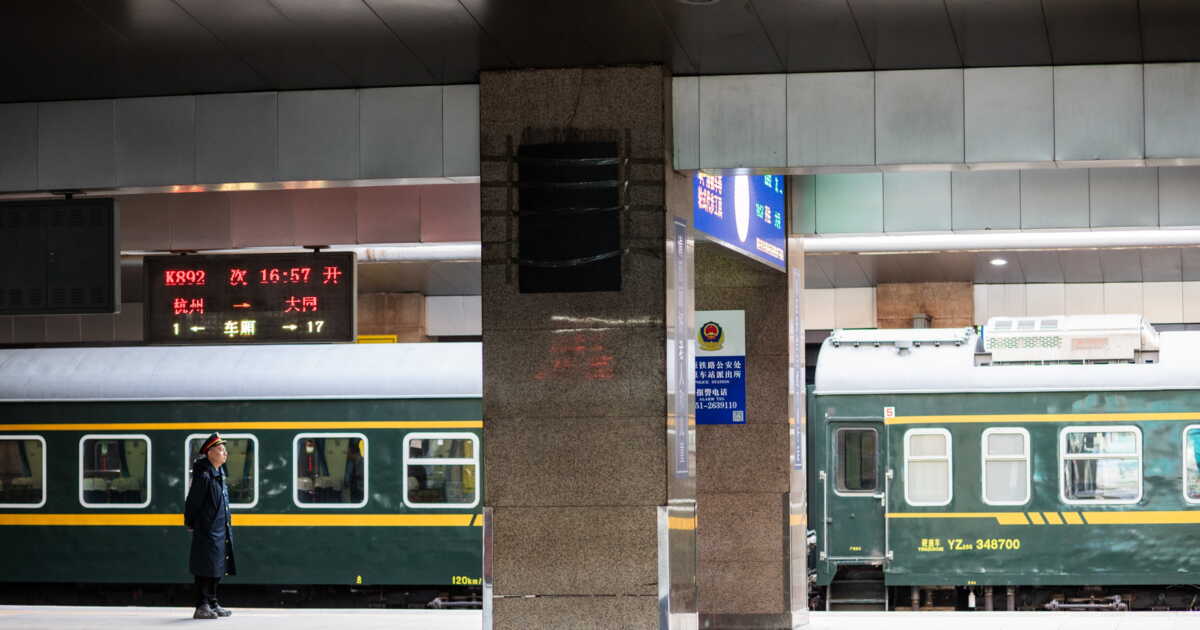
Learning that I would ride the “green train” to explore the traditional heart of China, my mother bombarded me with advice: “Pack enough clothes. Be wary of pickpockets. Remember to bring toilet paper.” At 68, hailing from chic Shanghai, and a little anxious, she has in mind the journeys of her youth on these noisy trains. The crowded cars, the whistling locomotive, everyone elbowing to preserve their personal space in the smoke-filled air of cigarette smoke…
Forty years later, in Wutai, in Shanxi province (northern China), the mood is quite different in this April when, dressed in her enduring dark green, the train 8817 bound for Taiyuan enters the station. Passengers wait neatly in single file at the door of their car. Only Emeric, the GEO photographer who accompanies me, prowls near the edge of the platform to capture the train’s arrival. The station officer, cap on his head and a small flag in hand, watches him, more tolerant with the foreign visitor than with his fellow countrymen.
In the Bowels of the Country
One only has to gauge how some travelers react to the presence of an Occidental to understand that this China does not share the same openness as the coastal megacities. On the train, as Emeric, stocked with his two backpacks, passes by, children whisper to their parents, adults take his picture… As soon as we are seated, our neighbor greets us. Mr. He, in his fifties, is taking this train to return home to Xinzhou, three hours away. “I organize artistic activities with residents of Wutai County and I go back home once a week”, he explains, noting that he works for a rural revitalization program.
A project of President Xi Jinping. “I am a bit like this train”, he concludes with a smile, pointing to the characters inscribed on the window:
“A slow, not-for-profit train serving rural renewal.”
Getting on a lüpi huoche (“green-skin train”) means boarding with the China of the rural, those small hands that keep the gears turning the world’s second-largest economy. Of the 4.6 billion rail journeys made in 2025 in the country, only 20% were aboard these trains, introduced in 1959, which, for some, race along at the maddening average of… 30 km per hour. In the 1990s, the entire country traveled only with them.
Through the window of the Wutai–Taiyuan route scrolls the ochre loess plains, a mixture of dust and silt, of Shanxi. The Hans (the majority ethnicity among China’s 56 groups) consider this province their ancestral cradle, claiming to be descendants of the sanhuang wudi (“Three Augusts and Five Emperors”), founding gods of Chinese civilization and mythical sovereigns who are said to have settled here in ancient times. Perhaps that’s why residents here are known for their reverence for tradition. They are also known for being great talkers. From the back row, Mr. Zhang has inserted himself into our conversation with Mr. He. With a keen gaze and bristling brows, this fifty-something from the provincial capital Taiyuan returns home with his wife and daughter after having paid respects at their ancestors’ graves during Qingming, the Chinese Tomb-Sweeping Festival.
“Do you know there are several words for tomb? he states, delighted to show off his knowledge to the Shanghai-born narrator, reputed to be more versed in economics than culture. Since the Ming Dynasty, they call the tombs of emperors ling, those of ministers mu, and those of common people fen.
During this long weekend, the country’s temples experience a spike in attendance. That’s why, before boarding this train, we made a detour to Mount Wutai, one of the four sacred Buddhist peaks in China, in the north of Shanxi, about an hour from Wutai Station. It welcomes millions of pilgrims each year who crowd its fifty temples to venerate Wenshu, the bodhisattva of wisdom. During Qingming festivities, the bell tower at Xiantong Temple, two thousand years old, is exceptionally opened.
Halls Dedicated to Deities and Mao
“Qingming is the moment when the world of the dead and the living communicate,” Master Guoyuan, a 55-year-old monk wrapped in his gray robe, explained to us. He is charged with guiding pilgrims who ring the five-ton bell three times to ensure their prayers reach their departed ancestors. He entered the monastic life fifteen years ago after being diagnosed with lung cancer. “My sincerity, my fear of death and my prayers healed me without any treatment”, he assured us. Ethnically Mongolian, he has found here many monks from the Inner Mongolia Autonomous Region. Mount Wutai indeed hosts Han Buddhist temples as well as Tibetan ones, reflecting a mix of religious traditions. There are even halls dedicated to Taoist deities, and even to the great communist leader Mao Zedong, who passed through here in 1948.
A pilgrim can therefore offer fruit to Wenshu, spin prayer wheels under a Tibetan stupa, invoke the Taoist god of wealth, and leave a few cigarettes for the Great Helmsman. People often pray without distinction and pragmatically, as long as fortune is at the end… Fortune, Madame Fei is still waiting for it. When we met her, with a headscarf, an apron, gloves and dusty knee pads, she was the only pilgrim praying prone, multiple times in a row. “I did it 300,000 times last year,” she said. “Things are going badly in the world. Prayer isn’t necessarily tied to belief or superstition; it’s more about having something to cling to.”
When she learned that my grandparents were from Shandong, like hers, she brightened. “It’s fate,” she said. You look worried, unlike your foreign friend who looks well and lucky. You should pray to the Buddha Wenshu.” And she offered us two durian-flavored candies wrapped in plastic.
Thermos and Instant Noodles
Our journey aboard the 8817 train continues. The platforms between the cars teem with life. Passengers gather there to light a cigarette, fill a thermos, pour hot water over their instant noodles, right beside the toilets (whose latches are not always closed!). Other travelers use the space to freshen up or recharge their phones, like Mr. Ding, in his twenties, a professional pistol shooter. When he becomes a coach, the young man will earn between 3,000 and 6,000 yuan (roughly 376–752 euros) per month, far from enough to buy an apartment in Taiyuan or to marry someday. “One of my colleagues went to teach in the United States but he was killed by one of his students,” he says. I would prefer South Korea or France, but anyway I have to improve my English.”
In our car, Mr. Zhang, inexhaustible, shifts from story to geopolitics, from the dollar’s rate to Confucianism. He and his wife work in steel exports. He boasts: “The trade war with the United States? It’s been a long time since we did business with them; we turned toward Southeast Asia.” And when I ask how his business is going, he offers a cryptic thought: “At our age, we’re like flies trapped in a plastic bottle: the exit route is obvious but blocked. We won’t get rich, but we won’t starve either.”
RETOUR DE TERRAIN Emeric Fohlen (Photographer) Weilian Zhu (Journalist)
During his green-train journeys with Weilian Zhu, our photographer Emeric Fohlen has found strong appeal among young passengers, who filmed him attempting various disciplines (read the article). “During our long journey between Pingyao and Luoyang, I talked as best I could with three young girls on a platform, he recounts. “Despite the language barrier, we ended up laughing together. Then they taught me a choreography that they later posted on their social networks. I’ll probably never know how many people saw it, but, for a moment, I may have been a small celebrity in China.”
A Brief Martial Arts Demonstration for Social Media
After covering 230 kilometers in five hours, the lüpi huoche finally nears Taiyuan. Along the tracks, the arid regions give way to factories and sheds, power lines crisscross the landscape. Countless wind turbines dot the mountain ridges. Known as a “sea of coal” because it supplies 27% of national production, Shanxi saw its installed renewable-energy capacity exceed that of CO2-emitting plants for the first time in 2025. The train crosses a railway bridge. Below, workers busily toil on a construction site, even during the holiday season. On the fencing concealing the work from the street, a huge poster of President Xi Jinping urges the people to work hard for common prosperity.
Taiyuan is a large city of 5.5 million inhabitants, yet Emeric’s presence continues to arouse curiosity. The stop is brief. We board another green train toward Pingyao, our next stop, 80 kilometers away. Emeric is immediately accosted by four students from a wushu school. In a makeshift English, the two girls propose a short video demonstration for their social networks. And he agrees! In return, one of the boys shows us the “raspberry pose”, one leg extended, one bent, arms spread out to either side of the torso, all in perfect stability on a train in motion. No time to linger with them; after an hour and three-quarters, our train arrived. With its walled enclosure and brick houses with gray-tiled roofs, the old town of Pingyao appears to have remained almost the same since the 14th century. An almost timeless atmosphere reminiscent of Zhang Yimou’s famous film Raise the Red Lantern, shot 30 kilometers away, which narrates the internal quarrels of a wealthy local family in feudal China during the 1920s.
Pingyao’s New Youth
One century later, the place attracts tourists. Young women stroll along the ramparts and streets dressed in flowing silk gowns and jeweled brooches. “It’s fashionable to reconnect with the codes of traditional beauty,” explains the owner of one of the many shops offering costume rentals. This trend of consuming Chinese products and culture has even a name, guochao (“national wave”). Students or workers, these young women show on their phones photos of themselves striking all sorts of poses during this memorable day: tired but thrilled, they have become, for a day, the “Pingyao’s grand ladies”, a title once reserved for the daughters of bankers who lived here. In the 19th century the city was the country’s financial center. It is here that, for the first time, a banknote was exchanged for a gold or silver deposit.
In the city’s museums that recount this transformation, taels of silver (the Chinese currency in use until 1933) pile up in display cases. These antiquities may soon be joined by current notes: nowadays, only 13% of Chinese people report paying for most purchases in cash, as most do so by scanning QR codes with their smartphones. For example, the only place we see cash in Pingyao is in a bar: customers use it not to pay for drinks, but to thank a singer who belts out 1990s hits, a nostalgia for a decade when China posted two-digit growth, money flowed, and career paths skyrocketed. A time so different from today’s China, with a stagnant economy and a largely disenchanted youth.
Pilgrimage to the Yellow River
Just after midnight, we depart Pingyao on the K237 train. Our bunks are in a cramped compartment, two rows of three bunk beds, plunged into darkness. Slipping under the sheets, we surrender to sleep, dazed by the train’s sway, the murmur of each stop, and the cigarette smoke. This line was created in the 1980s to connect Taiyuan to Shenzhen, then a “fishing village” of 30,000 inhabitants chosen by the State as a laboratory for its transition to a market economy. Four decades later, the ticket price of 273.50 yuan (34 euros) has hardly budged, and the line still ferries workers from inland regions to what is now China’s technology capital in 36 hours.
A high-speed train can indeed connect the two cities in eight hours, but the 943.50 yuan (118 euros) fare is not affordable for all. At 6:15 a.m., we are woken by the chief steward who pulls the curtains without ceremony. Despite the pale sun hidden behind a veil of dust, the landscape looks greener. The Yellow River’s influence, over which the train is about to pass, is often said to run through the veins of every Chinese person, and I feel a little shiver as I glimpse the sandbanks and the tranquil waters at dawn. The poems praising the river are countless. Among them, Li Bai’s (701–762), a great Tang Dynasty poet learned at school: “Don’t you see that the Yellow River’s water comes from the sky, rushing to the sea, never turning back on its course?”
Sometimes, a few words are enough to shape a nation. The poet roamed the region and also wrote many verses about Luoyang, a city in the heart of Henan Province. This city, long overlooked by tourists, has a history that can rival that of Beijing. Capital of thirteen dynasties, it reached its apex under Wu Zetian (690–705), the only reigning empress the country has known. Repeatedly ravaged by wars—and until recently, best known for its tractor factories—the city now leans heavily on its history. In the 2010s, it revived, in concrete reproductions on the ruins of its former palace, several imperial buildings.
A Breakfast in Compartments of Tin
To deepen the immersion, it even recreated a “old town” on the site of a 20,000-person residential district. In the evening, guided by red lanterns, crossing artificial rivers on stone bridges, one wanders as if back thirteen centuries amid onlookers, many of whom wear the hanfu (the traditional Han attire), the silk robe and shawl on the shoulders for women, the tailored robe at the waist for men. The illusion works. But upon reaching the central square of the neighborhood, where a DJ plays techno music, this fake Luoyang eventually confuses us. Here, historical authenticity does not carry the same meaning as in the West. The White Horse Temple, east of Luoyang, is presented as the building where the earliest Buddhist texts were translated into Chinese 2,000 years ago, though it was repeatedly burned and rebuilt… To the south of the city, the Longmen Caves are ancient, but thousands of Buddha statues carved between the 5th and 10th centuries have lost their faces, chipped away by buriners and sold to foreign collectors during the civil wars that followed the empire’s fall in 1912.
Seventy kilometers away, young graduates climb Mount Song, one of the five mountains venerated by emperors. Like dozens of generations before them, they come to decipher the poems carved on a rock face and to admire the landscape from cliff-side pagodas. They say nothing, but I read it as a need to feed spiritually before entering the working world. Like me, they know that this massif with its dense forest and sheer cliffs houses the Shaolin Temple: a Buddhist monastery founded in the 5th century, famed worldwide for its wushu school, and today accused of excesses, commercializing classes, diverting funds, and a failed stock-market attempt—set against a backdrop of a sex scandal. In the new China, the pursuit of gain often justifies the means. Those who resist are derided as tangping, “idle youth”.
Everywhere, highways and high-speed railways rise from the earth to support growth. Yet aboard the lüpi huoche, time seems to stand still. And I now long to take one with my mother so she can tell me about her journeys of yesteryear. The dining cars retain a Soviet feel with lace curtains and red armchairs. In the morning, breakfast – rice broth, pickled vegetables, and salted egg – is still served in a compartmented tin plate. Seventy years of service and these trains are still there, bearing precious goods that cannot be bought: time and memories.
Would you like to know how to prepare for a journey aboard a green train? Discover our article https://www.geo.fr/voyage/voyager-en-train-en-chine-billets-couchettes-repas-nos-conseils-233508
➤ Article published in GEO magazine No. 571, “The Hidden Italy, from Marche to Calabria”, September 2026.
➤ Do you love GEO? Then to never miss a thing, discover our subscription plans to receive GEO at your home every month.