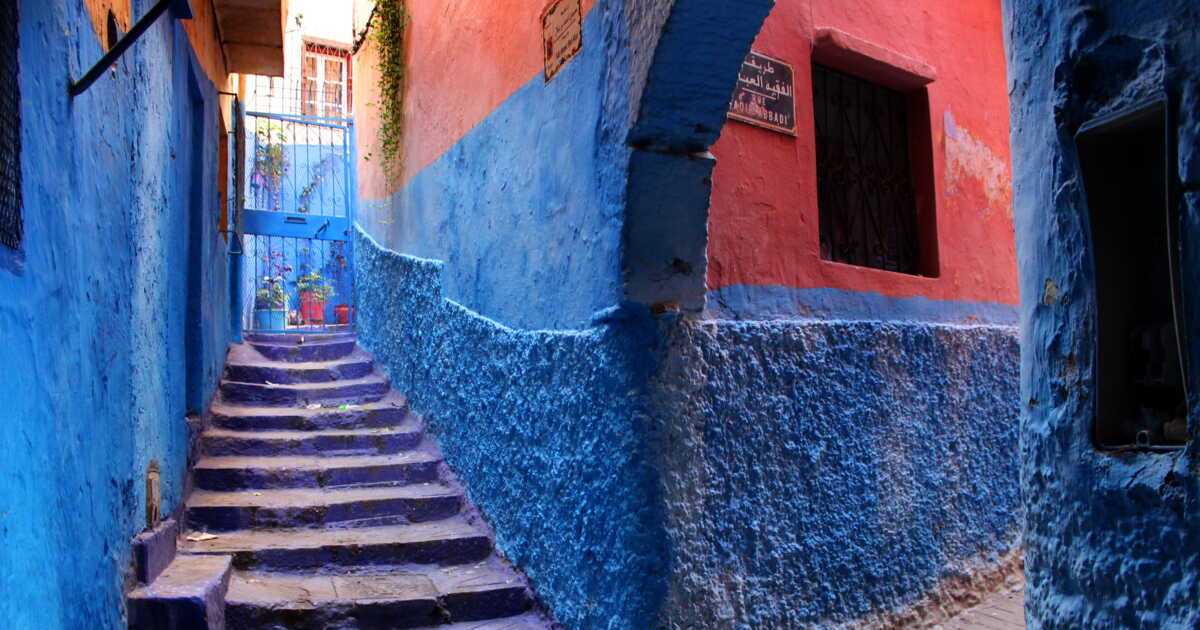
A Moroccan port located near the Strait of Gibraltar, whose white houses glitter under the sun, Tangier is a city born of myth that has long shone through its commercial activity, from the Phoenicians and Carthaginians to the Byzantines and then the Arabs, from whom they set out to raid Spain… A rich history, paired with the softness of the Mediterranean, which makes it a city that every traveler will not fail to visit.
1. Explore Tangier’s Medina
Exploring Tangier’s Medina corresponds to entering a maze of lanes where Andalusian architecture, colonial influences, local craftsmanship, and oral traditions meet. From the center of town to the heights of the Kasbah, the Medina of Tangier preserves an urban layout typical of Maghrebian old towns, with its souks, inner courtyards, and bustling stalls. The Siaghine Street leads to the Tangier Cinematheque, housed in the former Rif cinema, a witness to the city’s connection with the United States through the figure of Paul Bowles.
A few steps away, the Legation Museum, a unique American diplomatic representation transformed into a museum, houses collections highlighting this shared worldview. The exploration can extend to the Grand Socco, a crossroads of traffic and daily life, offering a transition to the modern neighborhoods. It is the ideal place to enjoy a mint tea, in a soothing atmosphere, before continuing the visit of this city whose history follows the curves of the Mediterranean climate.
2. Admire Cape Spartel
Admiring the Cape Spartel allows understanding the symbolic reach of a site where the Atlantic Ocean meets the Mediterranean Sea, in a spectacular natural convergence. Only about fifteen kilometers from the Port of Tangier Med, this rocky promontory offers an unobstructed view of the Moroccan and Andalusian coasts, particularly striking between June and September, when the average temperature favors an afternoon stroll.
The lighthouse, built in the 19th century, testifies to the maritime vocation of the region and reinforces the site’s strategic value. Cape Spartel, by its position, integrates fully into the routes connecting Tangier to Casablanca, or toward the south along the coastal road leading to Tetouan Asilah. This place, which blends heritage, geography, and contemplation, represents a perfect setting for a cultural and panoramic stop on Tangier’s heights.
3. Visit the Hercules Caves
Visiting the Hercules Caves, located near Cape Spartel, allows merging geology, legend, and seascapes in one place. These natural caverns, shaped by erosion and history, owe their fame to Greek mythology, according to which the hero Hercules sought refuge there after one of his twelve labors. The main opening of the cave, oriented toward the ocean, strikingly evokes an inverted map of Africa, offering an exceptional vantage point over the waves.
Set up for visits, this site constitutes a must-stop for any Tangier itinerary, reinforced by its proximity to the Rmilat forest, a true greenery by the sea. Accessible within a few hours’ drive from Chefchaouen or Asilah, the place delights nature lovers as much as fans of ancient narratives.
4. Strolling along Tangier’s Corniche
Walking along the Tangier Corniche is to travel along a reimagined urban shoreline that illustrates the city’s contemporary openness to the world. Lined with cafes, hotels, and accessible public spaces, it connects the center of town to Tangier Beach, in a visual continuum marked by contrasts between past and present. Ideal for an afternoon stroll, the corniche offers a privileged vantage point on the strait’s movements, the silhouette of freighters on the horizon, and the play of light at sunset.
Popular with both Tangerois and travelers, it embodies the cosmopolitan spirit of a city where the hushed ambience of tea rooms sits alongside the dynamism of modernity. A stop here lets you sample local specialties, recall the eras of the Rolling Stones or Paul Bowles, and feel Tangier’s tangible link to the United States.
5. Discover the Gran Teatro Cervantes of Tangier
Discovering the Grand Theatre of Tangier, recently renovated, is to measure the rising prominence of the northern Moroccan artistic scene. Located in the center of town, this cultural space hosts a varied program — theater, music, dance — reflecting the linguistic and aesthetic diversity of the city.
In connection with institutions such as the Cinémathèque de Tangier, the theater participates in redefining Tangier’s contemporary identity, while fitting into the multicultural heritage that Tangier shares with Europe, the Arab world, and the United States.
The hushed atmosphere of these places contrasts with the city’s buzz, offering visitors a moment of intellectual pause in a perfect setting for creation. The theater is also a conduit of local memory, where figures such as Paul Bowles or the Rolling Stones left lasting marks.
6. Perdicaris Park near Tangier: nature and relaxation just steps from the center
The Parc Perdicaris, also called the Rmilat forest, and Tangier’s beach form a complementary duo for a nature escape just a stone’s throw from the city. The park, a vast wooded area overlooking the Atlantic, offers marked trails within a preserved ecosystem, ideal for an afternoon outing. Sea views and the proximity to Achakar Beach.
Down below, the beach spans a wide expanse of fine sand, suitable for relaxation or water activities. The contrast between forest and sea illustrates the Mediterranean climate that characterizes Tangier, making the city attractive from June to September. This coastal segment provides a breath of fresh air within the urban area, offering a perfect setting for families as well as solitary walkers, in a rare natural harmony so close to the city center.
7. Explore Tangier’s Kasbah: immersion in living heritage at the gates of history
Visiting the Kasbah of Tangier means entering one of the most emblematic historical cores of the Tangier Medina, perched on the heights, not far from the Grand Socco and the Petit Socco. Behind its walls unfolds a labyrinth of lanes where Andalusian architecture dialogues with lime-washed houses and inner courtyards.
The site, with its panoramic view of the Strait of Gibraltar, offers a dense heritage experience, between old governor’s residences, art galleries and quiet terraces where one can sip a mint tea in a hushed atmosphere. The site is an ideal place for an afternoon stroll, when the average temperature and light highlight architectural details. Nearby, the American Legation Museum testifies to the richness of transatlantic exchanges, especially through the figure of Paul Bowles.
The route can continue toward the Siaghine Street, up to the Rif Cinema and the Cinémathèque de Tanger, contributing to a coherent cultural discovery. Nestled between tradition and modernity, the Kasbah also opens up possibilities for nearby excursions, from Tetouan and Asilah to the Hercules caves, or toward Chefchaouen, within a few hours’ drive from the Port of Tangier Med.
8. The Petit Socco: a central square of cosmopolitan heritage through the centuries
Located in the center of the Tangier Medina, the Petit Socco concentrates a significant share of the city’s urban memory. Formerly frequented by diplomats, writers and merchants, it was a privileged observation place for figures like Paul Bowles, fascinated by this worldview in miniature.
As you walk around its surroundings, you discover an urban sequence marked by Andalusian architecture, historic buildings, old cafés, and typical stalls serving local specialties. Easily accessible from the Grand Socco, the sits within a pedestrian network where the pleasant average temperature, especially from June to September, makes it a perfect place for an afternoon stroll.
It is also a perfect setting to grasp Tangier’s social complexity, observing the crossroads of local populations and passing visitors. The unique atmosphere, blending a hushed ambience with discreet activity, invites extending the experience to the nearby Legation Museum, a few steps away, or toward nearby destinations such as Asilah or Chefchaouen, reachable in under three hours by road, starting from a route linking Tangier to Casablanca.
Is it worth visiting Tangier? A city between Mediterranean openness and Andalusian heritage
Visiting Tangier arouses growing interest for those who want to understand a city with a worldview shaped by migrations, exchanges, and culture. Located at the crossroads of Europe and Africa, between the United States, the France, and Andalusia, Tangier captivates with its Andalusian architecture, its diplomatic past (as evidenced by the Legation Museum), and its contemporary energy.
From the Mto Tangier Medina to the Tangier Med Port, from the Kasbah to the cafés of the Grand Socco, the city articulates memory and modernity in a network of lanes and panoramas. Tangier to Casablanca is more than a railway link: it is the journey between two faces of a Morocco in transition. Yes, Tangier deserves to be visited, because it does not simply show — it explains.
What to do in Tangier with family? A peaceful and accessible destination for kids and grown-ups
Visiting Tangier with family offers a serene and educational discovery opportunity. The Parc Perdicaris, with its Rmilat forest, provides a suitable ground for walking, play, and observing nature. The Tangier beach, equipped for swimming, completes the experience with its accessibility and the quality of its fine sand. For a heritage immersion, the Kasbah Museum, in an environment adapted for younger audiences, traces local history in a secure setting.
In the afternoon, families can also stroll through the Medina of Tangier, explore the Siaghine Street, or have a mint tea in a hushed atmosphere. Asilah, despite the existence of many other hubs, remains a possible excursion, as does Chefchaouen, reachable within a few hours’ drive.
What to do in Tangier at night? Exploring the city between golden light and local ambiance
Tangier at night reveals a soothing and luminous facet, conducive to a more contemplative exploration. From sunset, the corniche becomes a popular crossing to observe the reflections of the strait, while Tangier’s Medina maintains a discreet bustle with souks still open.
The Rif Cinema and the Cinémathèque de Tanger offer screenings in a hushed atmosphere, reflecting the local cinematic richness. On the heights, the Café Hafa lets you savor a mint tea facing the sea, in a memory-laden setting. In calmer moments, the Kasbah invites night walks through a labyrinth of quiet streets. What to do in Tangier at night? Discover a city that listens as much as it is visited.
What to do in Tangier when it rains? Museums, literary cafés, and indoor heritage
When it rains in Tangier, cultural spaces gain full meaning. The Legation Museum, housed in a 19th-century building, recounts the relations between Tangier and the United States. Not far away, the Cinémathèque de Tangier, in the former Rif cinema, offers a cultural refuge with auteur films and exhibitions.
The covered lanes of the Medina of Tangier grow quieter, and one discovers literary cafés, notably around the Grand Socco, conducive to reading and conversation. Even in the rain, the city preserves its distinctive atmosphere, revealing a hushed ambience favorable to reflection. The climate, though Mediterranean, can still hold surprises that one can transform into an ideal place for another way to visit.
This article was drafted with the help of artificial intelligence, then corrected, supplemented and validated by the editors of the desk.