An air of opera soars toward the vaulted ceilings decorated with arabesques and trompe-l’oeil. The morning’s golden light dances on the walls, revealing here and there fragments of frescoes that have sailed through the centuries. It is within the setting of this small palace nestled in the heart of Montecosaro, a medieval town of 7,000 inhabitants, about ten kilometers from the Adriatic coast and ranked among Italy’s most beautiful, that designer Emanuele Coppari, aged 48, works. With diamond-cut curls at each ear, a ring in his nose, and a face etched with a sculptor’s knife, the man would not look out of place in a Cinquecento aristocratic portrait—the golden era of the Italian Renaissance in the 16th century. This loquacious all-around talent is renowned across Europe for sketching luxurious shoes for women—which seems almost natural in a region whose name is Le Marche (The Marche) in Italian (pronounced “lay mar-kay”). Yet the artist also envisions sophisticated jewelry, invents decorative objects, designs theater sets… Recently, he added a new activity to his repertoire that some of his clients had been asking for: creativity workshops. Far from daily routine, participants travel to his studio to rekindle inspiration…
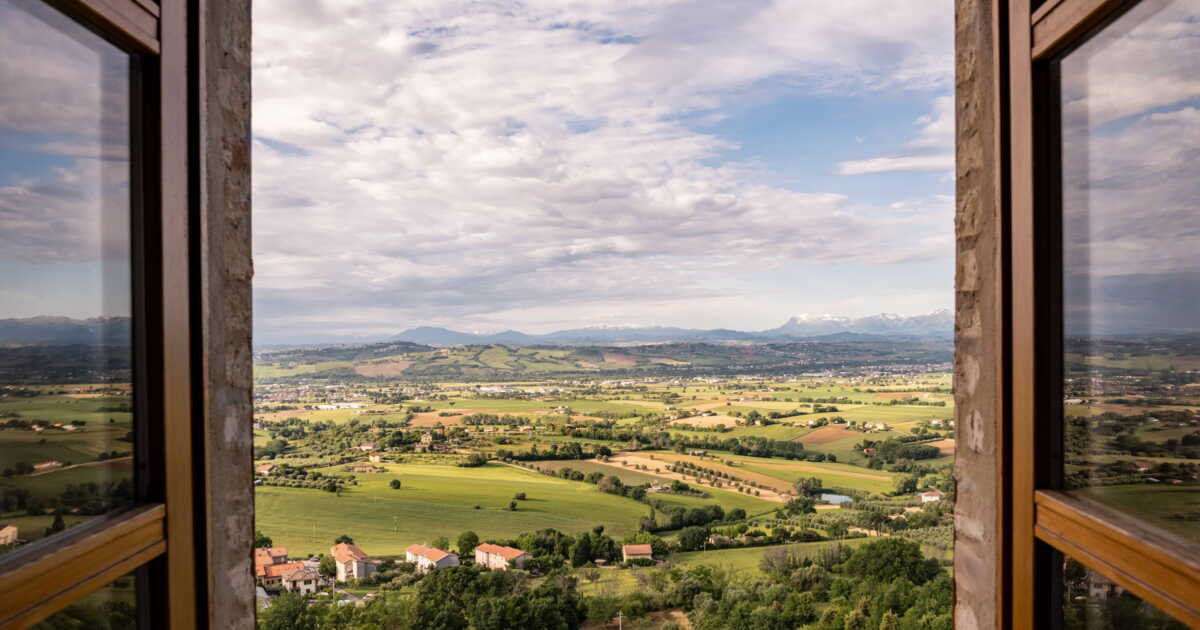
And it works! A simple glance from the window is enough to understand why. Outside, it is the grande bellezza (“great beauty”). Between sky and earth, Montecosaro, all dressed in pink-hued bricks, crowns the top of a lush hillside.
The Record for Italy’s Most Beautiful Villages
A road branches off from there, winding over gentle hills dotted with olive trees, striped with vines, and carved by furrows. Further afield, an ancient stone bridge spans a river; sturdy farms carry themselves with airs of impregnable little kingdoms; a church rises with a procession of neatly aligned cypress trees. Grande et éternelle beauté, meticulous and pictorial, of these Transalpine landscapes that resemble the backdrops of Renaissance masterworks, which are too often—and wrongly—imagined to lie only between Pisa, Florence and Siena.
The Marche are the peninsula’s secret ace. True, neighbors Tuscany and Umbria to the west, Emilia-Romagna to the north, and Abruzzo to the south likewise unfold miles of timeless panoramas, but one crucial difference remains: this central province – “situated at the heart,” as the Marche people say – stays carefully off the tourist radar. Also, few know this grand quiet region, stretched between the azure Adriatic ribbon and the Apennine peaks wrapped in snow. A land that is maritime, rural, and Alpine all at once, where it doesn’t take long to think it hides a pure concentrate of the Bel Paese that Dante sang about. Who knows, indeed, that this place holds the record for the borghi più belli d’Italia (“most beautiful villages of Italy”), with 31 labeled locales? And also the highest density of opera houses in the country, with 140 theatres listed for 246 municipalities? In this land where Pergolesi was born (in 1710, in Jesi) and later Rossini (in 1792, in Pesaro), bel canto is a fixed passion, but that is not all: the fertile valleys conceal an impressive collection of art galleries and museums.
“This little country does not shine only through its landscapes; it nourishes your soul”, proclaims with lyric reverie Emanuele Coppari. This morning, the shoemaker must visit a leather supplier for a new collection, then tour the workshops he collaborates with all year: sole turners, heel makers… All operate within a 150‑kilometer radius. On the way, he attempts to map out a GEO itinerary of discovery. Dozens of names crowd in… At the province’s center, he notes, there is first the beautiful city of Macerata, famous for its Sferisterio, a neoclassical stadium that has become one of the open-air opera temples. Not far away, a mandatory stop in the aristocratic city of Fermo, for its central square, one of Italy’s most elegant, and its Prieurs’ Palace whose art gallery houses a monumental Adoration of the Shepherds by Rubens, and a globe drawn by a renowned Venetian cosmographer in 1713. Rolling toward the mountains, a must‑stop in Cingoli, perched 600 meters high, 40 kilometers from the Adriatic, aka the “Balcony of the Marche.” On the coast, the village of Torre di Palme, a belvedere suspended above the surf, is not to be overlooked either.
Centuries-Old Know-How
And what about Sirolo! To the south of Ancona, on the Conero Riviera, it dominates white cliffs. One takes the time to walk the path that descends through the pine scent to the cobalt blue sea. There, a beach stretches out in the classic Italian style—parasol and deckchair neatly arranged, but its nostalgic ambiance makes you feel as if you’ve stepped into an old Cinecittà production. In high season, a restaurant with its feet in the water, La Paranza, serves the coast’s finest seafood pasta. “Attention, these are only a few suggestions at this stage; you’ll still have plenty to see!”, warns Emanuele.
He isn’t wrong… Proof lies in following the route of towns marked “Marche Eccellenza Artigiana” (“Marche, the Artisanal Excellence”). A different way to discover the province. From one bottega to another, a flourishing array of centuries‑old know‑how unveils itself. Near Urbino, in Urbania, the reputation of ceramicists has been established since the Renaissance. Forty-five kilometers away, in Fratte Rosa, cookware made of terracotta has been produced for eight centuries. An hour south, Fabriano specializes in high‑quality paper since the 13th century. And to buy a fine hat, for four centuries, head a little further east to Montappone, a quiet town of 1,600 inhabitants that claims to manufacture 10 million hats for men and women each year (70% of Italian production), thanks to a network of micro‑workshops often housed in the very homes of the workers. The workers collaborate for a half‑dozen hatteries that have storefronts. This decentralized way of doing things has helped maintain iconic models, such as the paglietta, the ultimate boaters’ hat, and the saturno, a black round hat with wide brims worn by clergy.
Field Report by Sébastien Desurmont, journalist
For our journalist, this GEO feature on the Marche proved to be a journey into what Italy offers most joyfully: a dolce vita that blends hedonism, relaxed elegance, a deep attachment to all that comes from the past, particularly the Renaissance… And indulgence. “In Macerata, I thought I had had the best meal of all my Italian trips… but no! The very next day, around Ascoli Piceno, and in the days that followed, in Urbino, Ancona, Gradara, they were all feasts.”
Just a few kilometers away, Castelfidardo, a town of 18,000 inhabitants, presents itself as the world capital of the accordion. The instrument reportedly arrived here only in 1863, in the baggage of an Austrian pilgrim who came to venerate the Loreto sanctuary nearby. A fascinating museum recounts how a young boy borrowed it for a night, disassembled it, and extracted the secrets of its manufacture. Today, the city makes the Rolls of the piano with bellows, that withstand even Chinese competition. “The quality of the raw materials and the finesse of the assembly give our models something unique”, proudly explains Riccardo Breccia, the head of Victoria, one of the most renowned brands, alongside others (Bugari, Pigini, Scandalli) that keep nearly the entire town in motion.
At every stop, craft and architecture converse. In Offida, a sublime fortified village on a rocky spur, the tradition of bobbin lace has been documented for five centuries. Behind the walls, the refined gesture is part of the scenery. After admiring the triangular-shaped main square, the town hall with its loggia and tower, and the gilded theater, the wanderer loses themselves in the lanes. On doorsteps, ladies bent over their work chat as they sew.
A Café “With the Fly”
One could spend hours watching this old-time spectacle. Yet one must move on. Far to the south, Ascoli Piceno, the “city of a hundred towers” (in reality, about fifty remain), deserves almost its own trip. Arriving after a rain, at dusk, is a stroke of luck. The piazza del Popolo, paved with travertine—a pearly limestone—gleams with an almost unreal glow. Around it unfurl Renaissance arcades, the Palazzo dei Capitani, the vast Saint Francis Church. Not to mention the historic Meletti Café, with its Art Nouveau interior. In the evening, that’s where all the stylish people gather for a glass of anisetta “con la mosca.” “With the fly” indeed. In reality, a coffee bean… The waiter drops it to the bottom of a delicate stemmed glass filled to the brim with a crystal-clear anise liqueur.
Invented here in 1870, the drink is unmatched for cutting through the feasting one is bound to indulge in in this capital of convivial living. Nearby, at Il Vinattiere, one of the good spots in the center, Piero Raccichini’s menu unfurls with troubadour‑like gusto and reveals the rich gastronomic heritage of the Marche. “Preserving high-quality agriculture, the ancient prestige of the lordships, and our festive traditions, such as the carnival, has allowed us to keep ancestral dishes that you won’t find anywhere else in Italy”, he explains. In the kitchen, his partner Isabelle prepares vincisgrassi, a lasagna-type dish loaded with meat and offal, slowly simmered; followed by ravioli di gallina incaciati, chicken‑stuffed ravioli in a medieval broth, spiced with cinnamon and Pecorino.
But the undisputed star remains the ascolana olive all’ascolana. Another symbol of the Marche’s stubbornness, given how labor-intensive its preparation is. Fresh olives, particularly the plump ascolana tenera, are pitted one by one, stuffed with a deft mixture of three meats (beef, pork, chicken), coated in a delicate breadcrumb, and finally fried until the outside is crispy and the inside remains tender. To be enjoyed in groups of eight, ten, or twelve, hot, in a paper cone, while strolling with head held high. Two centuries old, this recipe benefits from an origin designation that protects both the fresh olive and its stuffed preparation—a unique case in gastronomy. Purists insist you eat them on site.
The Renaissance’s Radiance
In Urbino, in the province’s northeast, a handful of shops sell them, but the taste has already changed… This final leg, straddling the borders of Tuscany and Umbria, carries a different flavor: the intellectual radiance of the Renaissance. The historic center looks like a model city, and the ducal palace, with its tall towers, houses one of the world’s richest painting collections. Yet the most moving visit remains the brick house where the painter Raphael was born in 1483. Behind the heavy door, a staircase leads to the living rooms. Dining room, bedrooms, kitchen… On the walls, copies evoke the works of the father, Giovanni Santi, as well as those of the son. In the inner courtyard, not far from the room where the young prodigy learned, a mortar and pestle are protected beneath a glass cube. Few visitors linger there. Yet the sign is explicit: “On this stone were ground the colors of the workshop.” Next door, glass bowls hold yellow powders that, it is claimed, when mixed, give the Madonnas by Raphael their silky blond. Naturally, imagination runs wild…
Early morning in the age of the powerful Montefeltro dynasty, Urbino’s builders. A workshop boy, bent over the mortar, might be there, preparing more pigments—crushing lapis lazuli for blue, cinnabar for vermilion, a fragment of copper carbonate for the tender green… While that goes on, the young Raphael and his father might do as today’s Urbintis do: climb the steep street to the fortezza Albornoz, this medieval enclosure from which one still enjoys a breathtaking view of the city, and beyond the walls, the soft hills and the white-topped Apennines. The unchanged Marche landscape, the one glimpsed in The Dream of the Knight, The Madonna of the Goldfinch, and The Belle Jardinière, precious masterpieces by the most famous son of Urbino.
➤ Article published in GEO magazine no. 571, “Italy in Confidence, from the Marche to Calabria,” September 2026.
➤ Do you like GEO? Then, to miss nothing, explore our subscription options to receive GEO at your home every month with ease.