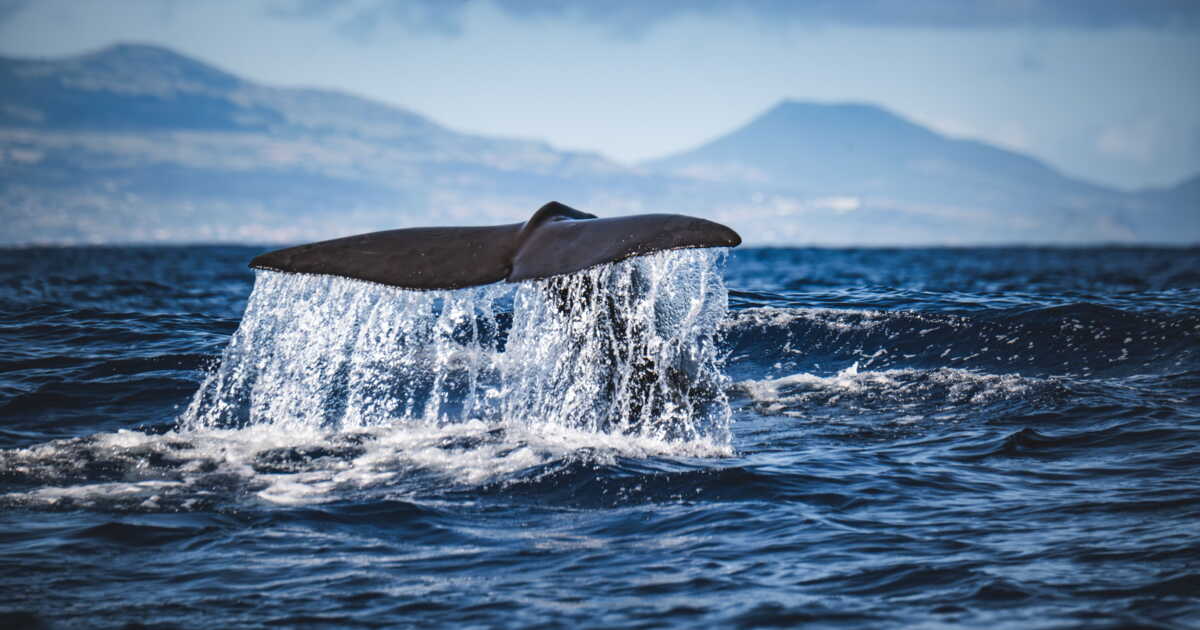
Will it dive? Will it not? The passengers of the floating Zodiac, engines off, on the deep blue of the Atlantic, about six miles offshore from Pico Island, hold their breath. Before them, about a hundred meters away, a imposing humpback whale surfaces to breathe. Its dark, gleaming back is barely visible, hinting at the 15-meter beast that lies beneath the water. Regularly, its breath shoots up about three meters high, in a geyser-like roar that blends with the murmur of the swell. “You can see its pale pectoral fins shining”, notes Jonas Rasim, a marine biologist, standing in a yellow slicker at the stern. The scene is hypnotic. But the animal has oxygenated enough, and should soon resume hunting in the depths. Suddenly it rears up, goes vertical, and treats its audience to the hoped-for greeting: in cinematic slow motion, its gigantic tail speckled with white emerges from the ocean, like the wings of a giant bird, before slowly sinking back toward the abyss. For the cetacean, a routine dive. For the humans witnessing its appearance, a vision of eternity.
In Pico, the Whale Highway
The skipper floors it. By noon, after an hour of riding glittering waves, the rigid-hull boat is back at the port of Lajes do Pico, a string of white houses nestled in a cove ringed by green slopes. On the port side, Pico, the volcano that gave its name to this Azorean island. Free of its morning clouds, it dominates the scene with its bare cone. Jonas Rasim steps ashore on the jetty and leads his group to the small stone-and-white-wood building that houses Espaço Talassa, the company that organizes these whale-watching excursions. During the morning, the chalk tally on a board at the entrance confirms that, in addition to the humpback, the crew also tracked boreal rorquals heading offshore, as well as a pod of about forty dolphins, some of whom performed a display of acrobatics. Not surprising. The waters around here teem with cetaceans, now at peace here after having been hunted for a long time.
“The Azores are one of the best spots in the world for watching whales, especially here, in the south of Pico”, boasts João Viallelle, seated on a bench in front of Espaço Talassa, eyes narrowed by the noon sun. At 22, the young man with curly hair runs the small company with his mother, founded in 1989 by his father. At the time, this activity, like tourism in general, was non-existent here. The potential, though, was obvious. Facing the open sea, the island’s southern coast sits at the mouth of a cetacean highway, where mammals migrate in spring between the Tropics, where they reproduce, and the Great North, where they spend the summer. These traveling mammals find here a stopover to rest during their Atlantic journey. The waters overflow with krill, small fish and meatier prey, such as squid, which also benefits sedentary species, notably the sperm whale. Result: of the 90 cetacean species on the planet, nearly a third can be observed here at some point during the year. And this without straying far from the coastline: off this volcanic archipelago, the ocean quickly reaches great depths. ““We are three observation companies in Lajes do Pico, plus two more in Madalena [the island’s small capital, 40 kilometers to the west],
From Harpoons to Binoculars
To start his business, João’s father could rely on another asset of Pico, a small island of 445 square kilometers populated by 14,000 souls: residents seasoned in handling marine mammals, knowing exactly how to cross their path. For here, cetaceans near the coast have long drawn interest. At the outset, the intentions were more hostile. A few leagues from Espaço Talassa, in old boat sheds facing the sea, one dives into the history of whaling, mainly for the sperm whale, which rhythmized for a century and a half the life on this rock lost in the Atlantic. In the main room of the Whalers Museum (Museu dos Baleeiros), a slender ten-meter-long boat stands on display. It is this kind of sail-and-oar craft that islanders used to approach the enormous marine mammals, harpoon them and finish them off with spears, like picadors of the seas. The giants were then hauled ashore and butchered, primarily to recover their fat, converted into oil used, for example, to light up towns. A practice introduced here by American whaling ships from the eighteenth century. Many of them hired Azorean sailors, some of whom later took up this lucrative activity themselves, which they could pursue in a artisanal fashion, off the coast of their village. These perilous contests, sometimes deadly for men, lasted here until the 1980s. Then, with Portugal’s entry into the European Union, the practice was banned. The very last sperm whale was killed off Pico in 1987.
“Whaling, however, was never the main activity here, explains Célia Alemão, who welcomes visitors to the museum that day. It was more of an extra. Those who practiced it had other jobs, in farming, livestock, or fishing, or all three at once.” After putting away their harpoons, some whalers turned to tuna fishing. And others turned to tourism. In particular the lookouts, the ‘vigias,’ those men tasked with a key mission: posted in towers overlooking the coast, they scanned the ocean in search of potential prey. Once an animal was spotted, they fired a flare to summon the villagers, who would then rush out in boats toward the beast…
For Money and Thrill
The use of vigias, now directing tourist Zodiac boats by radio, is a peculiarity of the Azores. They are a handful who operate along Pico’s coast, such as Renato Cardoso, 27 years old, a marine biologist employed by the CW Azores. He works near Madalena, atop a wooden watchtower, one of the few erected after the hunting era. At his feet, vineyards bordered by black stone walls slope gently toward the sea, where the neighboring islands of Faial and São Jorge line the horizon. “In summer, I stand there at 7 a.m., before the outings begin, says the young man wearing an orange cap. And I can stay all day, until the last boat returns.” With his eyes fixed on his binoculars, he scans the bluish-gray sea, watching for signs of the mammals, which he identifies by the shape of their breath or the glimpses of their bodies. He then assesses their distance and trajectory, guiding the skippers, making sure they do not approach too quickly or too closely… “I learned from my colleagues, some of whom were lookouts during the hunting era,” he says. “But it takes a lot of practice to be a good vigia…” For Renato, this old-school method is also a way to cultivate the heritage of the whalers, which still permeates the island.
The shift in direction, from hunter to spectator, does not erase respect for the past. At the eastern extreme, in the island’s most isolated area, a winding road snakes down to the small harbor of Calheta de Nesquim, whose church of dazzling white overlooks the ocean. In the square, a basalt-colored bust honors José Dias de Melo (1925-2008), a renowned writer born in the village, whose work celebrates the baleairos. Behind the small café for regulars, two men push open the door of a boat shed, revealing three gleaming boats: genuine hunter’s skiffs, renovated and still fitted, for some, with their gear. Almerindo Lemos, 82 years old, sturdy and with merry eyes, grabs a harpoon and raises it in a familiar gesture. From 1971 to 1981, he struck some 200 sperm whales in such fashion, only a few meters away, standing at the prow. For money, of course, but also for the thrill. “In a position like that, you couldn’t be afraid,” the former harpooner concedes, half pride, half nostalgia. By his side, Vitor Ferreira, half a century younger, has not witnessed the hunters’ era. But this sailing enthusiast, himself a nephew and grandson of a whaler, admires their slender boats driven by a huge sail. “To me, they are the most beautiful in the world, he confides. We still use them for regattas.” What do they represent to him, their bloody history? “When I think about it, my feelings are mixed, admits Vitor. The hunt was a bad thing, but people needed it to survive. So we respect those who practiced it.” Nearby, in the ocean, cetaceans, who care little for the past, take advantage of these blessed waters where they once risked their lives.
➤ Article appeared in GEO magazine no. 572, “The Azores, nine islands, nine worlds to explore”, October 2026.
➤ You like GEO? Then to miss nothing, discover our subscription plans to receive GEO at home every month with ease.