Among all the magical powers lent to the Brocéliande forest for centuries, one is very real and owes nothing to fairies or Merlin: its ability to conjure coolness. In this July 2026, as Brittany sweats through a heatwave, the miracle unfolds beneath the canopy, where oaks, beeches, and chestnut trees form a welcome UV shield.
At the Heart of the Val sans Retour
Brocéliande. Its mere mention conjures King Arthur and the Knights of the Round Table. In the 19th century, Breton Romantic scholars – such as Théodore de La Villemarqué or Félix Bellamy – placed the forest of storytellers within a tangible Armorican landscape, shaped by red schist and sunken valleys. About fifty kilometers west of Rennes, this 11,000-hectare domain appears on maps under the more prosaic name of the Forest of Paimpont. Two other sites contest the myth, but Paimpont has won the battle of the minds: armed with its dozen or so legendary places, the massif welcomes hundreds of thousands of visitors each year.
First stop, the most iconic: the Val sans Retour. At the entrance to this narrow gorge, the walk begins at the edge of the Fairy Mirror, a tranquil pond where vegetation is reflected in dark water. It is here, according to tradition, that Morgane imprisoned knights who were unfaithful in love. On the shore stands the Tree of Gold, a chestnut gilded by the sculptor François Davin after the great fire of 1990. Climbing onto the ridges, the path leads to the Rock of the False Lovers, then to Merlin’s Seat. From there, the view embraces the forest’s green ocean, before the loop (4 km) descends back toward Tréhorenteuc.
Saints and Fairies
Known as “the Grail Church,” the village church surprises at the façade, where a motto carved in sandstone warns the curious: “The door is inside.” Inside, the visitor steps into a remarkable setting, where stained glass windows and frescoes bring Morgane, the Knights of the Round Table, and Breton saints together. It is on this peculiar forecourt that Olivier Perpère, alias Ozégan, leads his groups. Beard and gray hair braided with beads, a look half-druid, half-privateer, he is soon to be 70 and the doyen of the storytelling guides. “When I started in 1985, he recalls, the people here did not imagine the treasure they had before their eyes.” Forty years later, there are about twenty licensed guides roaming the massif. And Brocéliande has become an economic windfall: shops overflow with souvenirs, terraces serve Lancelot or Morgane organic beers, and the shelves of bookstores brim with regional comics and crime novels.
Tomb Raiders
From Tréhorenteuc, a one-hour walk allows reaching the Hôtié de Viviane, a burial attributed to the fairy but, in reality, Neolithic (3355 to 2890 BC) and communal, then the Giant’s Tomb, an imposing red schist chest from the Bronze Age (2000 to 1500 BC). About ten kilometers further north, at the end of a short forest loop, emerges the Barenton fountain. It is at the edge of this basin, where intermittent bubbles of nitrogen occasionally bubble up—a water “boiling yet colder than marble”, Chrétien de Troyes described in the 12th century—that, according to tradition, Merlin fell hopelessly in love with the fairy Viviane.
Good to know
In Brittany, two other massifs contest Paimpont’s Arthurian heritage, each asserting its own claims. In Finistère, the forest of Huelgoat leans on its spectacular granite chaos: it hosts the Camp of Artus (an ancient Celtic oppidum) and the Artus Cave, where Merlin would have hidden a fabulous treasure. In the Côtes-d’Armor, the forest of Lorge (or Quintin) makes its case with toponymy – the hamlet of Bressilien recalling the medieval Brecheliant name – and the ruins of old feudal manors traditionally linked by legend to the lords of the tale. Although it had been considered the true Brocéliande since the 15th century, the forest of Lorge gradually lost that status to Paimpont.
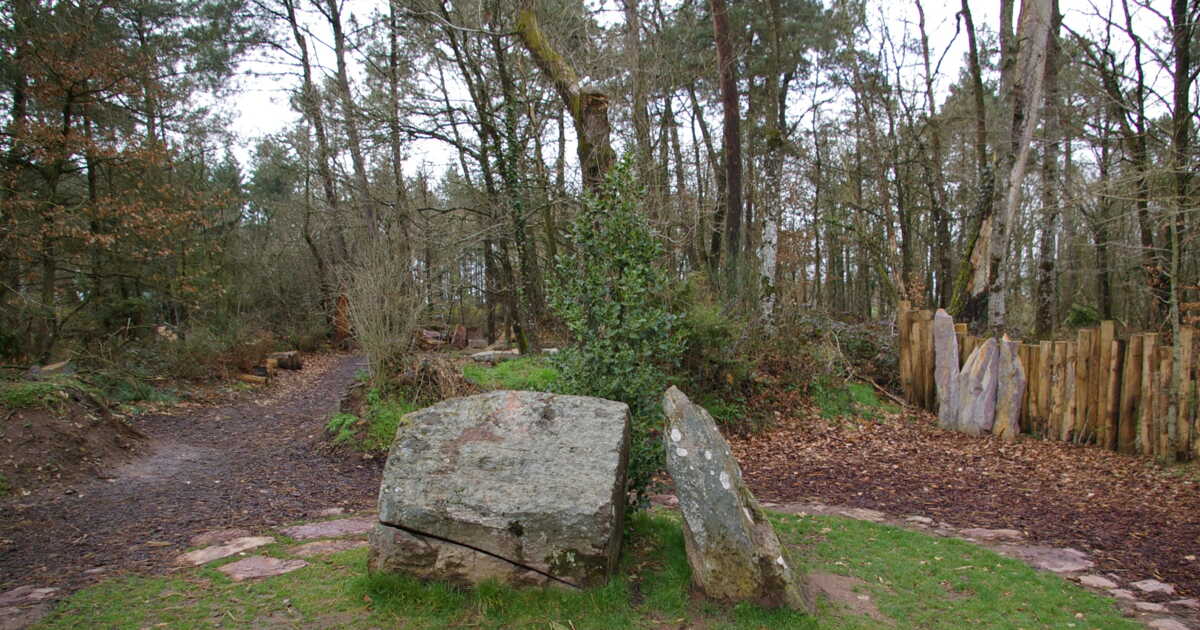
On the northern edge, the pilgrimage reaches its nerve center: Merlin’s tomb. Of the original monument, a third-millennium BCE passage grave, only a few slabs remain. The rest was dynamited at the end of the 19th century by tomb raiders. It is here, in an invisible prison created by the fairy Viviane, that the sorcerer would lie in wait. The site exudes a striking magnetism: visitors still lay flowers at the foot of the rock or slip little papers into the crevices of the stone, hoping for health or love to be granted.
When the Legend Rewrites the Past
This devotion brings a smile to Laurent Goolaerts, president of the Encyclopedia of Brocéliande, a collaborative website that shares online the massif’s historical and legendary memory. “19th-century scholars pasted Merlin’s name onto a neolithic site three thousand years older, he explains. But they had an excuse: at the time, archaeology was still in its infancy and dating methods did not exist.” It doesn’t matter: medieval literature itself was full of anachronisms, dressing 6th-century heroes as Crusader knights. Historical rigor has not killed the poetry of these places. “Stories are not only meant to lull children to sleep, but also to wake adults, summarizes the storyteller Ozégan beneath the great oaks. We all need magic.” In the forest of Paimpont, a few mossy stones and a fountain are enough to rediscover the child within.
Nearby
At 30 min: the Wolf Chamber Valley
nicknamed the “Breton Grand Canyon,” this classified site reveals a spectacular landscape of cliffs dropping into wooded gorges. A stunning setting, perfect for a water‑side hike or a picnic 25 kilometers from Tréhorenteuc.
At 20 min: the Paimpont forges
A witness to the region’s metallurgical past, this industrial village charms with its purple-stone architecture, its tall furnaces in schist, and its wooden footbridges. After the guided tour of the forges, a walk around the large pond promises a bucolic, refreshing pause.
At 15 min: a sublime sacred treasure
The Abbey Notre-Dame de Paimpont (13th century, rebuilt in the 17th) impresses with its Gothic architecture, its Baroque woodwork, and its serenity. Not to be missed in the sacristy is a 15th-century Virgin and Child, ivories, and the silver reliquary of Saint Judicaël (circa 590–658).
➤ Article published in GEO magazine no. 572, “The Azores, nine islands, nine worlds to explore,” October 2026.
➤ You like GEO? Then to make sure you don’t miss anything, discover our subscription plans to receive GEO every month at home with ease.