Ruben Ramos knows it: the coming days are going to be incredibly busy. On this May Friday, the bespectacled man in his thirties is bustling at the entrance of the Império do Cantinho, a small white-and-blue sanctuary topped with two cherubs, perched above the village of São Mateus da Calheta on the southern coast of Terceira. It is about seven in the evening and the sun is beginning to dip behind the Serra de Santa Bárbara, the island’s highest peak at 1,021 meters, whose broad summit is visible in the distance. The graphic designer has finished his week, yet, as is often the case for him for the past year, there is still plenty to do.
Ruben has been appointed mordomo, that is, the chief organizer, in his neighborhood for the 2026 edition of the Espírito Santo festivities (“Holy Spirit”). He takes this duty to heart: this tradition has been observed here for five centuries! The festival highlights will occur in about ten days, around Pentecost, with concerts and a fireworks display, and most notably a procession behind a silver crown. Before the indispensable bodo: the street-side distribution of bread, wine, and meat to the neighborhood residents… Only then will members of the local Holy Spirit confraternity name a new mordomo, and Ruben Ramos will finally be able to catch his breath.
Des fêtes importées par les premiers colons portugais
Ruben, whose parents, grandfathers and great-grandfathers were also mordomos, is not alone on the island in shouldering these preparations. At the same time, across this verdant oasis of 55,000 inhabitants, neighborhood or village groups led by a mordomo or a mordoma are busy preparing for the festas do Divino Espírito Santo. Brought here at the end of the 15th century by the first Portuguese settlers, these celebrations were initially religious in aim: to honor the “divine breath” that unites God the Father with His Son Jesus, and which, the Bible says, descends upon His disciples at Pentecost.
On the mainland, these celebrations, influenced by the medieval Calabrian monk Joachim of Fiore, who prophesied the advent of an era of spiritual freedom and universal love within an egalitarian society, were largely repressed and eradicated. But not in the Azores, where they even became a marker of identity. Especially on Terceira, where these traditions are lived with particular fervor. Perhaps because this island cultivates a sharp sense of festivity, one that unites its community.
The festivities begin on Easter Sunday, seven weeks before Pentecost, in the intimate circles of homes. In districts or villages, crowns made of silver metal, thought to embody the power of the Holy Spirit, circulate from house to house, changing hands every Sunday. Called imperadores (“emperors”), the people who have the honor of receiving these objects – one must apply, and sometimes participate in a lottery – display them on an altar set up in their living room. They invite family and friends to collective prayers, then share with them the função, a meal of typical dishes such as alcatra, beef simmered in a clay pot. While traveling the winding roads of this rural land with its volcanic Irish-like air, one easily spots the houses that harbor the precious diadem: they display, on the street side, a crimson flag adorned with a dove, fluttering atop a mast.
Des chapelles de poche ripolinées pour l’occasion
After these intimate observances, public celebrations begin to ramp up during the Pentecost and Trinity weekends. That is when the mordomos… and the impérios come into play. These charming little chapels, always punctured by a door and two windows – three openings to symbolize the Holy Trinity –, brightened by vivid colors, appear on every street corner of the island, which totals 72, or one for every 800 inhabitants! In Angra do Heroísmo, the “capital” of Terceira, there are around ten. Most were built in the 19th century, replacing temporary wooden structures.
Ruben Ramos’s own chapel, for example, bears the date 1860 on its pediment. On Sundays, crowds turn to these pocket chapels, often repainted for the occasion, where the crowns are carried in procession, then displayed and revered. And it is around them that the bodos take place, distributions of food shared equally among all neighbors – and even among passing tourists – regardless of their financial contribution to the festivities, which are largely funded through donations collected by the mordomos. A reminder of the deep meaning behind these celebrations, upheld by ideals of equality and sharing, where prayer can be offered without a priest and where the common people, symbolically, can be crowned.
“The festas do Espírito Santo are like a religion within a religion. I know many people who do not go to Mass, but who, on this occasion, pray, give money… These festas are a way for us to stay connected to our community and our history; they are part of who we are. Their power doesn’t come from above; it comes from the people here.”
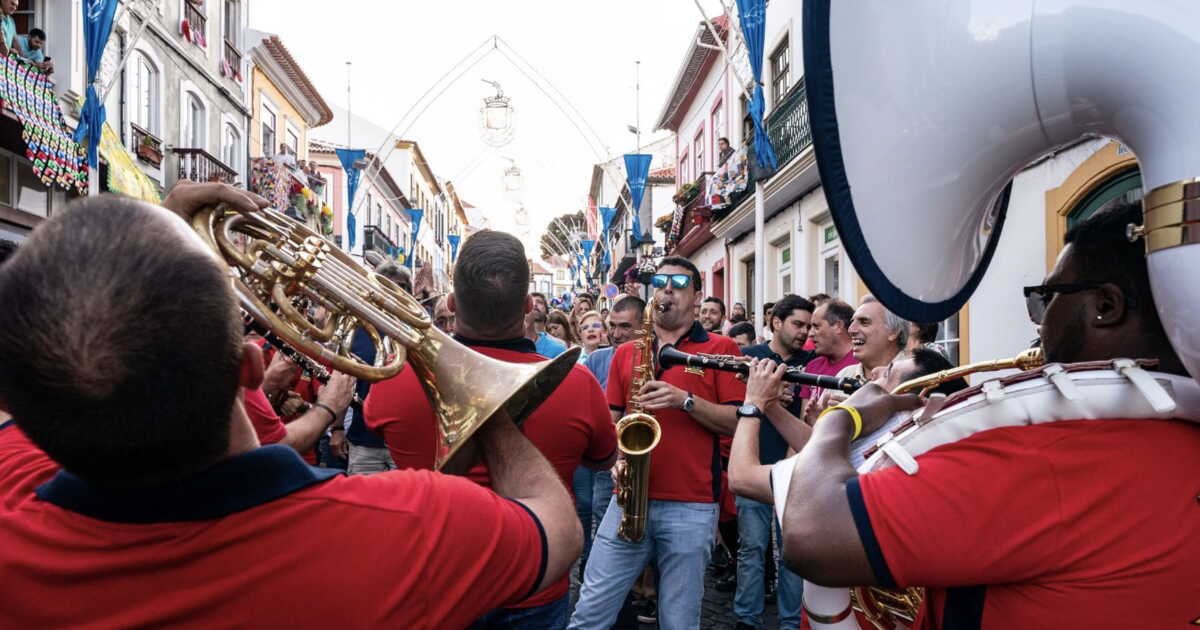
It is no surprise that these celebrations are, by a wide margin, the dearest to Terceira’s residents… who nevertheless have plenty of other occasions to revel. In Angra do Heroísmo, the festas do Divino Espírito Santo are far from over, and already municipal workers are installing lights on Rua Direita, the main cobbled artery that winds toward the sea: soon will begin the Sanjoaninas, the Feast of St. John, in June. Ten days and ten nights of performances and feasting, with brass bands, open-air concerts, tasquinhas (small stalls serving local dishes) and marcha populares (parades in traditional dress).
“Then, in July, you have the Biscoitos festival [a village on the north coast known for its wine], and in August, Praia da Vitória [the island’s second town],” explains Francisco Maduro Dias, 72, historian and former director of the Angra do Heroísmo museum. “You rest a little, and you begin again in September, when the villages take turns organizing their traditional celebrations, with processions and parades of vintage cars… It goes on non-stop until mid-October. On November 11, there are São Martinho festivities [marking the end of the harvest, with roasted chestnuts, filhoses (fried dough pastries) and jeropiga (grape must liqueur)]. And that’s when you must start getting ready for Christmas!”
Durant le carnaval, une orgie de théâtre populaire
At the start of the year, it is the carnival that occupies the islanders: it takes the form of an orgy of popular theater, where dozens of local troupes perform, for several days, satirical plays… before Easter, when the Spirit Santo takes over again. The celebrations are so unrelenting on Terceira that a saying goes that the Azores’ nine islands are really “eight islands and an amusement park.”
Why this love of feasting? “The first reason is that, to live in a place as isolated as this, you need to maintain a certain spirit of joy, liveliness, and activity,” says Francisco Maduro Dias. “The second is that Angra do Heroísmo was once the capital of the Azores [and briefly of Portugal, from 1580 to 1582 and from 1830 to 1833], a sort of miniature Lisbon where you copied its festivities. And the third is the economy: these celebrations require a lot of labor and resources. The island’s economy largely revolves around them!”
That is also true of bull running events, the toradas a corda, the islanders’ number-one passion. They take place at the slightest excuse, including during the Holy Spirit celebrations. In these fairs, whose origins trace back to a failed Spanish invasion in 1581, the animals are released for about twenty minutes in the middle of the street. The most daring spectators hurry to provoke them, while stout fellows in white shirts, the pastores (shepherds), control them with a rope tied around the animal’s neck. These races, funded by the ganaderias (breeding farms) that graze their stock in the moors that carpet the island’s center, occur roughly 200 times in 168 days, from May 1 to October 15!
In recent years, they have drawn more and more foreign visitors, to the point that a brochure has been published to explain the safety rules. The line of spectators most likely to misbehave used to be the GIs from the Lajes airbase near Terceira’s airport. “They came to the toradas, drank, and fancied themselves kings of the world,” jokes Mário Rosa from the tourist office. “Today, it seems their hierarchy prohibits them from participating, to avoid accidents.” Visitors, consider this a warning: feasting on Terceira is not a pastime for amateurs!
Things to See and Do
- Stroll through a magnificent city: From the 16th to the 19th century, Angra do Heroísmo was a key stopover for ships crossing the Atlantic. The architecture bears witness to this golden age. The former capital of the Azores is even considered one of the most beautiful cities in the lusophone world. It is an unparalleled pleasure to wander its checkerboard streets that run toward the ocean, lined with low houses boasting refined façades.
- Explore the island’s depths: In the island’s center, concealed in a thicket of heath, Algar do Carvão, the “coal chasm,” offers a unique experience: a guided descent on foot into a 90-meter-deep volcanic chimney carved by eruptions. As you go deeper, the lush vegetation gives way to an imposing cathedral of rock, streaked with extremely rare siliceous stalactites. montanheiros.com
➤ Article published in GEO magazine no. 572, “The Azores, Nine Islands, Nine Worlds to Explore”, October 2026.
➤ If you love GEO, then to ensure you don’t miss a thing, discover our subscription plans to receive GEO each month at home.