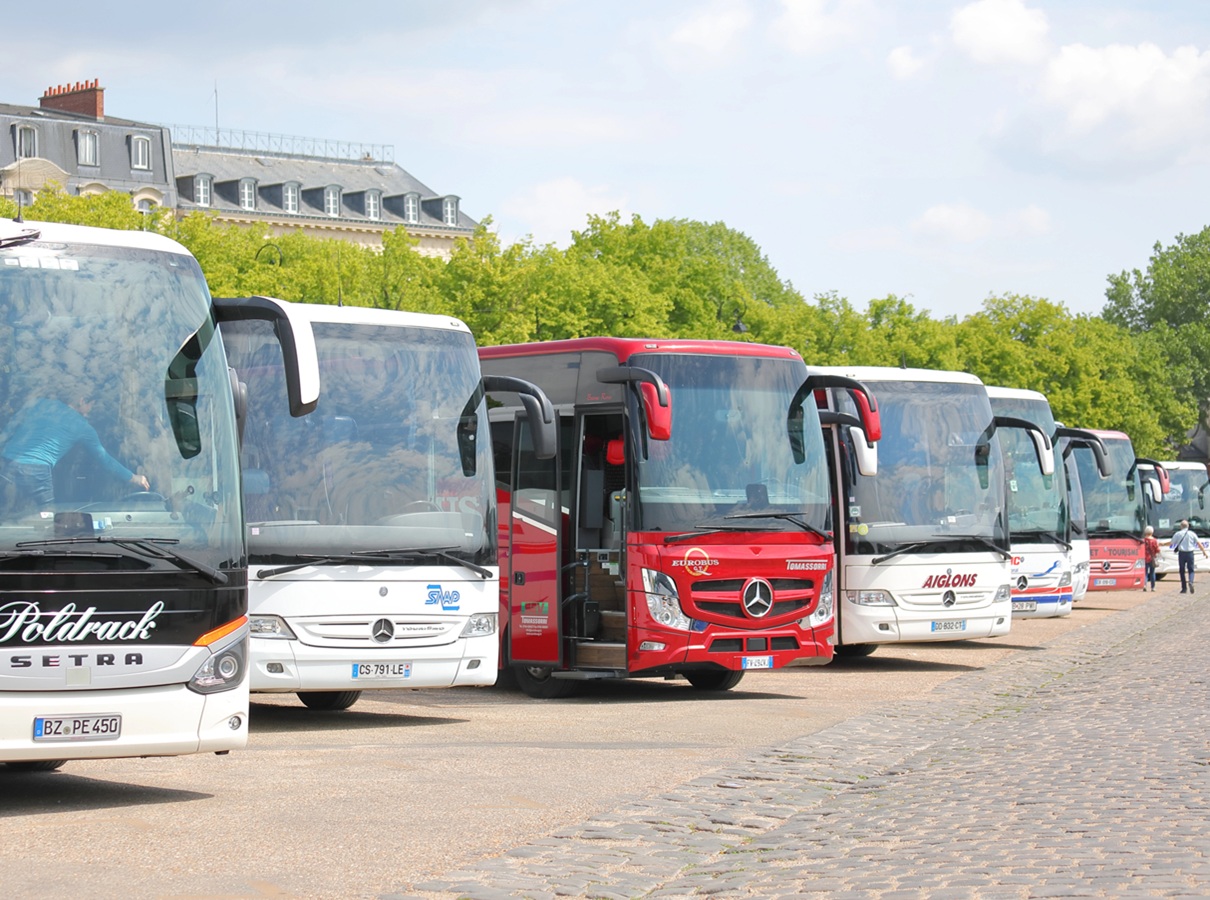


Cameras and grandiloquent statements are not really the habits of coach operators.
So, when Christophe and Arnaud Seyfritz decide to speak up to express their “anger” at a situation that has grown difficult, it is the entire profession that sounds the alarm. And, more broadly, an entire sector that must look at what is happening.
The two leaders of Voyages Seyfritz, based in eastern France, lament that, despite alerts from the entire ecosystem, the government’s responses are not enough. They feel they are not being heard.
Yet the situation already appears critical. “It’s very complicated. Because, in addition to rising costs tied to fuel, we are facing an economic activity that is slowing down, notably in tourism and casual services,” deplores Ingrid Mareschal, general delegate of the FNTV.
To this, there are increasingly many employees who say they can no longer fill their tank to come to work. As a result, sick leave is on the rise.
We are in a period where crises succeed one another. The fuel crisis is the crisis of the tipping point.
So, when Christophe and Arnaud Seyfritz decide to speak up to express their “anger” at a situation that has grown difficult, it is the entire profession that sounds the alarm. And, more broadly, an entire sector that must look at what is happening.
The two leaders of Voyages Seyfritz, based in eastern France, lament that, despite alerts from the entire ecosystem, the government’s responses are not enough. They feel they are not being heard.
Yet the situation already appears critical. “It’s very complicated. Because, in addition to rising costs tied to fuel, we are facing an economic activity that is slowing down, notably in tourism and casual services,” deplores Ingrid Mareschal, general delegate of the FNTV.
To this, there are increasingly many employees who say they can no longer fill their tank to come to work. As a result, sick leave is on the rise.
We are in a period where crises succeed one another. The fuel crisis is the crisis of the tipping point.
Autocaristes : “The situation is already critical”
 The tableau is so dark it could have inspired a Pierre Soulages painting.
“For some companies, the situation is already critical. They are suffering a lot. One company is currently under judicial liquidation. This is a conjunction of factors, continues Ingrid Mareschal.
In addition to the fuel crisis, there is the stoppage of BlaBlaBus and the Covid-era state-guaranteed loans (PGE) to repay.
Márgins have melted, cash flows too. What worries leaders is that at the start of the Iran war, they thought it would last three to six months at most. Except that we do not see the end.
Now that the crisis is prolonged, future prospects are closing and pessimism is significant in the sector. We have statements about activity prospects that fall notably between March and today“, she shares.
To read: Ingrid Mareschal (FNTV): “We feel economic difficulties approaching”
Faced with rising pump prices and inflation in general, but also a highly volatile political context, in France as abroad, the French tend to save in anticipation of difficult months.
This drop in household spending thus affects tourism, starting with coach operators. As in aviation, when oil soars, the impact on margins is immediate, since fuel represents the first expense item for these tourism players. It weighs around 20% of the cost structure.
And that is not the only problem keeping companies head above water.
Des autocaristes incapables d’augmenter leurs revenus
With costs skyrocketing, why don’t coach operators raise their prices?
Simply because, as we have seen in air travel and tourism, any fare increase leads to a drop in demand. But that’s not all.
“We are facing difficulties in passing on costs that are more significant than in goods transport.
We are either on DSPs (public service delegation) or on public markets, thus bound by a contract and the way it is indexed to fuel. Often we have renewal clauses every six months or every year to pass on cost increases, explains the FNTV head.
In tourism, if the coach operator was prudent and planned for this in the general terms of sale, he can update the invoice. Otherwise, it is difficult, especially for occasional activities with sports clubs, schools, etc. Moreover, there are many cancellations.
Inability, or almost, to raise their revenues, coach operators are trying to diversify, albeit poorly.
However, they no longer expect government solutions. So far, those proposed have not lived up to expectations or needs.
Simply because, as we have seen in air travel and tourism, any fare increase leads to a drop in demand. But that’s not all.
“We are facing difficulties in passing on costs that are more significant than in goods transport.
We are either on DSPs (public service delegation) or on public markets, thus bound by a contract and the way it is indexed to fuel. Often we have renewal clauses every six months or every year to pass on cost increases, explains the FNTV head.
In tourism, if the coach operator was prudent and planned for this in the general terms of sale, he can update the invoice. Otherwise, it is difficult, especially for occasional activities with sports clubs, schools, etc. Moreover, there are many cancellations.
Inability, or almost, to raise their revenues, coach operators are trying to diversify, albeit poorly.
However, they no longer expect government solutions. So far, those proposed have not lived up to expectations or needs.
“Des entreprises liquidées de la sorte, c’est du jamais vu”
“State aid is not tailored to our sector. They are more suitable for road transport. The eligibility criteria do not suit us.
We received 5,000 euros per company for April, then for May, then again for July and August. To benefit, the ratio between current profit before tax and turnover must not exceed 1%. Yet, for coach operators, this rate is closer to 4%.
In addition to not being able to benefit, our costs have risen astronomically. This amounts to several tens, even hundreds of thousands of euros per company.
Those 5,000 euros are a drop in the bucket, sighs Ingrid Mareschal.
To read: Because of kerosene, cascading cancellations and bankruptcies?
Would the eligibility criteria have been knowingly set to prevent broadening the beneficiary pool?
In any case, when the FNTV goes knocking at the door of Philippe Tabarot’s office, the Transport Minister, requests for broader aid clash with France’s budget deficit and thus with the government’s limited room for maneuver.
“The aid renewed for fishermen, after their protests, was granted at the expense of road transport operators, because they can pass on increases to their customers. We do not have the possibility to pass them on to the exact euro.
The state must allow us to pass on these increases“, demands the FNTV’s general delegate.
We received 5,000 euros per company for April, then for May, then again for July and August. To benefit, the ratio between current profit before tax and turnover must not exceed 1%. Yet, for coach operators, this rate is closer to 4%.
In addition to not being able to benefit, our costs have risen astronomically. This amounts to several tens, even hundreds of thousands of euros per company.
Those 5,000 euros are a drop in the bucket, sighs Ingrid Mareschal.
To read: Because of kerosene, cascading cancellations and bankruptcies?
Would the eligibility criteria have been knowingly set to prevent broadening the beneficiary pool?
In any case, when the FNTV goes knocking at the door of Philippe Tabarot’s office, the Transport Minister, requests for broader aid clash with France’s budget deficit and thus with the government’s limited room for maneuver.
“The aid renewed for fishermen, after their protests, was granted at the expense of road transport operators, because they can pass on increases to their customers. We do not have the possibility to pass them on to the exact euro.
The state must allow us to pass on these increases“, demands the FNTV’s general delegate.
Réaction du ministre des Transports :
 Published by Romain Pommier Journalist – TourMaG.com
 See all articles by Romain Pommier


Ajoutez TourMaG à votre flux Google Actualités