

For several years now, artificial intelligence has been gradually taking root in companies, especially with the rise of generative AIs.
At the opening of IFTM, Valérie Boned, president of Entreprises du Voyage (EDV), estimated that the sector was entering “a period of revolution with the acceleration of artificial intelligence.”
A few weeks later, at the EDV Grand Ouest regional convention, she also urged supporting agencies and framing the uses of AI.
The union is set to publish soon a guide enabling everyone to build their own AI charter, from supplier relationships to rules of use for employees. (See boxed.)
Transgallia: AI to cope with growth
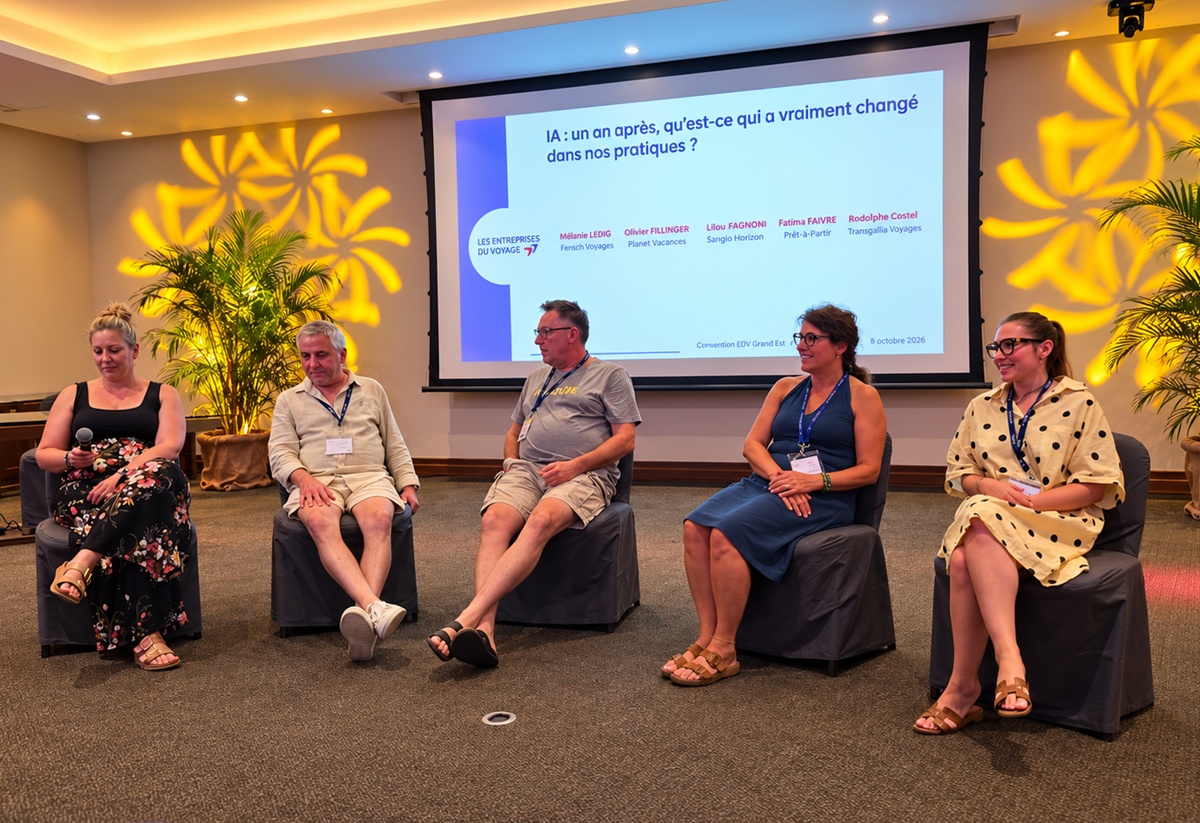
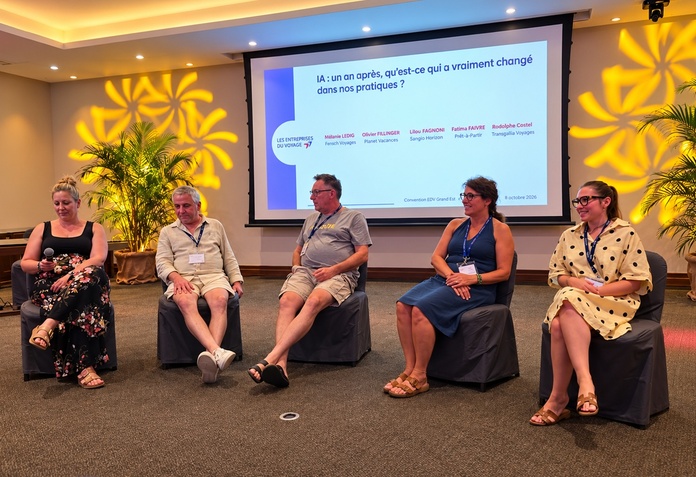
At the EDV Grand Est convention, which ran until October 8 at the Shandrani Beachcomber, in Mauritius, a round table dedicated to the topic identified the different strategies implemented by travel operators, as well as measured the gap between those already fully engaged in using this tool and those still in the observation phase.
AI has already integrated numerous internal processes at Transgallia. Rodolphe Costel, the commercial director and head of development of the company, details: “At first, I didn’t think I was particularly advanced in AI. But we had to face strong growth, without being able to recruit the people we needed. The only solution that emerged for us was AI: to relieve the teams of the most repetitive tasks to revalue human work,”
The only solution that stood out to us, therefore, is AI: to unload teams of repetitive tasks to revalue human work, by automating as many processes as possible.
“What I advocate is really training”
In his company, processes have thus been automated by linking various tools, notably the CRM, servers, email inboxes, and management tools.
“We gained 30% in productivity, but the aim is primarily to improve the quality of work. Repetitive tasks are handled by AI, which allows revaluing everyone’s work, gaining agility and, thanks to this tool, improving productivity while ultimately taking more pleasure in work” explains Rodolphe Costel.
Olivier Fillinger, head of Honua Voyages, very quickly explored the possibilities offered by AI. When he led Planète Vacances, a specialist in holiday camps, he had trained the different services according to their profiles: administrative, sales, web design, but also housekeeping staff and the chef.
“What I have advocated from the start, is really training, to be able to master the tools.” emphasizes him.
In this logic, he recently completed a new six-day training devoted notably to automation: “we have taken another step beyond what we had learned before.
My first message is therefore to work with capable people: this can save you a tremendous amount of time, perhaps even more than what you gain through AI.”
After testing, Chat GPT and Gemini, the Honua Voyages teams now work with Claude: “Until now, everyone had developed their own knowledge base according to their tasks. We have recently started to share these informations and connect our databases.
This now allows us to link common files to our different tools, whether for management, commerce and to share these informations more easily within the team.”
Olivier Fillinger has, for example, set up a monitoring system for calls for tenders for school trips: “AI makes it possible to automate the search for tenders and to greatly broaden the sourcing. A second pass can then be performed by AI, but the analysis of files and the decision to respond remain the human prerogative.
Today, we no longer need to go seeking them: the solution makes it possible to identify more of them and perhaps, in the end, to process more of them.”
“Let’s leave repetitive tasks to AI and keep the human touch!”
For Régis Heitzler, founder of Voyage de Rêve, artificial intelligence already represents a significant time saving in daily management, particularly for replying to emails and for translations.
Located near Germany, his agency must regularly communicate with a German-speaking clientele. He explains that a five-page travel diary can now be translated in seconds. “I think I save between 60 and 70% of the time spent on certain tasks. Of course, we must continue to verify the information produced by AI. Let the repetitive tasks to AI and keep the human contact!””
He has also set up an automation system for responses on WhatsApp: “I connected the messaging to AI to answer clients. We know that for 80% of questions asked during the trip, the answers are in their travel documents. I still validate every response.”
Prêt-à-Partir: a cautious approach to AI
At Prêt-à-Partir, the approach is more cautious. If the network already uses AI tools, the framework is deliberately controlled, notably to limit risks related to data transmitted.
“We are very careful with all data that can be given or transmitted to AI. So it is somewhat restrained, with notably an AI charter,” explains Fatima Faivre, regional director of Prêt-à-Partir. The use of these tools remains measured within the company, which currently prioritizes prudence and moderation over a broad deployment.
For its part, the network led by François Piot does not ignore this technology: “We use Copilot in a closed environment, and we are also working to make our site better referenced by generative AIs
We will return to a very content-rich storefront site, with the objective of allowing each agency to have content that is unique to them. That is the strategy.”
Focus on the AI charter guide that EDV will publish
The Enterprises du Voyage (EDV), through their digital commission, are preparing a guide to support the creation of an AI charter intended for travel operators.
Presented as a methodological tool rather than a turnkey charter, this document should help companies define their own AI usage rules, tailored to their activities, needs and identified risks.
The objective is to better regulate already widespread uses, including shadow AI, when employees use AI tools without official validation from their company. The guide will address several issues: legal compliance, data protection, cybersecurity, responsibility, transparency, explainability of decisions and environmental and social impacts.
The approach rests on five steps, starting with mapping existing and potential AI uses within the company, then classifying data and identifying suitable tools. It then foresees the definition of governance, the drafting of the charter and its validation by management, with legal support if necessary.
During a webinar on the subject, Grimaud Valat, partner at Cabinet DTMV, stressed the importance of training and informing teams, promoting transparency on AI use and maintaining human supervision, particularly in interactions with clients.
The charter should not remain a static document: it must be explained to employees, applied daily, and regularly updated to keep pace with evolving uses and tools. The guide, which will also include an example charter developed for a fictional agency, should be circulated in the coming days.