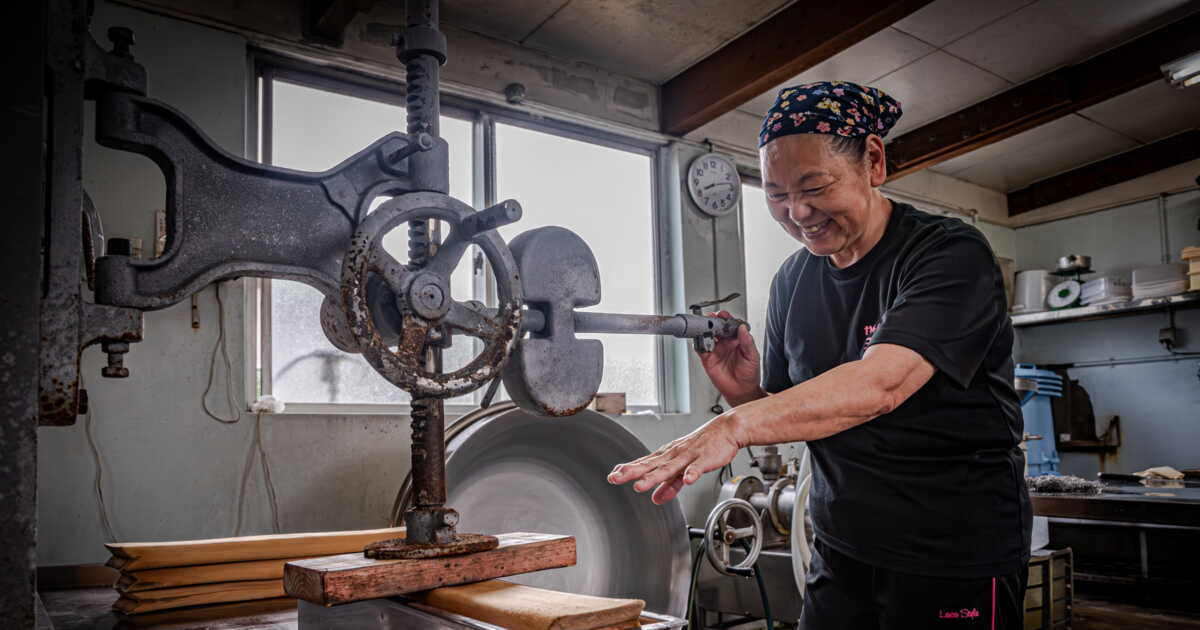
An elderly customer opens a small fridge, removes a block of shima-dōfu (“Okinawan tofu”) and places pieces into a box. No staff, no packaging, no checkout. Just trust. In this Kunigami shop, work began early. Etsuko Kinjō, 63, has been at it since 1:30 in the morning. She soaks the soybean seeds prepared the night before, rinses them and grinds them into a pale paste, then slowly heats the mixture while stirring. Then she presses the liquid to separate the soy milk from the pulp, adds seawater from Cape Hedo (north of Okinawa) as a natural coagulant. As the mixture begins to curdle, she transfers it into molds, pressing them gently to obtain a dense and uniform texture, ready to be sold hot.
The Last Guardians of Artisanal Tofu
Today, almost all family-owned shops like hers across Okinawa, the heart of daily exchanges, small conversations, familiar faces, are being supplanted by supermarkets selling standardized products. What is disappearing is not only fresh tofu, but the social bond that goes with it. She and her husband learned the trade from elderly people who had just closed their shops. The know-how has endured.
Maintaining the Operation
Etsuko lifts a block, still hot, from her mold. Her customers are locals. “Some come by car, sometimes by bike,” she says. “We almost know everyone.” She has no intention of expanding. “If I can keep the business going, that will be enough for me,” she says. Looking at Okinawa today, she senses a change: “Nowadays there are so many additives in food!” she notes. Her mother, 98, grew up differently. “She ate whatever was available—vegetables, tofu, fish…” The future of her shop? “I want to pass it on to my daughter or son and continue like this,” she says. Her small circle of regulars is enough to give meaning to her work—and to keep a disappearing craft alive.
Portraits
Isshin Urasoe, grower of brown algae and rarity
Emiko Kinjō, keeping an eye on her pots and everything else
Etsuko Kinjō, a hot batch of tofu, made that very morning
Takehisa Nakanishi, traditional miso… living and flavorful
Munehiro Machida, “Ojii”, master in his dojo and in his kitchen
➤ Article appeared in GEO magazine no. 572, “The Azores, nine islands, nine worlds to explore,” October 2026.
➤ Do you love GEO? Then to ensure you never miss an issue, discover our subscription options to receive GEO at home every month with ease.