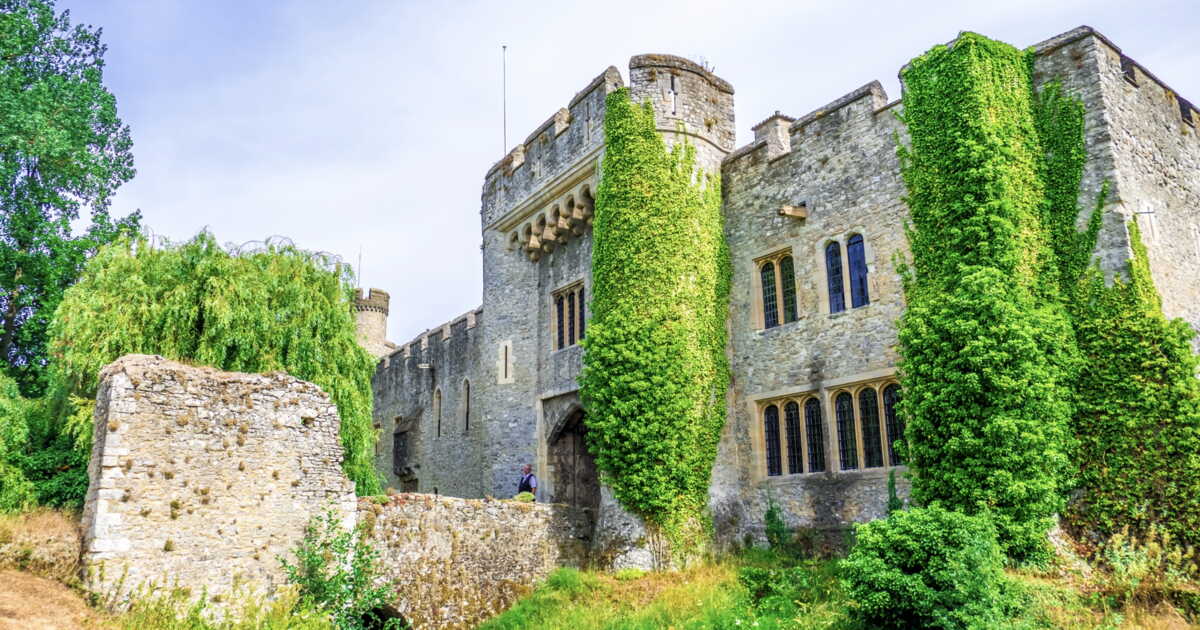
Want to buy a little piece of history? A medieval castle where King Henry VIII is said to have stayed with Anne Boleyn is up for sale in England for 5 million pounds, just under 6 million euros. Behind its moats and stone towers, Allington Castle has endured centuries of upheaval, from royal intrigues, rebellion, and abandonment. But what lies behind this Kentish historic residence, which has also served as a setting for cinema and television? Its story holds a few surprises.
Moats, Great Hall and the Ancient Tiltyard
The Knight Frank real estate agency is offering Allington Castle for sale at 5 million pounds, roughly 5.9 million euros. Set on a 17-hectare estate near the River Medway in Maidstone, the castle stands out for its towers, moats and inner courtyards. The property includes 30 bedrooms, a grand reception hall, cellars, an indoor pool, a tennis court, a greenhouse, and independent staff accommodations.
The grounds blend manicured gardens with wilder spaces. Ornament fountains and neatly kept parterres sit beside meadows where wild plants thrive and pollinator insects flourish. The estate also includes a historic dovecote, regarded as one of the oldest in England, as well as kestrels that nest in the towers. An orchard and a vegetable garden could also regain a productive function, with apple trees, pear trees, plum trees and hazelnuts.
Some features recall more directly the site’s past. The castle notably preserves a tiltyard, the space used for jousting, as well as an ancient bear-baiting arena. These facilities attest to the entertainments practiced on aristocratic estates, although their current presence does not alone allow dating their use precisely.
Listed as a Grade I historic monument in England, Allington Castle can host weddings and events for up to 150 people. It has also served as a backdrop for several audiovisual productions, including the historical comedy series Horrible Histories and the series The Avengers (in French “Chapeau melon et bottes de cuir”). But its interest goes far beyond its architecture and current uses. The estate is in fact closely tied to several figures in English history, notably King Henry VIII.
Henry VIII, Anne Boleyn and a Turbulent History
The castle is mentioned in the Domesday Book, an inventory of the lands and resources of the Kingdom of England carried out in 1086 at the request of William the Conqueror. Its architectural history is complex, the site having undergone several development phases before becoming the fortified residence of which some elements are still visible today.
In the early 16th century, Allington belonged to the Wyatt family. Sir Henry Wyatt undertakes work to transform the castle into a more comfortable residence. His son, Thomas Wyatt, born in 1503, becomes one of the prominent poets of the English Renaissance. He frequents the court of Henry VIII and is associated with Anne Boleyn, whose political ascent and marriage to the king shake the monarchy.
Henry VIII would himself have stayed at Allington Castle. According to Oli Streeter, a partner in the Southeast Rural Properties division of Knight Frank, the sovereign is said to have occupied the “royal chamber” during his visits. The castle is also linked to meals in which the king and Anne Boleyn are said to have participated.
The castle’s fate shifts in the 16th century. In 1554, Thomas Wyatt the Younger leads a rebellion against Mary Tudor, daughter of Henry VIII, notably to oppose her marriage to the Spanish prince Philip. After the uprising fails, the estate is confiscated. The castle gradually loses its status as a prestigious residence and falls into ruin.
It was not until 1905 that a new owner, art historian and explorer Sir Martin Conway, undertook its restoration with architect William Douglas Caröe. The work continued until 1929 and made the building habitable again. More recently, the castle was acquired by Sir Robert Worcester, a survey expert who died in 2025. Its sale now opens a new chapter for this dwelling, a witness to England’s transformations since the Middle Ages.