

Its 21 switchbacks thread through the Grandes Rousses massif, over 14 kilometers, with an average gradient of 8%, for a total elevation gain of more than 1,120 meters.
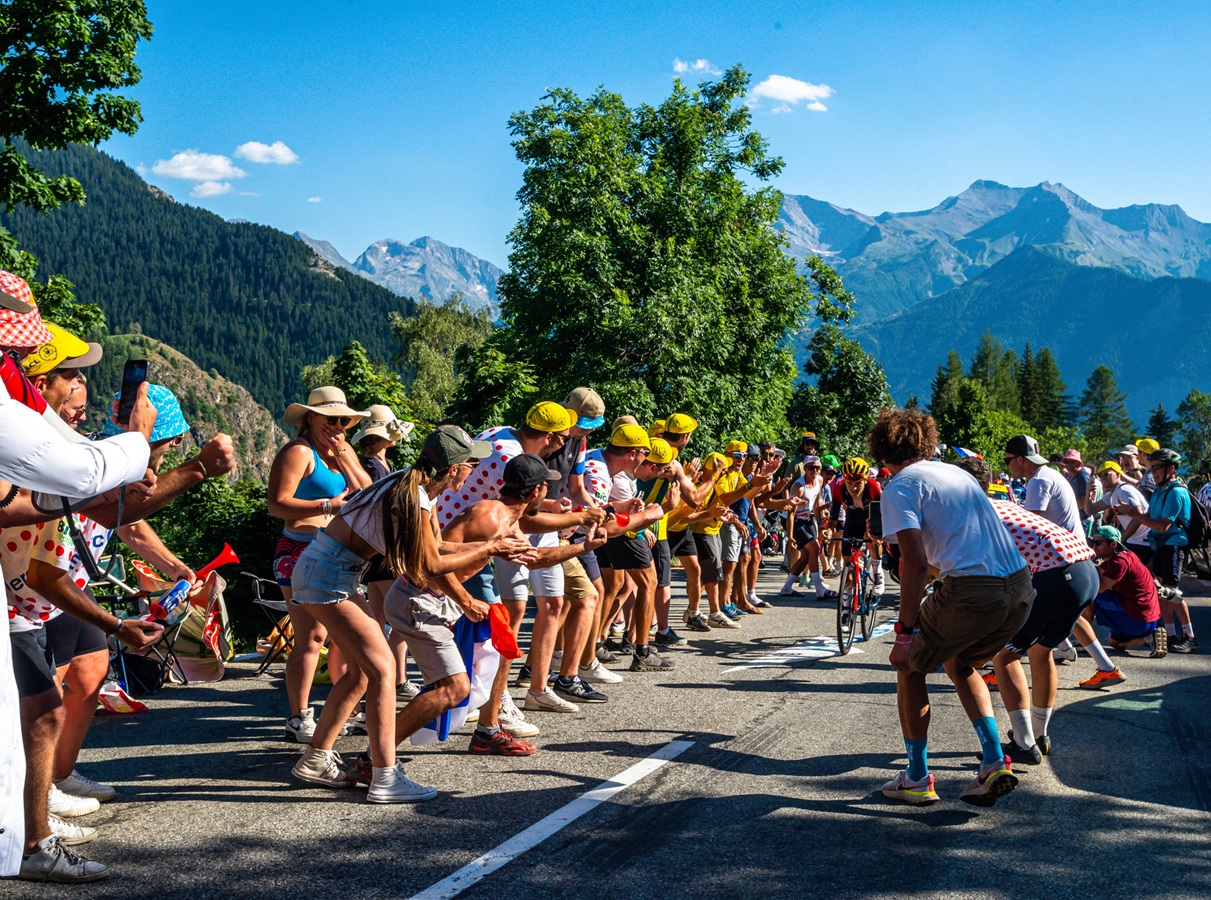
And it is in the frenzy of turn 7 of Alpe d’Huez, crowded by thousands of overexcited Dutch fans, battered by the heat of a stifling July and by the scent of hops, that a figure worthy of Paul Seixas with a few more years behind him sways and tries to forge a path, while asking the Dutch supporters to please… scan a QR code to answer his survey.
Here are the conditions under which part of Yannick Cabrol’s work was carried out as part of the study on the socio-economic impact of the 2026 Tour de France, commissioned by Isère Attractivité.
A question that might seem irrelevant, given how the event draws spectators and brings crowds to the roadside.
“I hopped on a bike and had a QR code banner printed. I paused at every bend and the Dutch came to scan my QR code to answer a short questionnaire about where they came from, the days they spent here, their expenditures, etc. It was an exceptional moment, especially since I climbed the Alpe d’Huez twice. For the community, the aim wasn’t to calculate a possible return on investment, but to determine whether public intervention is fiscally worthwhile and, above all, whether it generates a surplus of economic activity.
For the economy, it’s a tremendous success“, reveals the founder of SEGAT Impact.
Tour de France: 2% of overnight stays and 3% of expenditures in all of Isère!
Thus, nearly 600,000 people were expected in the 21 bends.
For the first time, the report provides somewhat more structured figures, as the Isère department invested 1.74 million euros for four stages and the cyclosportive organized by ASO, the organizer of the Tour.
“To obtain a precise figure, we scrutinized Flux Vision data. According to our calculations, starting from the Tour Stage and ending on the evening of the last stage, there were 450,000 additional visitor-days. We are talking here about the surplus compared to the average observed three weeks before and three weeks after the event.
As the race passages and the mythology surrounding this ascent grow, they have built the equivalent of a maxi Stade de France in the heart of the Alps, it’s incredible.
These 450,000 visitor-days translate into 290,000 additional overnight stays
“, details Yannick Cabrol.These five days under the Tour de France therefore accounted for 2% of annual overnight stays and 3% of expenditures (also annual) at the department level.
We are far from a few extra euros, especially since the very loud and festive Dutch supporters do not leave their favorite bend for a week and therefore do not sleep in hotels every night.
Yet, their presence is far from neutral for the local economy. “The impacts are huge for a sporting event, and this despite your observation about the Dutch visitors. Thousands, even tens of thousands of people sleep in their cars or in motorhomes. This turns the roadside into places of lodging.
And it should be noted that, summer or winter, there is no issue filling hotels in the Alpe d’Huez. The surge in spending is explained by a massive re-marketing of dormant beds, because people who own secondary residences imagine they can earn quite a lot of money when the Tour comes.
We also found that these visitors, contrary to what one might think, are people who spend a lot.“, announces the report’s author.
Source : SEGAT Impact, étude d’impact socio-économique et médiatique du Tour de France 2026 en Isère, pour le Département de l’Isère et Isère Attractivité (communiqué du 19 octobre 2026). Méthodologie DGE ; plus de 5 800 réponses à quatre enquêtes, données Flux Vision et dépenses transmises par les collectivités.
(1) Données communiquées à TourMaG.com par SEGAT Impact lors d’un entretien, octobre 2026.
Tour de France: “L’impact économique est comparable à la Coupe du monde de rugby”
By way of comparison, the Rugby World Cup 2023 had a 50 million euro impact for Marseille (six matches) and 29 million euros for Bordeaux (five matches).
However, the costs are quite different between the two events, especially since one happens every year.
“Overall, the Tour de France, in terms of consumer profile, length of stay, and number of spectators in surplus, represents an additional economic impact comparable to the Rugby World Cup.
But the audiences are not the same. 65% of rugby spectators are executives; 29% for foreign visitors at the Tour stages.
In the medium term, one could hypothesize that this first audience might come back, but it’s essential to distinguish between having the purchasing power to return and the reason for making another trip to France. No one measures this“, explains Yannick Cabrol.
If direct, pre-tax impact is assessed at 38.4 million euros, “public money from taxpayers generated a surplus of activity that almost exclusively benefits private actors, notably two-thirds to hoteliers and restaurant owners. It is an event that acts as an engine of economic activity, but it does not sustain itself.
Then there is a kind of preconception that Tour de France visitors do not spend, yet we have found that they spend more than the average visitor.
They spend a lot because accommodations are more expensive, and in dining, because they want to eat at French restaurants. There is a volume effect, but also a price effect
Tour de France: an event that draws in the… youth!
“I’m not convinced by the monetization method, which is advertising value equivalency, of media spillovers during any sporting event“, nuance. The consultant, however, affirms, “with 50% audience in France and significant shares abroad, due to the sporting stakes, it’s a fantastic three-week promotional film about France, broadcast nearly everywhere in the world.”
Then comes the question of how flows linked to the Tour’s visibility are distributed. I hypothesize that they likely concentrate in places where sport is practiced, then somewhat on heritage sites, says the analyst.
To read: Tour de France: we spent a day on the caravan!
If cycling can nourish in some people the image of a somewhat old-fashioned sport, that did not stop Netflix from dedicating a TDF series that refreshed its audience and broadened it beyond early fans.
And this is also one of the other surprises of the study: the average age of visitors.
“Typically, in Isère, 25-44 year-olds represent on average 35% of the visitor population. During the Tour, it rises to 47%. And if we only look at the foreign traveler population, 25-44 year-olds represent 53% of the roadside supporters. So truly, it’s an event where young people come in large numbers, and especially young foreigners.
It’s also the only opportunity for small and mid-sized towns to host a major international and free sporting event, continues Yannick Cabrol.
>
Wednesday 28 October 2026 – 11:34 Bouches-du-Rhône: CCIAMP strengthens its ties with Provence Tourisme
|
Tuesday 27 October 2026 – 11:04 MMV: 180 € offered to customers who join the Alps by night train
|