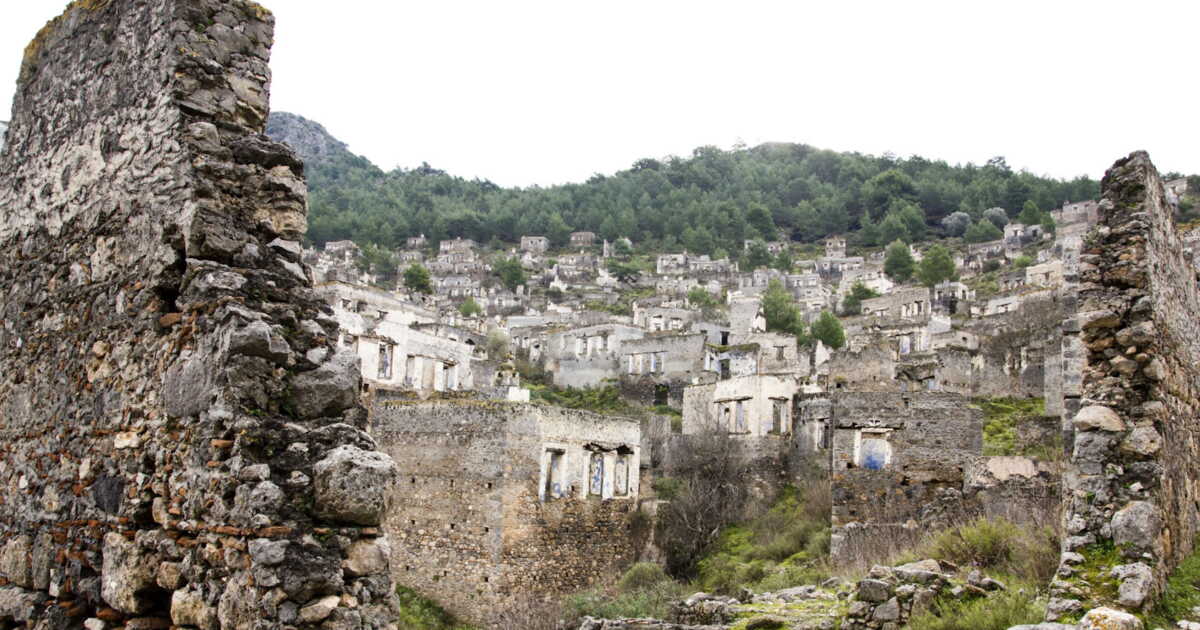
On the heights of the Aegean coast in Turkey, thousands of abandoned houses still outline the contours of an ancient town. The streets are there, the churches as well, along with the remains of a school and numerous dwellings. Yet, almost no one has lived there for more than 100 years. Behind this striking scene lies a painful history, tied to the upheavals that redrew the borders between Greece and Turkey at the beginning of the 20th century.
Kayaköy, a town emptied of its inhabitants after a population exchange
In Muğla Province, southwest Turkey, Kayaköy presents an unusual sight. On the slopes of a rugged valley, about 2,500 stone houses line narrow lanes. Many have lost their roofs, walls are crumbling, and vegetation gradually overtakes the area. Among these ruins stand several religious buildings, an old school, and a fountain.
To understand why this town is today almost entirely deserted, one must go back to the time when it bore the name Levissi. In the early 1920s, it housed at least 10,000 inhabitants, mainly Greek Orthodox Christians. Craftspeople for the most part, they lived notably from trade and shoemaking. The community maintained relatively peaceful relations with the Muslim Turkish farmers living in the surrounding area.
But the Greco-Turkish War, concluded in 1922, upends this balance. In the context of tensions between the two countries, Greece and Turkey organize a forced population exchange. The Greek Orthodox inhabitants of Kayaköy must thus leave their town to join Greece. In their place come Turkish Muslims from Kavala, a city located in the current Greek region of Central Macedonia and Thrace.
The change, however, does not take hold. Not attracted by its new surroundings, a large portion of the newcomers quickly leaves again. Kayaköy empties of its inhabitants and gradually falls into ruin.
Some Turkish families from Greece remain, however. This is notably the case for the grandparents of Aysun Ekiz, whose family now runs a small restaurant near the site’s entrance. She also sells handmade jewelry to visitors. The accounts passed down by her ancestors still testify to the brutality of this separation. “The Greeks cried because they did not want to leave, my grandparents told me,” she told CNN. Some even entrusted their children to Turkish friends, convinced they might return one day. They never did…
Churches, cisterns and abandoned houses to explore
Visiting Kayaköy allows visitors to discover tangible traces of this vanished life. The dwellings, built mostly in the century preceding the town’s abandonment, typically had two stories. They were also spaced to avoid depriving neighboring houses of natural light. Some still retain basements with pits once used for tanning hides, an activity linked to shoemaking. Others still house their cisterns, essential for storing water in the absence of a distribution network.
“Water for drinking was carried on the backs of donkeys,” recounts Aysun Ekiz to CNN. Residents also had to cope with rudimentary sanitary conditions. Lacking proper toilets, they used old scraps of cloth, which were burned as fuel or spread in the gardens to serve as fertilizer.
Time and the weather have finished weakening the structures. Jane Akatay, coauthor of the book A Guide to Kayaköy, spoke with CNN about the effects of earthquakes, storms, and heavy rains on the buildings. The mortar that once held the stones together has also degraded over the decades, accelerating collapses.
Today, visitors can freely wander the village streets after paying a three-euro entrance fee. Plan for about two hours to explore the different sectors, including the two churches. The most imposing one, called Upper Church, has walls of faded pink plaster and vaulted ceilings. Its state of disrepair, however, prevents entry.
From the hillside, the remains of the old school offer a panorama of the houses and the main church. On the other side of the valley, a steep path leads to a second church, smaller, perched atop a hill. Its architecture recalls the small religious buildings of the Greek islands, with a domed roof and window openings without glass.
From this hill, visitors can admire the Aegean Sea, its blue waters sparkling below, beyond the pine-covered hills. A landscape that contrasts with Kayaköy’s troubled history. For Yiğit Ulaş Öztimur, a visitor from Ankara interviewed by CNN, the village is indeed “a dark mirror of our past”. A phrase that aptly sums up what these empty houses still tell, more than a century after their inhabitants left.