Cities submerged by water, stone forests, whale fossils in the desert… UNESCO’s World Heritage sites are not limited to castles, temples, and grand historic monuments. Across the globe, certain designated sites tell astonishing stories and reveal landscapes that sometimes seem to have stepped from another world. Others bear witness to lifestyles that have since disappeared or to architectural feats that surprise. Here are ten places that deserve a detour, far from the usual heritage circuits.
Spectacular natural landscapes, stone forests, and whale fossils
Among the most unique places, the Socotra archipelago in Yemen harbors flora and fauna found nowhere else. This geographic isolation promoted the emergence of endemic species, including the famous Dragon’s Blood Tree of Socotra. This tree, with its distinctive silhouette, yields a red resin when its bark is cut, earning it the name Dragon’s Blood Tree. Between beaches, mountains, and limestone caves, the archipelago attracts nature and adventure enthusiasts. It remains difficult to access and lacks suitable tourist infrastructure.
In China, the Stone Forest of Shilin offers another singular spectacle. Formed about 270 million years ago, its limestone spires rise from the ground and evoke the trunks of a petrified forest. Some reach heights of 20 to 50 meters. UNESCO regards this landscape as a quintessential example of a stone forest.
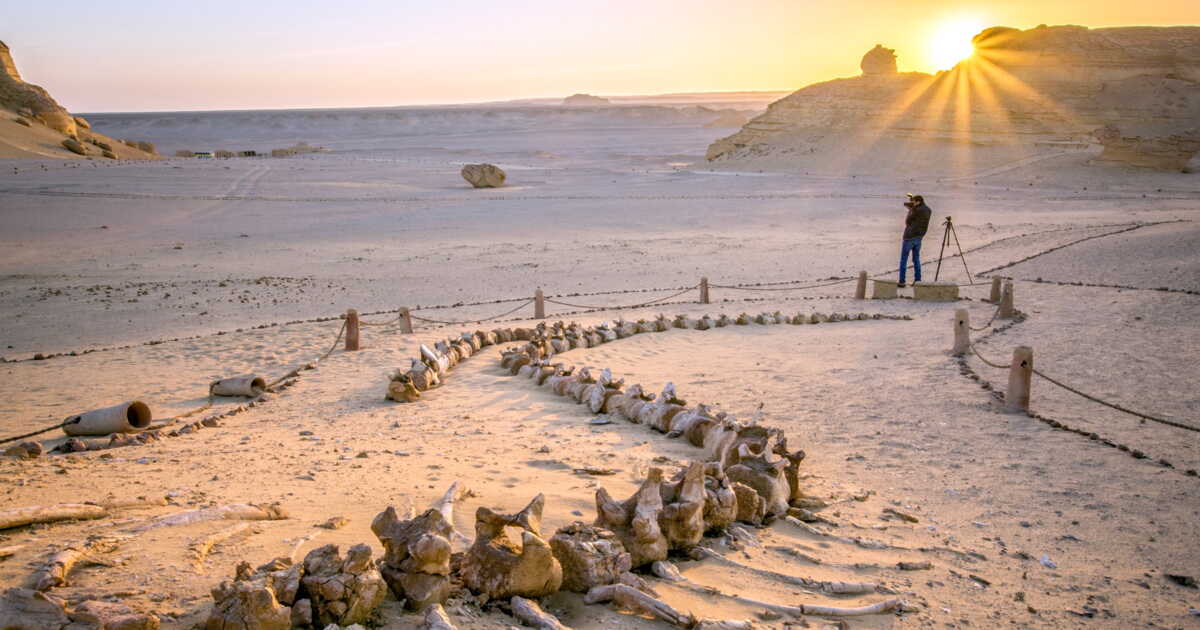
In Egypt, the Sahara Desert yields a discovery just as surprising. At Wadi Al-Hitan, nicknamed “the Valley of the Whales,” hundreds of fossils testify to the presence of an ancient ocean in this region about 50 million years ago. The remains belong notably to ancestors of modern whales and allow us to trace the evolution of these marine mammals, which once inhabited waters covering part of the Egyptian territory. Discovered starting in 1902, these relics are today displayed in an open-air museum about 150 kilometers southwest of Cairo.
In Turkey, Pamukkale attracts visitors with its white terraces that resemble cotton waterfalls. Located in Denizli Province, these limestone formations are fed by mineral-rich thermal waters. The natural pools have welcomed visitors since Roman times. At the top of the site lie the ruins of Hierapolis, an ancient spa city founded in 190 BCE.
Finally, in Namibia, the Namib Desert’s sea of sand offers a desert landscape shaped by fog drifting in from the ocean. Its dunes, among the most spectacular on the African continent, are fed by sediments carried thousands of kilometers by rivers, ocean currents, and wind. This particularly arid environment nevertheless hosts fauna adapted to extreme conditions, including invertebrates, reptiles, and mammals able to take advantage of the moisture from the fog.
Ancient cities, underground mines, and astonishing architectures
Ashore the island of Pohnpei, in the Federated States of Micronesia, the remains of Nan Madol give the impression of discovering a floating city. Built on a coral reef, this ancient city spans 92 artificial islets connected by tidal channels. Its construction, attributed to the Saudeleur Kingdom, began around 1100 and continued until 1628. Archaeologists estimate that its monumental buildings required about 750,000 tons of black rock. Its enigmatic architecture has fueled numerous comparisons with Atlantis and even inspired American writer H. P. Lovecraft for his short story “The Call of Cthulhu.”
In Canada, the Head-Smashed-In Buffalo Jump site recounts a hunting technique practiced for millennia by the Indigenous peoples of the Great Plains. The idea was to drive the bison toward a cliff so they would fall to their deaths. Hunters could then retrieve the carcasses at the base of the wall. The bone layers preserved on site testify to nearly 6,000 years of occupation and hunting practices. The site’s name comes from a legend of a man who supposedly tried to observe a hunt too closely and was crushed by the animals.
In Poland, heritage is also explored underground. The royal Wieliczka and Bochnia salt mines near Krakow testify to more than 700 years of exploitation. At Wieliczka, the galleries extend over nine levels and about 241 kilometers. Salt extraction ended in 1996, but visitors can still traverse part of this underground network, discover saline lakes, and admire the Saint Kinga Chapel, entirely integrated into the mine.
In Germany, two UNESCO-listed sites surprise with their appearance. The first gathers six groups of dwellings built in Berlin between 1910 and 1933. Far from palaces and traditional monuments, these buildings illustrate the beginnings of modernist architecture and the new ambitions of social housing. The architects notably experimented with flat roofs, innovative urban layouts, and amenities designed to improve residents’ living conditions.
The second is a factory. Built starting in 1910 by Walter Gropius, the Fagus Factory stands out for its large glass facades and its functional architecture. At a time when industrial buildings were typically dark and closed, the project emphasizes natural light and transparency. UNESCO considers the ensemble to have anticipated the architectural principles later developed by the Bauhaus School, the famous German school of architecture, design, and applied arts.