It is one of the most beautiful jewels of Australia. In the country’s north, Kakadu National Park unveils spectacular landscapes. Listed as a UNESCO World Heritage site, this vast expanse is also a remarkable sanctuary for Australian wildlife and a cornerstone of Aboriginal culture. From millennia-old rock paintings to the imposing saltwater crocodiles, discoveries abound in this extraordinary national park, as we observed during a report last June.
Encountering saltwater crocodiles, the masters of the rivers
Impossible to visit Kakadu without taking an interest in its most impressive inhabitants: the saltwater crocodiles. Familiarly known as “salties” in Australia, these reptiles belong to the species Crocodylus porosus. They are the largest and heaviest living reptiles on the planet. Adult males can exceed six meters in length and weigh more than a ton.
As apex predators among the most formidable on Earth, they possess an incredibly powerful jaw—capable of delivering a force of up to 3.5 tons, more than ten times the bite strength of a lion (roughly 300 kg). In the face of such an animal, a human would have virtually no chance if attacked. In the park, warning signs constantly remind visitors of safety rules: never approach the water’s edge. For even when the surface looks perfectly calm, a crocodile can be just a few meters away.
Moreover, despite what their name suggests, they do not live exclusively in saltwater. They are found not only in estuaries and mangroves but also in freshwater rivers, swamps, and billabongs. In Kakadu National Park, they occupy numerous waterways and wetlands. Their diet is varied: fish, turtles, birds, buffalo, dingoes, kangaroos, etc. To catch their prey, they often rely on the element of surprise, sometimes waiting for long periods beneath the surface before striking with blinding speed.
One of the most iconic places to observe them is Cahills Crossing. This submerged road crosses the East Alligator River and links to Arnhem Land, a vast Aboriginal territory located east of the park. Here, crocodiles gather to take advantage of fish drawn by currents and tidal movements. As the water gradually covers the roadway, the spectacle can become impressive: several dozen reptiles may wait near the crossing, watching fish attempt to cross the road. From viewing platforms set along the banks, it’s possible to watch them safely from a distance.
View this post on Instagram
Another essential experience to discover these reptiles: embark on the Yellow Water Billabong Cruise. This boat excursion sails through a vast network of wetlands, among water lilies, submerged trees, and water edges bordered by vegetation. The guides are well acquainted with their habits and help passengers spot the animals. The cruise is also a fantastic opportunity to observe the birds that populate the marshes, such as egrets, kingfishers, wild geese, and jabirus—these large Australian storks. Several departures are offered throughout the day, including at sunrise and sunset, delivering stunning light over the wetlands.
From towering waterfalls to vast swamps, a wild territory
With nearly 20,000 square kilometers, Kakadu is one of the largest national parks in Australia. And a drive through its roads is enough to understand why this land is so distinctive. The landscapes change constantly: vast floodplains and lily-covered swamps sit beside wooded savannas, lush tropical forests, and ochre-hued sandstone escarpments. In places, striking sandstone cliffs rise above the vegetation and dominate the scenery. These rock formations, among the oldest on the continent, testify to a geological history that stretches back billions of years.
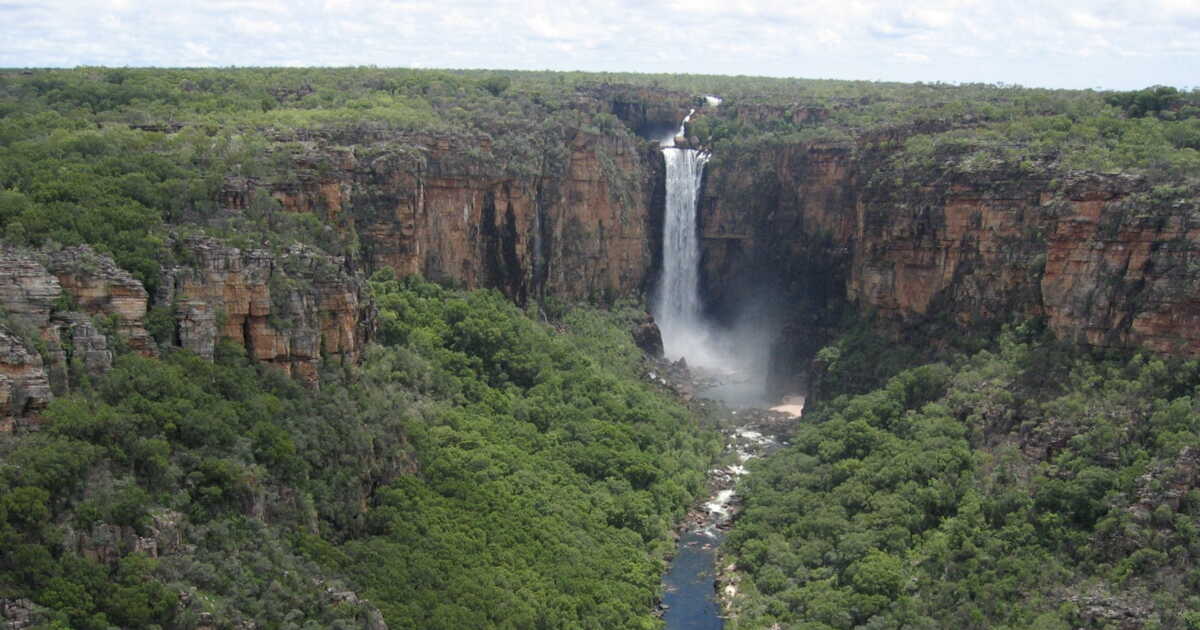
The park is also renowned for its spectacular waterfalls, notably Jim Jim Falls and Twin Falls. The former plunges roughly 200 meters from a towering sandstone cliff, while the latter splits into two cascades in a narrow gorge. And, as a bonus, it is possible to swim there when conditions permit. However, swimming is only allowed in certain areas and depends on safety conditions, notably the risk posed by saltwater crocodiles. Access may also be closed depending on the season.
This variety of habitats hosts a notably rich fauna. Kakadu is home to about 271 bird species, 77 mammal species, 132 reptile species, and more than 300 fish species. Bird lovers are particularly spoiled: yellow-crested cockatoos, black cockatoos with red tails, red-winged parrots, lorikeets, and rainbow bee-eaters provide a true explosion of color in the trees and above the plains. In the wetlands, jabirus, brolga cranes, herons, and magpie geese share the marshes; these can even gather by the thousands. On land, you may encounter wallabies, dingoes, bats, and monitor lizards. The park is also home to more discreet species, such as the Northern quoll, a small threatened carnivorous marsupial. Added to this wildlife are introduced animals, notably buffaloes and wild boars, which have deeply modified certain natural habitats.
Another notable feature of Kakadu is the emphasis on fire in landscape management. Rangers and traditional Aboriginal landowners carry out controlled, purposeful burns to limit the buildup of grasses and dry vegetation, especially after several months without rain. Inspired by ancestral know-how, this technique helps reduce the risk of large, unmanageable fires while promoting the renewal of certain natural habitats.
An exceptional Aboriginal heritage, between rock paintings and living traditions
Kakadu is not only a natural sanctuary. It is also a land inhabited by Aboriginal peoples for tens of thousands of years. The Bininj in the northern part of the park and the Mungguy in the south maintain a deep link with these lands, their animals, their plants, and their landscapes. For these communities, the territory is inseparable from their identity, beliefs, and traditions.
The lands of the park remain largely owned by their traditional owners. Kakadu operates under a co-management system that brings together Aboriginal communities and Australian authorities, via Parks Australia. The traditional owners participate in decisions regarding the territory’s management, preservation, and visitor reception. This arrangement helps keep ancestral knowledge alive while protecting an exceptional natural and cultural heritage.
One of the most fascinating testimonies of this history is rock art. Kakadu contains thousands of painting sites, some dating back thousands of years. These depictions recount daily life, hunting practices, the animals surrounding them, and their beliefs. Some paintings adopt, for example, a so-called “X-ray” style, where animals are depicted with their internal organs, as if their anatomy were visible through their bodies.
Among the most famous sites are Ubirr and Burrungkuy, also known as Nourlangie. Both allow visitors to discover galleries of rock paintings remarkably well preserved. The depictions testify to the evolution of lifestyles, but also to the importance of spiritual narratives and ancestral figures in the local culture.
To fully enjoy Kakadu and understand all the features of this territory, we were accompanied by a guide, Jack Tanner, from Cyaround Australia Tours.
Among the engaging activities to deepen this cultural discovery: the Guluyambi Cultural Cruise. This cruise on the East Alligator River is led by an Aboriginal guide who shares with visitors the traditions and knowledge of his community. Throughout the voyage, he speaks of mythology, the relationships between people and animals, as well as the traditional uses of plants. He also explains how the inhabitants used natural resources to feed themselves, hunt, and travel, and what know-how enabled survival in the Australian bush. A practical way to understand the close bond that still unites Aboriginal communities with their land.