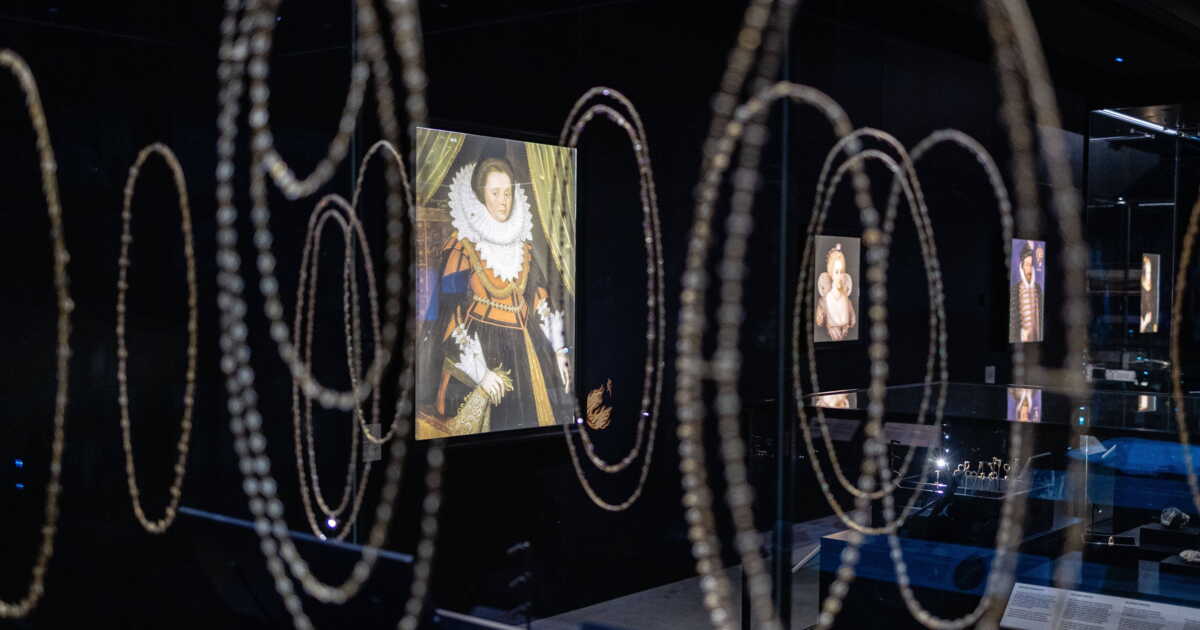
Until 2022, the collections were displayed nearby, in a run-down 1970s-era site in the same City district in central London. From Saturday, the public will be able to rediscover them, supplemented by recent acquisitions and installed in a section of Smithfield Market. Visitors are welcomed into a vast space with brick walls and white-painted iron columns topped by a glass skylight.
Recent history makes an appearance through a bicycle courier’s uniform, Indian prepared dishes, and a horse-drawn caravan café that delighted residents of east London from 1919 to 2019. An installation commemorates Grenfell Tower, a west London residential block ravaged by a fire that claimed 72 lives in 2017.
Shop signs hang on the walls, coming from businesses such as Topshop, the fashion retailer whose Oxford Street store closed in 2021.
Even more spectacular is the Lord Mayor’s gilded carriage, used for an annual parade in the City.
“When they proposed these buildings to us in 2015, we thought they would be the ideal venue for hosting the collection,” comments Alec Shaw, the museum director who oversaw the move, highlighting “the incredible architecture” of the venue. The building had been vacant since the 1990s and “there were leaks everywhere”, he adds. Restoring the skylight alone took about three years.
“Same fears, same hopes”
The last major food market in central London, Smithfield Market is gradually closing, and the remaining traders are due to depart in the coming years. The museum pays homage to the building’s history with archival photographs of hanging carcasses.
The main section of this London Museum, free to enter, is located underground, in a former railway depot. A window gives visitors a view of trains passing on nearby tracks.
The 5,000 pieces on display are arranged in chronological order, up to the 2012 Olympic Games. Visitors can notably immerse themselves in the world of London goldsmiths from the 16th and 17th centuries, with hammering and clinking sound effects and a treasure trove of more than 500 jewelry pieces from the era.
Queen Victoria’s black silk mourning dress is shown on a mannequin. The world of finance that defines the City is also represented, with a bowler hat and a Nokia mobile phone, as well as a banker’s Armani suit and an Hermès scarf from the 2000s.
On the performance side, photographs of Boy George and David Bowie sit beside the feathered costume of the Russian ballerina Anna Pavlova in The Dying Swan. “When you look through history, you see that all humans resemble one another a little, even if they lived 2,000 years ago in Londinium,” says the museum director, Sharon Ament.
“They had the same fears, the same hopes, the same dreams, the same concerns as we do today, and that creates a strong bond between us,” she adds.