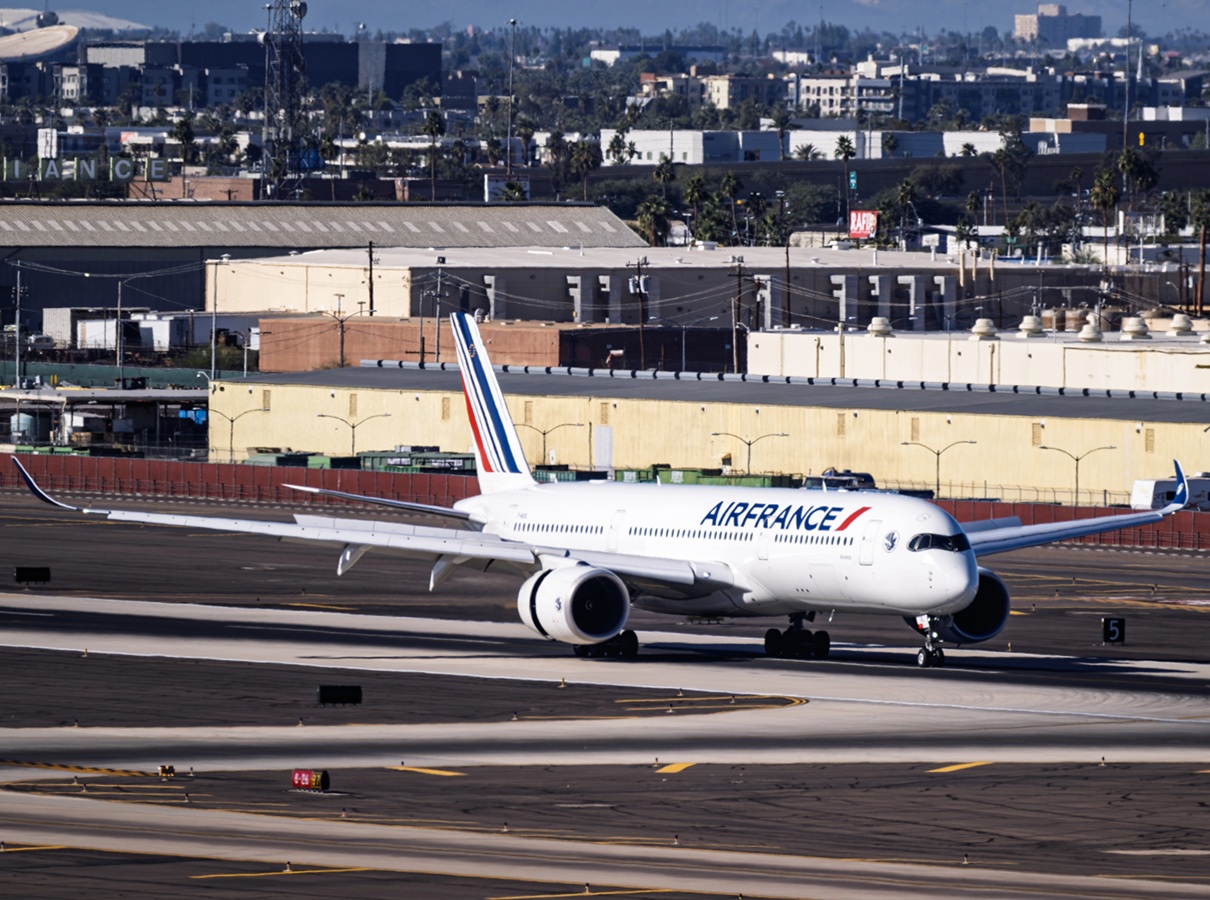


In September 2024, Air France proudly announces the launch of a new route.
Heading to the Philippines and more specifically Manila, located around 15 hours and 10 minutes of average flight time from Paris, due to the prohibition on overflights of Russia. An extension of the flight time that erodes the profitability of the route and the productivity of the crew aboard the A350-900.
To address this, starting in October 2025, an amendment to the PNC collective agreement covering the 2023-2028 period is signed between management and the unions.
Because this document, valid until 2028, does not permit scheduling flights longer than 15 hours, with the exception of flights to China, Korea and Japan, whose flight time is increased by avoiding Russian airspace.
The document allowed the Manila service to be treated separately from other flights of similar duration, notably toward the farthest Asian destinations from Paris, in terms of rest time and rotation frequency.
An exceptional provision that presumably improves the route’s profitability, while its frequency remains at only three weekly flights. The city had previously been served from Europe only by KLM, according to Presse Agence.
This exemption ran until March 31, 2026. Air France was able to temporarily extend the route via a derogatory agreement, as explained by management. The route was ultimately suspended between May and October 2026.
Its return was announced for October 19, 2026, but it did not reappear in the network for the winter 2026-2027.
Air France: what happened to the Paris-Manila route?
 Typically, for a journey lasting between 15 hours 01 minutes and 16 hours 30 minutes, cabin crew enjoy an on-site rest time of 60 hours, including three full nights.
The amendment ratified in October 2025 primarily aimed to tighten crew rotation schedules. These rotations were to occur over five consecutive days, compared with seven or eight for this type of route, as is the case for Japan or China.
Thus, layover rest was mechanically reduced, which helped improve the route’s economic performance. However, this amendment ended on March 31, 2026.
An exceptional measure must remain exceptional for Air France PNC unions, who fear that the exception could gradually become the rule. By the end of August 2026, unions were summoned to address the Paris-Manila issue.
According to UNAC, which was the only signatory among the five representative unions to oppose the initial amendment, management argues that the “profitability of this route was fragile and its renewal was by no means assured“, especially without renewing the amendment to the collective agreement.
The organization notes that the text is presented hastily.
UNSA PNC, on its side, states that management has simply re-proposed the same agreement, thus planning to reduce layover rest to 48 hours.
A practice reserved for routes with durations between 13 hours 01 and 15 hours, which would have been the case before the war triggered by Russia’s invasion of Ukraine.
The unions must thus reconsider the agreement, intended to come into effect in… “only 10 days“, continues UNSA. The review period is therefore very short. UNAC talks about only a few days, while SNGAF claims it had only 24 hours to give its consent.
Comment from Air France management :
“Air France confirms that it will cease in the coming weeks its link to Manila. This suspension follows the non-signature of a derogation agreement allowing this route, with return flights exceeding 15 hours of flight.
Customers with a booking will be reimbursed or transferred to flights operated by other carriers. Air France regrets this situation.”
Customers with a booking will be reimbursed or transferred to flights operated by other carriers. Air France regrets this situation.”
Air France: why did the unions not vote in favor of the amendment for the Manila route?
Collectively, with the exception of UNPNC-CFDT, all unions oppose renewing the agreement.
The Manila route will not resume and disappears from Air France’s network for the winter 2026-2027, which greatly jeopardizes any later revival of the link.
The very short reflection period is not the only reason for the unions’ disapproval.
UNSA recalls that the PNC are faced for the second time with a “request for an amendment to operate an unregulated route. This is requested until the end of the current agreement (2028), thus cumulatively deviating from almost half of our agreement’s duration“.
The four non-signatory organizations denounce an exception that risks becoming the norm. They question why an exemption should be granted to Manila and not to other routes.
They also question management’s strategy, when the profitability of a route depends solely on reducing the PNC layover time. Indeed, UNAC notes that every minute does not seem to be of equal value.
Thus, for a few minutes of flight time, sometimes less than five, any improvement would be refused by management, which points to the timetable provided by the collective agreement. Conversely, the 10 minutes beyond 15 hours on Manila would justify an exemption.
For the unions, flexibility would therefore always be demanded only of the PNC crews.
Proposals were indeed offered concerning layover times, the construction of rotations, and a revision of the overall approach to ultra-long-haul flights, so that efforts on certain routes could be offset on others. But management has swept away all proposals with a wave of the hand.