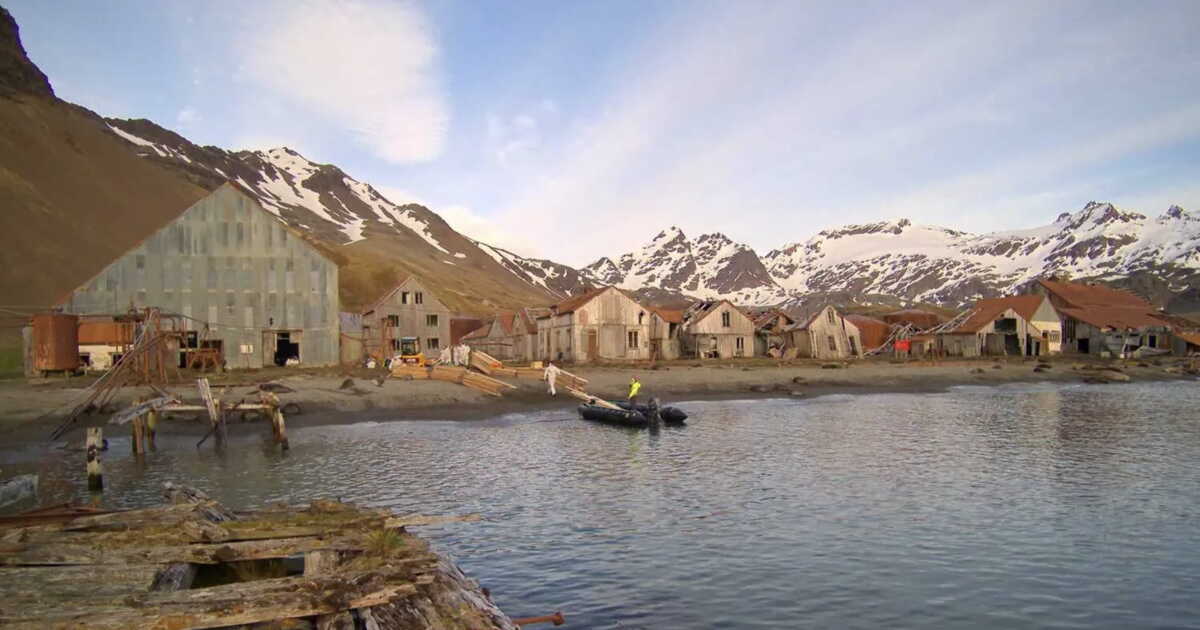
The Antarctic town of Stromness, on South Georgia, is coming back to life. Left abandoned for nearly 65 years, this former whaling station had only seals and seabirds for inhabitants. If it regains its glow today, it is thanks to the mobilization of around a dozen people, determined to save the building that was once the home of Ernest Shackleton, one of the greatest explorers of the Antarctic of his era.
In 1915, the adventurer and his crew were wrecked near a rocky islet called Elephant Island. Yet the nearest help was almost 1,300 kilometers away, at Stromness. He boarded a lifeboat with his companions Frank Worsley and Tom Crean, in the hope of reaching this whaling station. Not without difficulty, they managed to reach the destination safe and sound. “Frostbitten, but with light and joyful hearts, we set out toward the whaling station, which was now only a kilometer and a half away. The difficulties of the voyage were behind us”, the explorer notably wrote in his autobiography titled South.
Il s’était ensuite installé sur l’île, posant ses valises dans cette fameuse villa, laissée à l’abandon depuis le départ de l’explorateur et today undergoing restoration by the South Georgia Heritage Trust, a non-profit association dedicated to preserving historical heritage.
Ernest Shackleton’s Villa Was in a Dilapidated State
“The only thing we could really say was that it was still standing”, a tout d’abord déclaré Dickie Hall, qui a dirigé le projet de restauration, à propos de la villa. Il a ensuite poursuivi : “When we opened the front door, where there used to be a floor and a living room, everything was rotten and had collapsed into the basement.” After removing the century-old, dilapidated bricks and rotted timber, the team set about reconstructing the structure from the foundations. Weeks of work thus allowed the villa to be reshaped, while uncovering precious fragments of its history.
“Au fur et à mesure qu’ils retiraient les différentes couches, on découvrait de plus en plus les personnes qui étaient là”, a confié Helen Balfour, conservatrice adjointe au South Georgia Museum, au New York Times. Chaque objet retrouvé dans les décombres a été mis de côté et analysé par le personnel du musée. L’équipe de construction a notamment découvert des rouleaux de linoléum neufs et des matériaux de construction supplémentaires datant de l’édification de la villa.
Dans une partie scellée du grenier, elle a également mis au jour un chapeau de feutre et un bâton de ski artisanal. Enfin, de la crème capillaire, du dentifrice et des lames de rasoir ont été retrouvés dans un tiroir d’une salle de bains à l’étage, d’ailleurs mentionnée dans l’autobiographie d’Ernest Shackleton.
Mais mener à bien ces travaux n’a pas été une mince affaire, puisque le seul moyen d’accéder à la Géorgie du Sud est le bateau. L’équipe de restauration a donc chargé un porte-conteneurs de tout le matériel nécessaire au projet : portes et fenêtres d’époque, nouveaux planchers et même une mini-pelle. Les fournitures, provenant de Norvège et du Royaume-Uni, ont ensuite été acheminées via l’Amérique du Sud jusqu’au seul port de Géorgie du Sud. De là, l’équipe a dû transporter l’ensemble du matériel à travers l’île, qui s’étend sur 3765 km², jusqu’au chantier de Stromness.
A Virtual Model Allows Visiting the Villa
Those who participated in restoring the villa will, unfortunately, be the only ones able to see it with their own eyes. You may wonder why? Simply because it sits in a restricted-access zone due to asbestos. On top of that, its remote location and the difficulties of getting there—weather conditions can make the journey particularly taxing. But fear not for South Georgia enthusiasts! They will now be able to explore a digital model of the building.
Once the villa was stabilized and the final touches completed, a new team arrived on site to photograph every square centimeter of the building. Thousands of photographs were taken, then integrated into a model created thanks to laser scanning. A particularly laborious process, which also required dealing with the local wildlife. “You also have to deal with the wildlife, because there are seals roaming about, and they are always very curious and bitey”, said Art Lewry, who created the model.
This virtual version also lets you discover the villa as it was 110 years ago. To do this, antique objects from museum collections were photographed and digitized. The reconstruction is thus rich with details of what Ernest Shackleton, Worsley and Crean would have found upon their arrival, from tobacco boxes to coffee service. “Thanks to initiatives like this, we can take more people there virtually”, concluded Art Lewry.