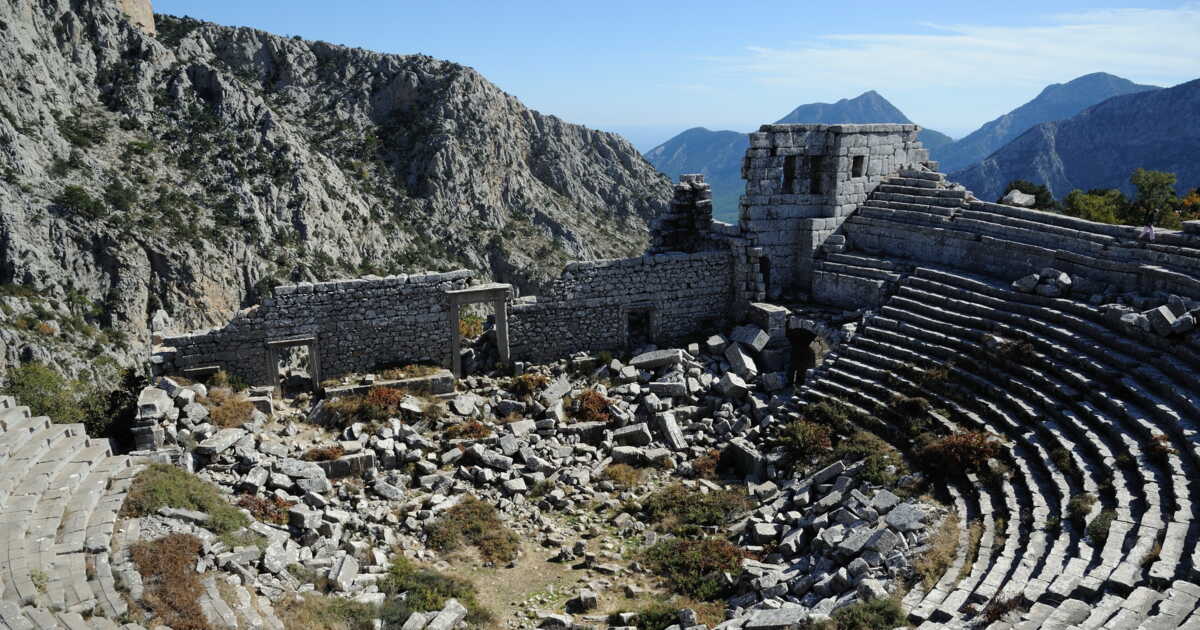
Few lands escaped the insatiable appetite of Alexander the Great in the 4th century BCE, but Termessos was one of them. Neither the famous king of Macedon nor other emperors managed to subdue this ancient city located in present-day Turkey. Even today, though it lies about 35 km from Antalya, it remains scarcely visited. CNN visited it and recommends the trip.
Situated in the Güllük-Termessos Mountain National Park, the ancient city offers visitors a direct plunge into time. And this begins from the very first minutes: the parking lot sits at the heart of an immense agora, the former market square of the city. Exiting the car, visitors glimpse majestic tombs hidden by the vegetation. This is part of the site’s charm.
The wall that made Alexander the Great retreat
One of Termessos’s long streets is bordered by the tombs of the city’s richest and most powerful inhabitants. On each of the sarcophagi, engravings serve as clues to who they housed. But do not expect to find tombs intact. Each has been looted long ago, leaving cracks and holes, sometimes since filled by vegetation.
After seeing this row, one must hike upward. Discovering Termessos entails trekking through the national park, across rugged terrain under Turkey’s blazing sun. From the hilltop, one can see the walls of fortifications, probably erected in the 4th or 5th century BCE, which allowed the city to resist invasions. Excavations that began in 2025, according to Hürriyet Daily News, should soon shed more light on the details of the city’s construction and its inhabitants, the Solym people.
A late Roman influence but still visible
This defensive wall and the topography of the site invite careful observation. In viewing them, Alexander the Great attempted to master them and to subdue Termessos, several times, but in vain. The city nonetheless ended up becoming an ally of Rome, not officially as part of the Empire but nevertheless in need of its protection. An earthquake destroyed the city’s aqueduct in the 6th century, which gradually set the stage for its decline.
Continuing the visit of Termessos today is to appreciate the grandeur of its ancient theatre, capable of seating up to 4,200 spectators. A magnificent structure likely built before the arrival of the Romans but later renovated under their influence.