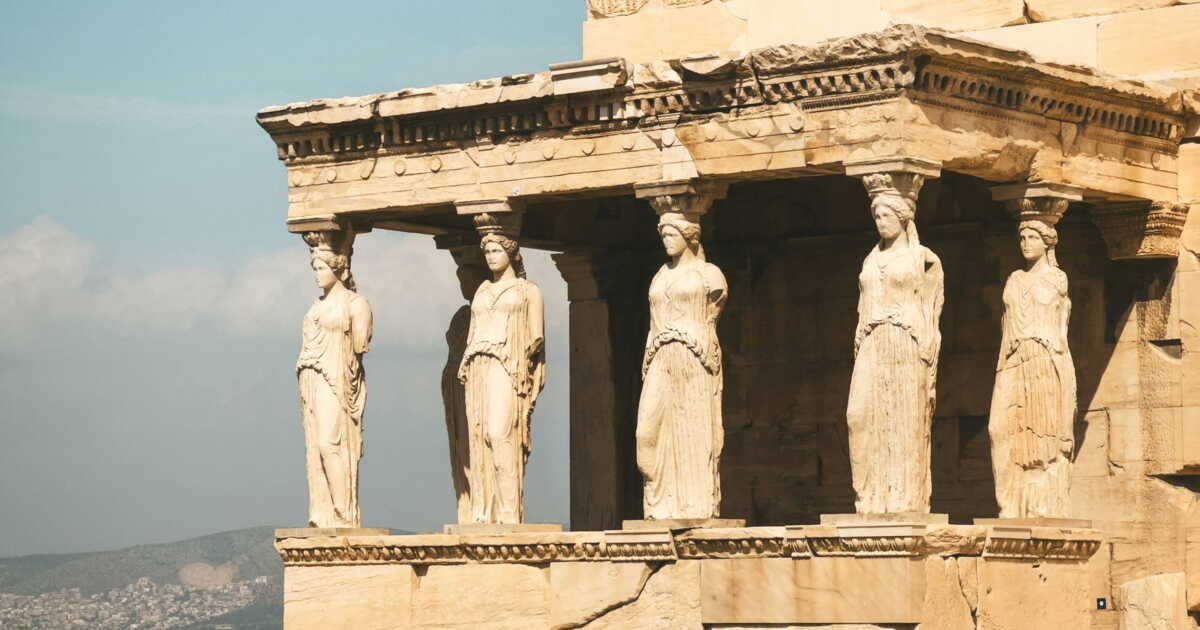
In Athens, far from the crowds, a small community continues, millennia later, to devote worship to the gods of ancient Greece. Zeus, Athena, Poseidon, or Dionysus do not represent, for the members of the Labrys movement, characters from myths and legends. They do not venerate them out of attachment to cultural heritage, nor from a desire to reconstruct history. It is a religious practice in its own right and very much alive… in the twenty-first century.
On Sunday, July 19, CNN witnessed a purification festival called Plynteria (or Pynterie), one of the stages of the Panathenaea, this multi-day series of festivities in honor of Athena. Men and women of all ages, dressed in white, gathered around a stone altar to cleanse the sacred statue of the goddess of wisdom.
Connecting with the Divine
Labrys is a group of Greek polytheists who organize collective events and encourage domestic worship of these ancient gods, notably celebrated thanks to works such as Homer’s Odyssey. Its cofounder, Christos Panopoulos, laments that popular culture has appropriated the Greek heritage internationally. “There isn’t a single Greek actor”, he denounces on American television regarding Christopher Nolan’s latest Hollywood adaptation.
The man, who has adopted the religious name Pandion in reference to two mythical kings of Athens, believes that his country is distancing itself from its ancient past while these narratives continue to nourish the identity and spirituality of many Greeks. “Myths and religious acts are like a symbolic language that allows us to act, to accomplish something. And what we seek to achieve is a connection with the divine. That is the whole point”, he sums up.
The Path Toward eudaimonia
Christos Panopoulos humorously notes that he has never received an order from Zeus, but he has gradually felt as if he is “in harmony with something” by devoting himself to polytheism, better understanding the world and his place within it. This quest attracts a diverse range of people. Panagiotis Koutalos, an English professor in Athens, grew up in a strict Christian environment before turning to Buddhism, and then to Greek polytheism. He appreciates a spirituality in which “no deity judges” its followers.
“In a monotheistic culture, the more human and animal facets of our nature are often perceived as things to be rejected. Here, nothing is judged”, explains the practitioner.
Anna Sinan, a native of Brazil, discovered the movement almost by chance, during a public ceremony in the Greek capital. There she found an atmosphere that reminded her of the carnival of her childhood. “Here, it’s a small community. The atmosphere is very special. It’s not just a simple festival. Before and after, a prayer is truly spoken. The very essence of the celebration has been preserved”, she explains.
These ceremonies regularly attract tourists, intrigued by this surprising return of the gods of Olympus, but for Labrys members, the essential lies not in folklore, but in a philosophy of life. Christos Panopoulos encourages toward the pursuit of eudaimonia while keeping at heart the virtues of these ancient deities, such as “the justice of Zeus” or “the wisdom of Athena.” These serve as valuable anchors in a contemporary society that he regards as lacking meaning.