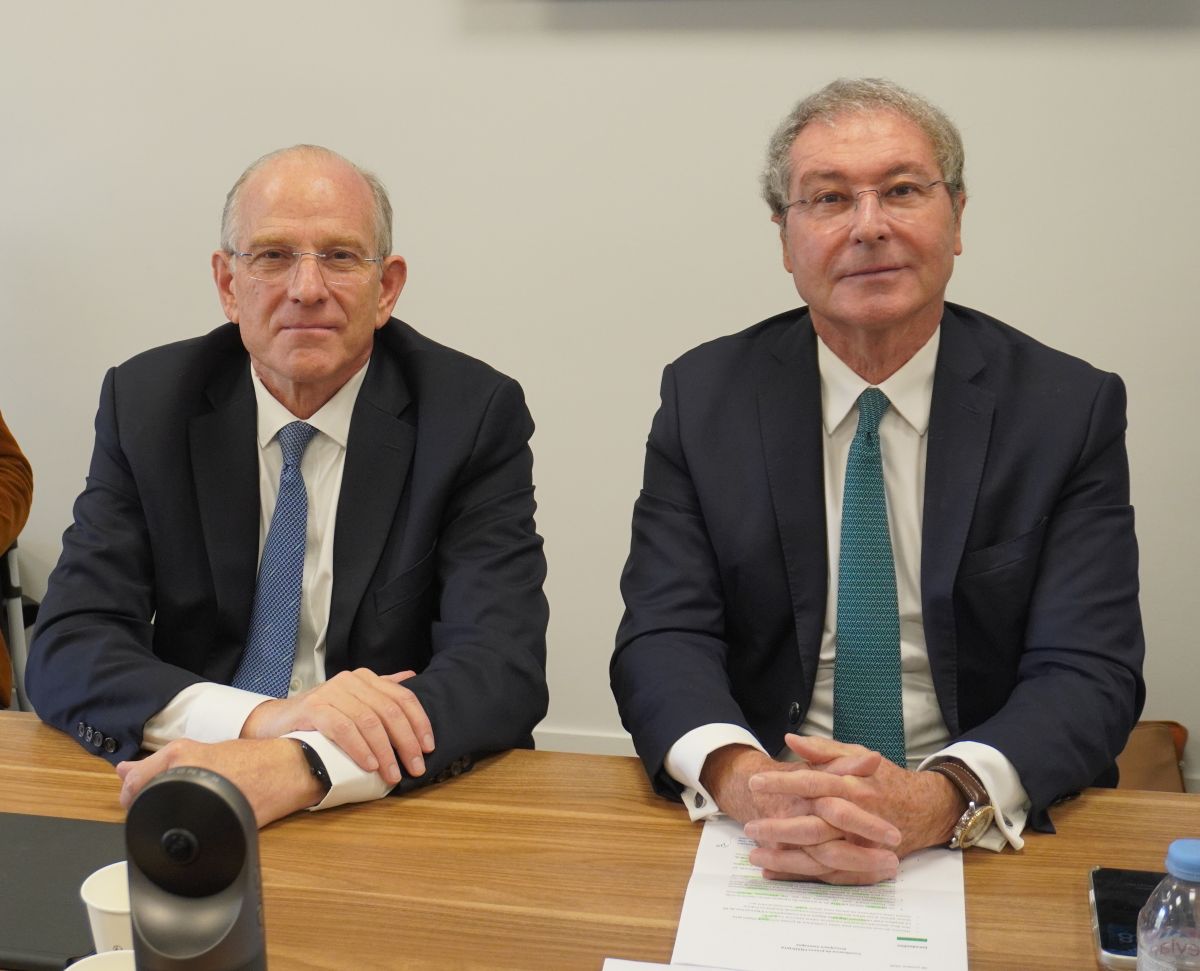


Invited to a press conference to take stock of the situation last Thursday within FNAM, one would have expected, given the latest announcements regarding the preparation of the 2027 budget, that the president of FNAM, Pascal de Izaguirre, would look gloomy.
Not surprising, then, that in the preface to his assessment of air transport after this summer, he mentions a “very serious situation“, particularly for France.
To go beyond the Franco-French context and see how France stands in Europe and how Europe stands relative to other regions of the world, FNAM had invited Rafael Schvartzman
Europe Weakened, France Falling Behind
In Europe, despite the Gulf crisis, passengers continue to travel: summer 2026 was another record season for European air travel, with nearly 36,000 flights per day on average (+2.4% vs summer 2025) and an all-time high of 37,640 flights in one day according to Eurocontrol.
However, warned Rafael Schvartzman, the real risk lies in rising costs. Since the closure of the Hormuz Strait, the price of kerosene has surged by about 60% and can now account for up to 45% of airlines’ operating costs, versus 25% in normal times.
Industry margins are expected to fall to around 2%, the lowest since the COVID crisis.
France, for its part, according to the figures from the IATA Europe Vice-President, has lost 6% of the airlines operating on its territory and today, traffic growth stagnates or even declines, a consequence of geopolitical tensions worldwide, but also of a European and national tax regime that is particularly high.
An observation clearly shared by the president of FNAM, who likewise provided figures showing a contraction in traffic in 2026: in August, passenger traffic fell by 1.0% compared with August 2025 (-1.4% internationally, -3.5% on Paris platforms). Over the year, traffic is below its 2025 level (-0.5%) and only slightly above 2019 (+1.0%), while domestic traffic remains at -21% compared to 2019.
The most worrying signal now concerns seat supply, planned months in advance: indexed to 100 in 2019, it stands at about 111 on average across Europe versus 102.1 in France, a gap of almost 9 points.
In this highly competitive French aviation market, where the Air France-KLM giant can afford to moderate price increases, other French airlines with weaker cash flows suffer from not being able to better pass through the impressive kerosene price increases.
According to DGAC, departure fares from mainland France rose by only +2.2% in the first eight months of the year.
To safeguard the viability of companies, FNAM has officially put forward several requests:
- the tracking and securing of kerosene supplies, which must remain a priority;
- Flexibility in flight scheduling, with a moratorium on the rule that you lose your slot if you don’t use it (Use-it-or-lose-it). During this crisis, it enables cancelling unprofitable flights;
- Immediate liquidity support, notably, as during Covid, the return of state-guaranteed loans (PGE);
- The suspension, for the duration of the conflict, of the aviation ETS, the European Union’s carbon market where airlines must buy and surrender quotas corresponding to their CO₂ emissions, as well as the mandatory compensation of domestic flights defined by Article 147 of the Climate and Resilience law;
- Finally, a reduction of the air ticket tax back to the level applicable before March 1, 2025.
Taxes, again and always, remain, according to FNAM leaders, one of the major causes of the downturn in air transport.
Tirelessly, the head of FNAM advocates for the abolition of the TSBA with arguments that are well heard by the supervising authority, DGAC, and the Minister of Transport, though they cannot yet bend Bercy. It is true that the current situation does not make things easy.
“We are heard, but we are running into a short-term vision from the government, the concern of showing billions of euros in savings today,” laments Pascal de Izaguirre.
The Swedish Example
Yet the FNAM’s demonstration that higher taxation harms medium-term public revenue is rather persuasive.
Indeed, it estimates the foregone tax revenue associated with the additional downturn since 2025 at €750 million in 2025 and nearly €1.6 billion in the projected annual 2026, compared to a nominal tax revenue of €850 million.
A negative yield, just as the federation would argue, would be the case for the new taxes planned in the 2027 budget proposal, the TEITLD and the security-safety tariff (T2S), which would siphon an additional €250 million from the sector.
To add even more ammunition to this difficult anti-tax crusade, the FNAM gave a concrete example, that of Sweden, which, according to them, clearly illustrates the reversibility of the tax and the possibility of reversing the supply dynamics.
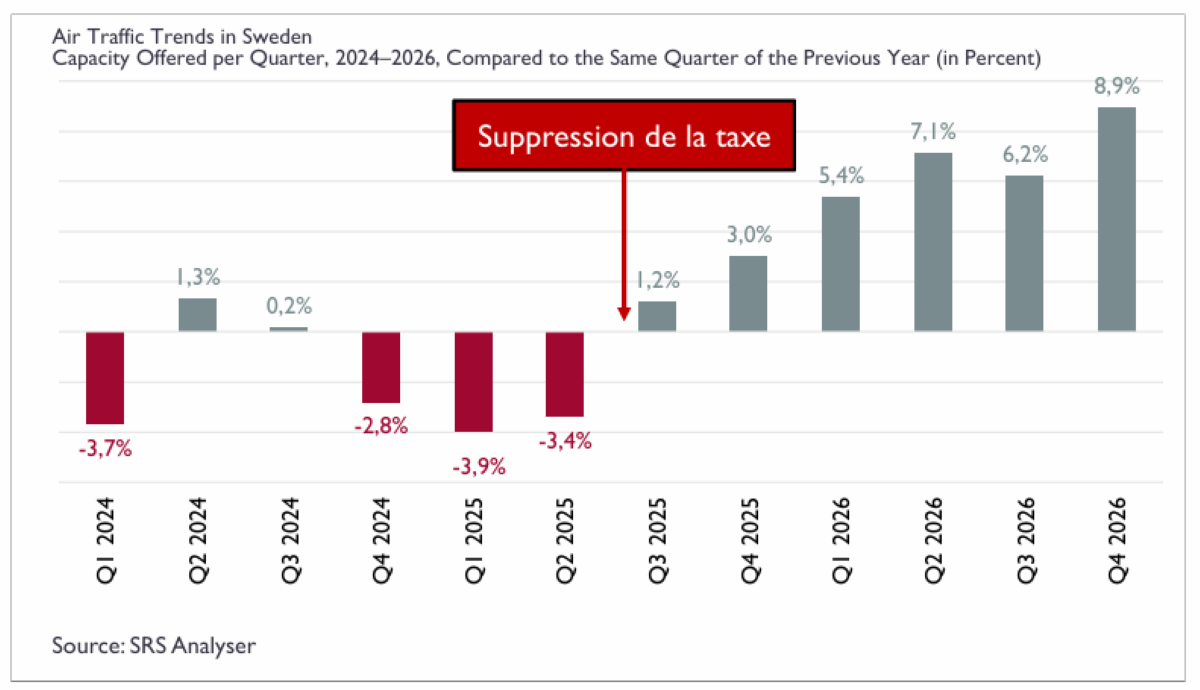
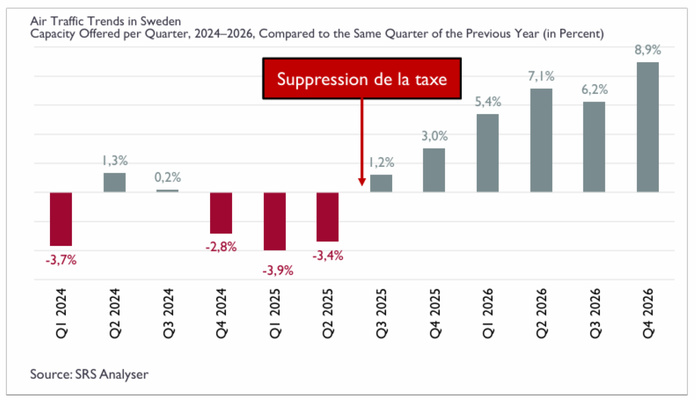
On the presented chart, one notes that following the removal of the tax there is a significant rebound in capacity growth and a forecast that this growth will continue up to +8.9% in the fourth quarter compared to 2025.
“Moderation on taxes is needed by the air transport, and among the measures we can implement immediately that would ease the economy of French airlines, this is one of the most accessible and effective ones,” added Laurent Timsit, the FNAM’s general delegate.
“Moderation on taxes is needed by the air transport, and among the measures we can implement immediately that would ease the economy of French airlines, this is one of the most accessible and effective ones,” added Laurent Timsit, the FNAM’s general delegate.
Soon a Presidential Platform
Convincing the government is therefore a tough fight, but it is also to those who will lead the country next year that one must start talking.
Asked by TourMaG about this, the FNAM president clarified: “We are working on preparing a platform for the presidential elections. We have asked the Deloitte firm to refine and complete their previous studies on the economic impact of aviation, and the negative impact of taxation.
This work will be completed by the second half of October. During November, we will build this presidential platform.
We are waiting a bit for the landscape to settle, and at that moment, we will approach the candidates who are most likely to run to present all these elements.”