Summary
-
The Sagrada Família: between lost heritage and global triumph
-
An architect on the path to beatification
-
Gaudí’s spiritual turning point
-
“With him, nothing was left to chance”
-
Mosaic salamander
-
Fascinated by dragons
-
The art of experimentation
-
The spirit of the “Architect of God” lingers nearby
He could almost touch it by stretching out his arm. Ferran Tomàs, 65, lives in one of the buildings surrounding the Sagrada Família construction site, the Basilica of the Holy Family. The film producer, whose latest movie premiered on Netflix in February, climbs the stairs of the jointly owned building and makes his way to the roof terrace now and then to observe the progress of the work. Jovial, he opens a double-locked metal door, steps over the final step. Straight ahead, the monument rises, casting a heavy shadow over Ferran’s building on this sunny morning. From here, the four-armed monumental cross raised at the end of winter 2026 at the top of the church’s tallest tower, the Jesus Christ Tower, looks gigantic. Its balance seems precarious, above the luminous star crowning the Virgin Mary’s tower, the neighboring smaller one. When Ferran was born, the site had already begun in 1882 and was funded by donations. “When I was little, I used to come and play in the sand piles on the site,” he recalls. There was only the northeast façade, the Nativity, and the first little turrets symbolizing four of the twelve apostles.
Instead of following the builders’ usual sequence—foundations first, then walls, and finally the roof—the flamboyant modernist architect Antoni Gaudí opted to raise an entire façade first, in order to quickly give Barcelona residents a sense of the project he had in mind. A “teasing” aimed at attracting donations and securing financial support to continue this edifice commissioned by a devout Catholic bookseller, Josep Maria Bocabella i Verdaguer, who wanted it to be a “temple of expiation,” where believers could wipe away their sins in exchange for hard cash. “It was like a vertical film set, all flat, that left the Barcelonans utterly indifferent” says Ferran, who, for his part, finds these early structures of the religious building magnificent. The master designer did not see further. On June 10, 1926, Gaudí died after being struck by a tram, at almost 74 years old. The remainder of the basilica, largely built later after the 1992 Olympic Games hosted by the Catalan capital, leaves Ferran Tomàs doubtful: “The church that hordes of tourists come to photograph is very recent. It is not the work of Gaudí.”
The Sagrada Família: between lost heritage and global triumph
Indeed, a large portion of the architect’s plans, drawings and models disappeared in 1936, ten years after his demise, at the onset of the Spanish Civil War, when anti-clerical groups burned his workshop located in a small house adjoining the Holy Family. It is from fragments of models and especially photographs of these models, published earlier in various books, that plans interpreting Gaudí’s logic were redrawn in the 1940s. Today, the question still haunts Barcelonans: is the basilica, as it appears to us, in line with what its creator had imagined? No one dares to decide…
Cent years after the death of its creator, The Sagrada Família is now the tallest church in the world (172.5 m) and the most visited monument in Spain (5 million visitors each year), ahead of the Alhambra in Granada and the Prado Museum in Madrid. From afar, an inattentive eye might mistake the completion for imminent, after nearly a century and a half of labor, though another decade or so remains to finish it. After all, it took roughly two hundred years to build Notre-Dame de Paris! Would Gaudí have rejoiced at the sight of his masterpiece? The man, a devout parishioner, was austere and taciturn. Not the type to gush. And the Barcelonans returned the sentiment in kind. Before the 1992 Olympics opened Barcelona to the world, prompting the city to transform its urban planning and reconcile with a seaside that had long been neglected, the architect’s legacy elicited, at best, indifference, at worst, contempt.
“In former times, in art history books, the mention of his work was contained in a single line,” confirms Ferran Garcés, 60, a former teacher, bookseller and writer. “Many of them despised him. People who moved into his houses even threw out the furniture born under his pencil.” This Gaudí specialist likes to sit at the café of Casa Amatller, a residence designed by another Modernist contemporary, Josep Puig i Cadafalch (1867-1956), on the imposing Passeig de Gràcia, Barcelona’s local Champs-Élysées. While sipping a chocolate as thick as it is hot, he recalls with a smile that Salvador Dalí, another native of the country, began reviving Gaudí in the 1950s by photographing his works. “But up to the 1990s, no one went to see his most spectacular buildings, Casa Batlló and La Pedrera,” he says. “I myself, as a child, used to frequent Park Güell because it was the only place with space to learn to ride a bicycle. Everyone used to ignore Gaudí’s columns, staircases and balustrades, which now attract millions of visitors.”
An architect on the path to beatification
What a contrast with the honors he now receives! The one some have begun to call the Architect of God, and whom his mother reportedly nicknamed the Child Jesus, has been on the path to beatification since the Pope Francis, a week before his own death in 2025, declared him “venerable.”
To grasp how Gaudí has come back from such a distant past, nothing beats a trip south of the city, on the right bank of the Llobregat river, near the Mediterranean and close to the airport. There, a town named Santa Coloma de Cervelló houses a treasure: the crypt of a small unfinished church. The building, regarded as a draft, a small-scale precursor to the Sagrada Família, was commissioned in 1898 from Antoni Gaudí by businessman Eusebi Güell for the believers of Colonia Güell, the workers’ colony surrounding his textile factory. The colony was once in town, but the boss had desired to keep his workers away from social conflicts and the chaos of the anarchist movement. And he housed them in the countryside, near their new workplace. Güell also commissioned a country house in Pedralbes for the architect, of which today only the stables, the riding arena, and the gatekeeper’s lodge remain, as well as an urban palace in the central Raval district. In Santa Coloma de Cervelló, Josep Padró, 79, with impeccably trimmed beard and white hair, lives in one of the restored brick houses along the tranquil lanes of the Colonia. He is one of the 750 inhabitants still populating this once modernist precursor neighborhood. One of his maternal great-grandfathers, a machinist, was part of the first workforce to arrive there. His paternal grandfather was a baker in the Colonia, his father a clerical worker at the Güell factory, his mother a worker in the weaving workshop. “In my family, we say Gaudí was very diligent,” says the former teacher turned local historian, now retired. “He would come every day from Barcelona to supervise the site. A real epic! He had to descend to the Sants station, take a train to Cornellà, and then a horse-drawn carriage for the last five kilometers. Since he worked on models rather than plans, people teased him, saying he was bad at math.”
The nature as model
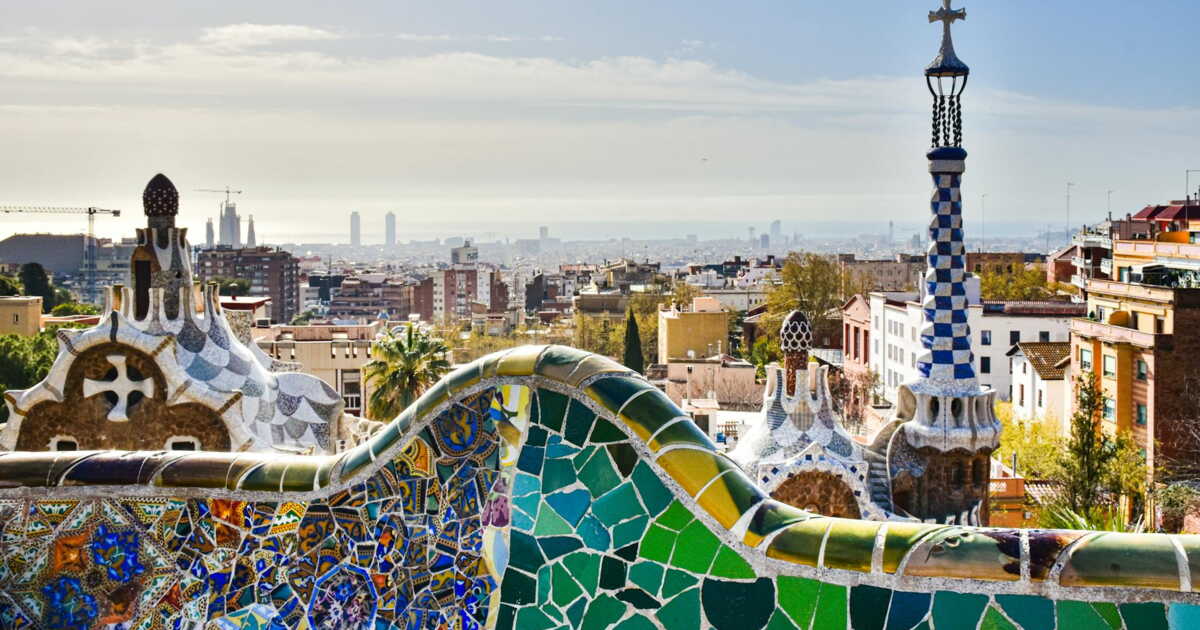
At first glance, Gaudí’s creations appear strange. But on closer look, one notices familiar shapes: like the stone trees in Güell Park (below), actually the projecting parts of a supporting structure, or tall pillars branching under the Sagrada Família’s vault… Antoni Gaudí not only drew from nature’s aesthetics but also transplanted its principles into his architecture. In Casa Batlló and Casa Milà, he designed a natural ventilation system based on air circulation and the use of courtyards to regulate temperature without air conditioning.
Today, it has become very chic to marry in the famous crypt that locals, until recently, compared to an ugly cave. In the middle of a vast pine forest, Gaudí enjoyed, with this project, complete creative freedom. “Rumor has it he experimented with a lot of techniques and often changed his mind,” recalls Josep Padró, comfortably settled in his office-library. “The masons went crazy; they predicted that when the church was finished, the crypt’s pillars would collapse.” Concerned with respecting nature, Gaudí drew a polygonal plan to avoid cutting down any trees. An unusual idea for the time. Nature, this avant-garde, also aimed to reproduce itself in construction. “He implemented here the major innovations that would later allow, several decades later, to erect the Sagrada Família,” emphasizes, admiringly, Andrés Andrés, 53, technical director of the Güell Colony Consortium, the institution that owns the premises. Wearing large glasses, this Gaudí enthusiast stands at the crypt’s entrance, knowing every corner. “First notable element, the pleated structure of the crypt façade, designed to bear the weight of the future church without buttresses or flying buttresses,” he notes. “Then the inner inclined pillars, mimicking the shape of the trunks of the surrounding maritime pines. Finally, the branching of the columns at the upper part, forming a stone canopy.” Two other novelties complete this mineralized forest: the treatment of light, with a stained glass arrangement inviting the sun to illuminate the crypt from morning to night, thanks to an altar oriented northward, rather than toward the east as is common in churches; and liturgical furnishings, with benches shaped in curves and scalloped basins serving as ciboria.
Gaudí’s spiritual turning point
Gaudí was also a pioneer of recycling. He used, among other things, the wood and hardware from Güell’s packing crates to fashion this furniture. The outer grilles of the stained glass panes were formed from weaving loom needles and old bobbin supports. In 1918, upon Eusebi Güell’s death, his heirs told the architect that the project was costing too much. A concrete slab was poured over the crypt as a roof, and the church ultimately never came to fruition. In the meantime, Gaudí’s involvement on the Sagrada Família site, which he had led for more than three decades, took on a whole new dimension. It marked the turning point of his career. From then on, he stopped all private projects to devote himself entirely to the future basilica.
In Sant Gervasi, a district of Barcelona traversed when leaving the Güell Colony, another example of Gaudí’s visionary talents is found. While the Sagrada Família project was starting, he was chosen by the Sisters of the Saint Thérèse company to build their convent. This commission marked the beginning of a spiritual shift that led him to develop religious themes in his work. Thus, the large internal metal gate of the Saint Thérèse school opens only from the inside, referencing the “inner castle” that Saint Thérèse spoke of to explain the intimate encounter with God. To this day, the convent is the architect’s only building still standing under the same ownership.
Returning to the cloister concept, Gaudí arranged on the first floor a narrow rectangular gallery around two courtyards, using the famous parabolic arch he employed in nearly all his subsequent projects. A clever way to avoid the heaviness of Gothic architecture, something the resident nuns are proud of. They point to four-armed crosses at the upper corners of the building, on the edge of the roof. The motif is inspired by the cypress fruit whose scales, falling to the ground, release seeds that will give life to a new tree, a symbol of resurrection. It is the same cross that crowns the Sagrada Família.
“With him, nothing was left to chance”
And it crowns Torre Bellesguard, on the heights of the Sarrià district, perched a little higher than Sant Gervasi. Identifiable by its corner tower shaped like a bell tower, the Figueras family townhouse, started in 1900 on the ruins of a 15th-century castle, shows how attached Gaudí was to Catalan identity. “On the main façade, he drew the crown of Barcelona and inscribed in gold letters the name of King Martin, the last monarch of Catalonia’s golden age of independence,” notes Ferran Garcés, Gaudí specialist who has conducted research here for thirteen years. He invites visitors to climb onto the roof. There, from a precise angle of the narrow rampart path, suddenly the tower, the chimneys and two dormers of Torre Bellesguard seem to form a massive dragon’s head, the evil creature felled by Saint George, Catalonia’s patron saint. “With Gaudí, nothing is left to chance,” observes Ferran Garcés. “By studying him, one can gradually discover all of Barcelona and all of the local history. He branded our city with his imprint, much like Edith Piaf in Paris and Frank Sinatra in New York, eclipsing, unfortunately, the many other talented architects who were expressing themselves there at the same time.”
Mosaic salamander
Juani, who runs a 400-square-meter souvenir shop at the foot of the Sagrada Família (she prefers to keep her surname private), has likewise noticed that Gaudí outshines all others. “The best-selling item is the mosaic salamander from Güell Park, and when tourists buy plates depicting city monuments built by other architects, they still think they are Gaudí’s,” she notes, amused. Tea cups depicting the Sagrada Família and La Pedrera are in high demand by Russians, jewelry reflecting the door handles of Casa Batlló by Americans, while the Japanese prefer chocolates bearing the architect’s image.
Gaudí, in truth, has only a dozen completed works to his name among the roughly 70 projects he had in mind during his life. Yet, seven of them are inscribed by UNESCO on the World Heritage List. Among them is Casa Vicens, one of Antoni’s first realized works, just after graduating from the Barcelona Provincial School of Architecture, in the Gràcia district that one passes after leaving Torre Bellesguard. A ochre residence covered with Orientalist ceramics, blending Mudéjar, Persian and Byzantine arts, this country home of broker Manuel Vicens commissioned from Gaudí in 1878 has been open to visitors since 2017.
Fascinated by dragons
Descending further toward the city center, the dragon who fascinated Gaudí reappears on another roof: the Casa Batlló, a jewel among jewels, its shimmering façade topped by a wavy shape covered with blue ceramic scales suggesting the dragon’s back. To the left, a slender turret crowned with the famous four-armed cross, again, symbolizes Saint George’s sword. Interior designer Ana Atance, 56, never tires of marveling at the subtleties of the colors in this house acquired in the 1990s by the Bernat family, founders of the Chupa Chups lollipop company, to transform it into a museum. She has been working on its restoration for more than thirty years. “I’m like an archaeologist who makes new discoveries every day, scraping away layers of paint to uncover the original stuccos,” she says, stroking the stone-colored walls of the entrance hall, where the trompe-l’œil mosaics have recently been restored with gold leaf. To restore the colors of the original, there is no choice but to dig, because the period photos are in black and white.
The art of experimentation
A worker ant’s labor that still holds pleasant surprises, even though the detractors of Modernism destroyed many marvels, here and in other houses, over the years. At the death of the last descendant of the Batlló family, about a decade ago, Ana recovered the chandelier with its glass beads, carefully dismantled and stored in a leather suitcase.
Further up on Passeig de Gràcia, Casa Milà, which Barcelonans call La Pedrera (“the quarry of stones”) because of its mineral façade, also flaunts admirable plasters that draw fluid lines across all ceilings, hinting at plants, waves and spirals of water. In the attic lies an inverted-scale model used by Gaudí to model shapes in space, using gravity. Without computers or 3D software, he suspended chains and strings to which he attached small bags of sand representing the loads of the future structure. With a horizontal mirror placed underneath, on the floor, he obtained the right-side-up image of the project. This is how the parabolic silhouettes of the Sagrada Família were born.
“Everything he experimented with throughout his life ultimately served him to build the basilica”,
summarizes Alejandro Seoane, 46, one of the seven architects currently leading the Sagrada Família project.
The spirit of the “Architect of God” hovers nearby
From his office beneath the splendid dome of the sacristy, this salt-and-pepper-haired enthusiast believes he is “haunted” by Gaudí: “I fell under his spell at 13, when I went to an exhibition at La Pedrera. I was blown away by the beauty of the place and immediately asked my father to take me to visit the Sagrada Família construction site. From that day, I went every Friday after school; it became an obsession. I didn’t listen to what people said about Gaudí in town. People didn’t like him; I wanted to go back to the source, to the roots. Here, we’re all like that.” The spirit of Gaudí lingers nearby. It must be said that the “Architect of God” rests in an apse of the crypt at the Sagrada Família, right under the feet of those who are finishing his work.
Fieldwork return
In search of Gaudí’s traces in the streets of Barcelona, our journalist questioned a large number of experts to establish a list of all the places where the architect, who came from his Catalan village of Reus, lived from 1868 onward. “What a surprise, Gaudí was a real nomad,” notes Guillaume Delacroix. “In fifty-eight years, he lived in every neighborhood: the Born, near Santa Maria del Mar, then Ribera, the Raval and Eixample, before settling in Gràcia, in the pink house of Park Güell, and finally back in Eixample, at his Sagrada Família workshop. He lived everywhere… but never in a house built by his own hands.”
➤ Article published in GEO magazine no. 568, “Barcelona, Antoni Gaudí’s open-air studio,” June 2026.
➤ Do you love GEO? Then to never miss an issue, discover our subscription offers to receive GEO every month at home with ease.