Summary
-
Voodoo Remains a Living Religion
-
Hidden and Hard-to-Reach Sanctuaries
-
Every Element of the Forest Can Become a Mediator
-
Sacred Forests, Last Refuges of Beninese Biodiversity
-
Benin, between Population Pressure and Adaptation of the Cult
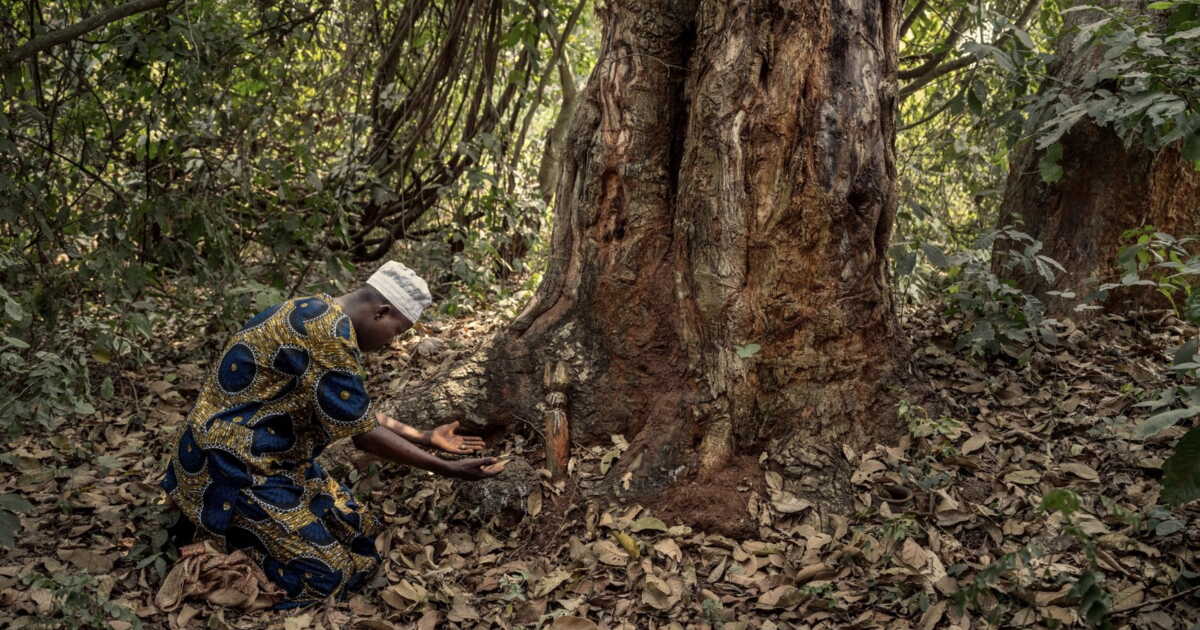
After several hours of walking, the vegetation opens up to a clearing. At the center stands a giant, a massive baobab whose enormous gnarled branches seem to support the sky. At its foot, a hounon, voodoo priest, and a young adept, both clad in bright wax fabrics, are so focused that they forget my camera aimed in their direction. They have allowed me to follow them into this place forbidden to non-initiates, on the condition that I never reveal the sanctuary’s location nor disturb the ceremony.
As the priest intones incantations, the young man raises a wooden stake about twenty centimeters long and drives it into the soft bark. A clear sap immediately beads. This rite is tied to matters of the heart: according to Beninese belief, the “tears of the baobab” will find resonance in the person targeted by the vow. In a neighboring village, a young woman will feel a tear sliding down her cheek for no apparent reason. She will then know that a suitor has sought the intercession of the sacred tree to declare his love. Free to her, she can then consult the dignitary to reveal the identity of this suitor… and decide how to proceed with this story.
Voodoo Remains a Living Religion
This intimate, almost poetic gesture says a lot about a religion that is often reduced to clichés. Voodoo – called here vodun – was born on the shores of the Gulf of Guinea, between present-day southern Benin, Togo, Ghana and parts of Nigeria. Exported with enslaved peoples of the Atlantic slave trade, it traveled to the Americas and the Caribbean, giving rise to vodou in Haiti, to candomblé in Brazil and to santería in Cuba. Versions shaped by diverse syncretisms that nourished a caricatured and Hollywood-made imaginary, with dolls pricked by needles, zombies and curses. But in Benin, far from those clichés of black magic, voodoo remains a living religion. The tradition rests on belief in Mawu, an entity that is both feminine and masculine, creator of the world, invisible, with whom no one can directly commune.
The intermediaries between Mawu and humans? A multitude of deities, spirits and supernatural forces, who reside in sacred forests, 2,940 sanctuaries that, while accounting for only 0.16% of the country’s area, play a crucial ecological and cultural role. In these places one prays, one consults, one negotiates protection, justice, health, love. At certain hours, for certain rituals, access is reserved for initiates. Women are sometimes completely excluded. To obtain the rare privilege of crossing these invisible borders, I first had to obtain the sésame from Daagbo Hounon, the highest authority of the vodun cult, enthroned in 2006 and recognized by the Beninese state (see the field box Return from the Field).
Field Report
Gaël Turine, photojournalist
Piercing the sacred forests of Benin required the blessing of Daagbo Hounon, the highest authority of vodun. To persuade the dignitary, Gaël Turine emphasized his knowledge of this cult: “I spoke to him about my eleven journeys tracing voodoo, in Haiti, the United States and Senegal.” These years of reporting convinced the man: no, the GEO photographer did not seek “to judge or sensationalize”. The high priest agreed to open the doors of the secret sites to him, provided he respected the rites. As the exchanges progressed, another message emerged, notes Gaël: “For this spiritual chief, these forests, homes of the deities, are also refuges to be preserved.” A crucial struggle for him, who regularly leaves his palace to tend his farm near Ouidah.
Hidden and Hard-to-Reach Sanctuaries
Getting spiritual authorization is not enough. One must also reach these sanctuaries, often hidden away from villages, in hard-to-access zones. So, one day, I must follow my guide, Mhadonack Agbessi, nephew of Daagbo Hounon, along a muddy stream winding through a sea of ferns. No straying from this liquid path, the only passage allowed.
Another time, I must advance knee-deep into swampy ground, which sucks at my boots with every step. In front of me, an initiate opens the way, probing the shifting ground with a long pole. Elsewhere, we board a canoe to reach a precarious altar set on stilts in the middle of Lake Toho, in the southwest of the country, where offerings have been laid in the hope of a fruitful catch. Often, I walk, ride, and even travel on a donkey along dusty tracks to attend a few minutes of ceremony: devotees with palms turned to the sky, prostrating before such a statue tucked into a sacred tree; or a priest, wearing a long white loincloth, hanging prayerful fabrics and vows of the faithful in the branches of a palm tree, which the wind carries to the spirits in a neighboring sacred forest.
Another day, at the edge of a southern forest, we stop in front of a hut built of four concrete walls, a flat roof, a dirt floor, leaning against a lush forest. The place looks unassuming, but this is where it all begins. “It is a threshold”, explains Mhadonack Agbessi. A doorway to the sanctuary. Before entering the forest, one must announce themselves. In sport pants and a sleeveless shirt, the priest who welcomes us sacrifices a black rooster, the price to pay to obtain permission to visit the deity who resides beyond (a few days earlier, nearby, in a low mud-and-thatch hut topped with a sheet-metal roof, another priest had been content to spray the walls with palm wine during a ritual dance to purify our access).
Each Element of the Forest Can Become a Mediator
Beyond this vestibule of the sacred, the religion takes on body. Each element of the forest can become a mediator: a tree, a termite mound, a spring, anything can host the vodun pantheon. Dan, the rainbow serpent, embodies continuity and fertility. Hêviosso, who governs lightning and rain. Sakpata, who watches over the earth, skin diseases, and the power of soil. Lègba, keeper of thresholds, whose name I have seen inscribed on this kind of hut. Gu, who presides over iron and labor. Zangbéto, who ensures nocturnal watch and the protection of the community. And also Mami Wata, widely celebrated in Ouidah, the great city of voodoo, about forty kilometers west of Cotonou, connecting humans to the world of waters, wealth, fertility, and beauty.
I quickly learn to identify divine residences. They appear as a cloth stretched among the branches, smeared with red palm oil, fetishes stuck between roots or in a tree trunk’s crevice, and the presence of offerings and melted candle wax on the ground.
Sacred Forests, Last Refuges of Benin’s Biodiversity
The religious status of forests has long served as an ecological safeguard: cutting the vegetation there is forbidden and local species thrive—acacias, irokos (Milicia excelsa), baobabs. Wildlife also benefits. Civets, mongooses, small antelopes, birds, snakes, chameleons, mona monkeys (Cercopithecus mona) with blue-gray faces are among the inhabitants. In the south, where population densities are high and farming is prevalent, these spaces are sometimes the last remnant of the original forest.
But they, too, are retreating. The Kpassè sacred forest, in Ouidah, is the most striking example. This important voodoo center houses several deities and serves as the setting for major ritual ceremonies. It is also one of the few sacred forests open to the public, drawing many visitors, tourists, and pilgrims. It is said to have once covered 30 hectares, but the city has chipped away at it gradually and today it is reduced to about four hectares, enclosed within a two-meter-high wall.
Other key sites of Ouidah’s cult are affected, such as the important Temple of Pythons, now tucked away in the city center, in the Dangbéxwé district. Its courtyard houses a small hut containing the sacred snakes, as well as a six-century-old iroko tree. Each year, the trunk of this venerable tree, dressed in white, is anointed with the blood of a sacrificed goat to honor the deities.
Benin, Between Population Pressure and Adaptation of the Cult
Paradoxically, a tree native to the region now threatens the sacred sites of Benin’s voodoo: the oil palm, overexploited, sometimes illegally. In the Abomey region, cradle of the Dahomey kingdom where voodoo was codified, as we progress on foot along a trail through a dense jungle, the sound of a motorbike suddenly breaks the quiet. A motorbike passes us, jolting, with a huge sack stuffed to the brim with palm fruit clusters on its luggage rack, another balancing on the tank. “They will deliver them to a clandestine palm oil workshop,” explains my guide. Further along, we discover operators have settled wild on a sacred site. Two women wade in a basin, where they churn a thick ochre-brown molasses, produced by crushing palm fruits. A few meters away, other fruits burn in metal drums repurposed as ovens. The air smells of burnt palm and hot oil. The prohibitions of voodoo? They weigh little against the necessity to survive.
Elsewhere, my lens captures a landscape of desolation: the ground covered with a carpet of gray ashes, from which the stumps of burnt trees protrude. This sacred land has been burned to become agricultural land. Not surprising. In twenty years, Benin’s population has nearly doubled to 15 million mouths to feed by 2026. In the densely populated southern region, villages spread and land pressure intensifies. To feed families and ensure a minimal income, the daily urgency overrides the respect due to the trees of the gods.
A Folklore Serving Benin’s Soft Power
And what if voodoo, once demonized, becomes a lever of Benin’s soft power? This is the government’s bet, banking on this faith of 50 million followers worldwide to boost tourism.
By the end of 2027, the International Vodun Museum will open its six circular buildings in Porto-Novo. But the cultural revolution has already begun: launched in January 2024 in Ouidah, the spiritual heart of the cult, Vodun Days, a new version of the National Vodun Festival established in the 1990s, are the marquee event. The 2025 edition drew 435,000 visitors, immersed in a whirl of music, mystical trance, and ritual mask dances. On those days, sanctuaries once forbidden open to laypeople: the Python temple, the Mami temple (dedicated to the water goddess), the Kpassè forest, and the Sakpata convent, a place of initiation dedicated to the earth deity.
Back to Ouidah. In the Sogbadji neighborhood lies the Houxwé palace, a rammed-earth residence of the famous Daagbo Hounon. Far from princely splendor, the site comprises modest single-story buildings framing a wide dirt courtyard. It is here, to the beat of drums, that the zangbéto (“night guardians”), dervishes dressed in braided straw, whirl into trance.
On January 10, 2024, during the great national festival celebrating the arts, culture and vodun spirituality, weaving through the crowd beneath a sun-shielding portable canopy, the Daagbo Hounon, 73 years old, wore a colorful top-hat adorned with beads and sacred symbols. Beside the pontiff stood a very young girl, designated as high priestess by the fâ, an oracle, and called to serve as interim when the Daagbo Hounon disappears. A woman in the upper echelons of vodun, these sites opening a little more to view: perhaps this is where the future of Benin’s sacred forests lies.
➤ Article published in GEO magazine no. 569, “Recharging in Auvergne”, July 2026.
➤ If you love GEO, then to miss nothing, discover our subscription plans to receive GEO at home every month.