

The Pavillon Bleu label unveils its 2026 standings on May 18 in Saverne, in the Bas-Rhin. A first for this national ceremony, held on a waterway site.
The Saverne port, labeled since 2018, had notably received the Thomas Joly Award in 2020 for a project to revegetate the riverbanks in favor of biodiversity.
Developed in France by Teragir, the Pavillon Bleu has for more than 40 years distinguished beaches and pleasure ports engaged in sustainable tourism initiatives.
The label rests on several criteria related to water management, biodiversity preservation, pollution reduction, and visitor awareness.
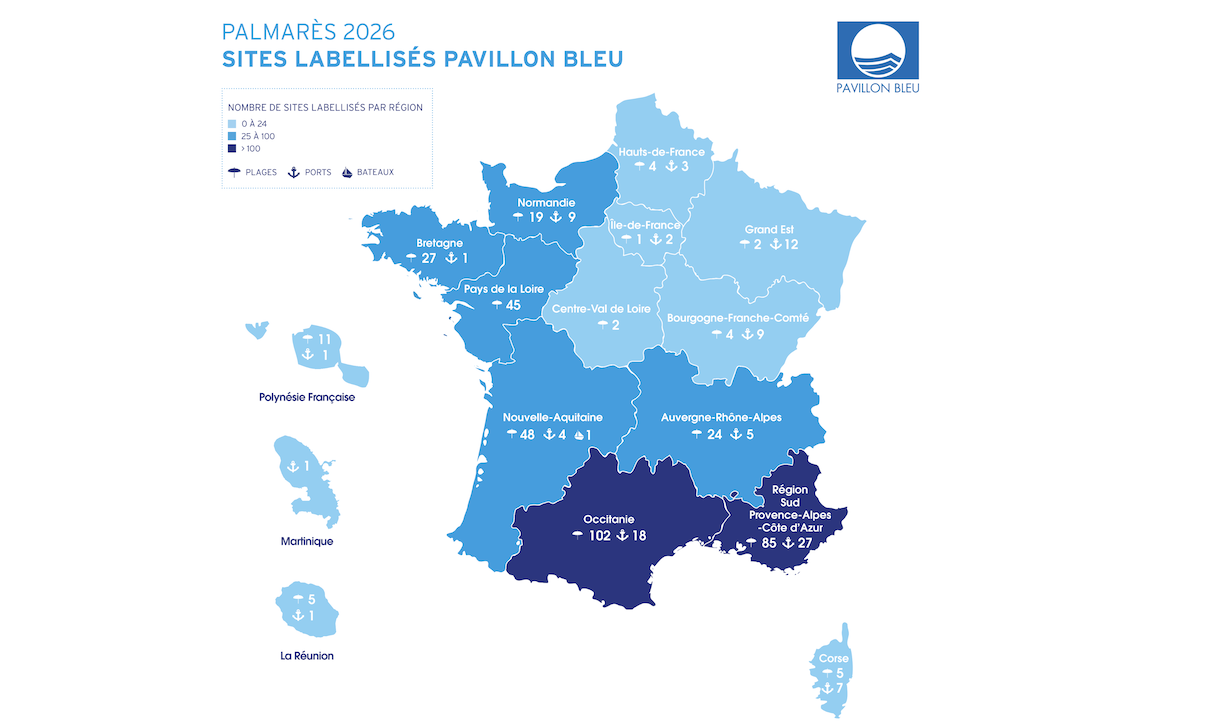
This year, 485 French sites obtain the label, comprising 384 beaches, 100 ports de plaisance and one boat. The sites concerned may fly the Blue Flag throughout the 2026 season.
The Saverne port, labeled since 2018, had notably received the Thomas Joly Award in 2020 for a project to revegetate the riverbanks in favor of biodiversity.
Developed in France by Teragir, the Pavillon Bleu has for more than 40 years distinguished beaches and pleasure ports engaged in sustainable tourism initiatives.
The label rests on several criteria related to water management, biodiversity preservation, pollution reduction, and visitor awareness.
This year, 485 French sites obtain the label, comprising 384 beaches, 100 ports de plaisance and one boat. The sites concerned may fly the Blue Flag throughout the 2026 season.
Les régions littorales toujours en tête
France thus maintains its position among the five countries with the largest number of labeled sites in the world.
The program, carried internationally by the Foundation for Environmental Education, is now present in 50 countries and brings together more than 5,300 labeled beaches, ports and boats.
The 2026 list confirms the strong presence of the major coastal tourist regions in France. Occitanie tops the list with 120 labeled sites, ahead of the Provence-Alpes-Côte d’Azur region with 112 sites.
Nouvelle-Aquitaine accounts for 52 distinguished sites.
Several new sites also join the ranking this year, among them the ports of Saint-Léger-sur-Dheune, Nevers, Charleville-Mézières, Buzet, the Old Port of Golfe Juan and the Jacques-Yves Cousteau port in Castelsarrasin.
On the beaches side, Le Tréport, Carqueiranne and Saint-Symphorien-de-Thénières are among the newly labeled municipalities.
A boat also earns the label: the Atalaya catamaran from Explore Océan, based in Hendaye, offering sea outings dedicated to cetacean watching.
The program, carried internationally by the Foundation for Environmental Education, is now present in 50 countries and brings together more than 5,300 labeled beaches, ports and boats.
The 2026 list confirms the strong presence of the major coastal tourist regions in France. Occitanie tops the list with 120 labeled sites, ahead of the Provence-Alpes-Côte d’Azur region with 112 sites.
Nouvelle-Aquitaine accounts for 52 distinguished sites.
Several new sites also join the ranking this year, among them the ports of Saint-Léger-sur-Dheune, Nevers, Charleville-Mézières, Buzet, the Old Port of Golfe Juan and the Jacques-Yves Cousteau port in Castelsarrasin.
On the beaches side, Le Tréport, Carqueiranne and Saint-Symphorien-de-Thénières are among the newly labeled municipalities.
A boat also earns the label: the Atalaya catamaran from Explore Océan, based in Hendaye, offering sea outings dedicated to cetacean watching.
Le tourisme fluvial mis en avant
Choosing Saverne to host the national ceremony highlights the growing importance of inland waterways in sustainable tourism strategies.
According to Teragir, river and lake spaces now account for more than a third of the labeled sites.
The Pavillon Bleu emphasizes several advantages of these territories: generally lower environmental pressure than coastal areas, a role in maintaining ecological corridors, potential for soft mobility, and a contribution to the economic revitalization of river-adjacent municipalities.
This evolution also aligns with travelers’ new expectations, who favor shorter getaways, slow tourism, and experiences reconnecting with nature.
According to Teragir, river and lake spaces now account for more than a third of the labeled sites.
The Pavillon Bleu emphasizes several advantages of these territories: generally lower environmental pressure than coastal areas, a role in maintaining ecological corridors, potential for soft mobility, and a contribution to the economic revitalization of river-adjacent municipalities.
This evolution also aligns with travelers’ new expectations, who favor shorter getaways, slow tourism, and experiences reconnecting with nature.
Deux initiatives réunionnaises récompensées
The Thomas Joly Prize, which annually rewards biodiversity initiatives, distinguishes in 2026 two Réunion-based projects.
The City of Saint-Leu is rewarded for its biodiversity preservation and awareness strategy within the framework of its Municipal Biodiversity Atlas.
The Port of Saint-Gilles-les-Bains is, for its part, distinguished for its involvement in the campaigns “Nights Without Light” and “Days of the Night,” aimed at reducing light pollution and preserving nocturnal biodiversity.
The City of Saint-Leu is rewarded for its biodiversity preservation and awareness strategy within the framework of its Municipal Biodiversity Atlas.
The Port of Saint-Gilles-les-Bains is, for its part, distinguished for its involvement in the campaigns “Nights Without Light” and “Days of the Night,” aimed at reducing light pollution and preserving nocturnal biodiversity.
 Published by Amelia Brille TourMaG.com Editor
 View all articles by Amelia Brille


Add TourMaG to your Google News feed