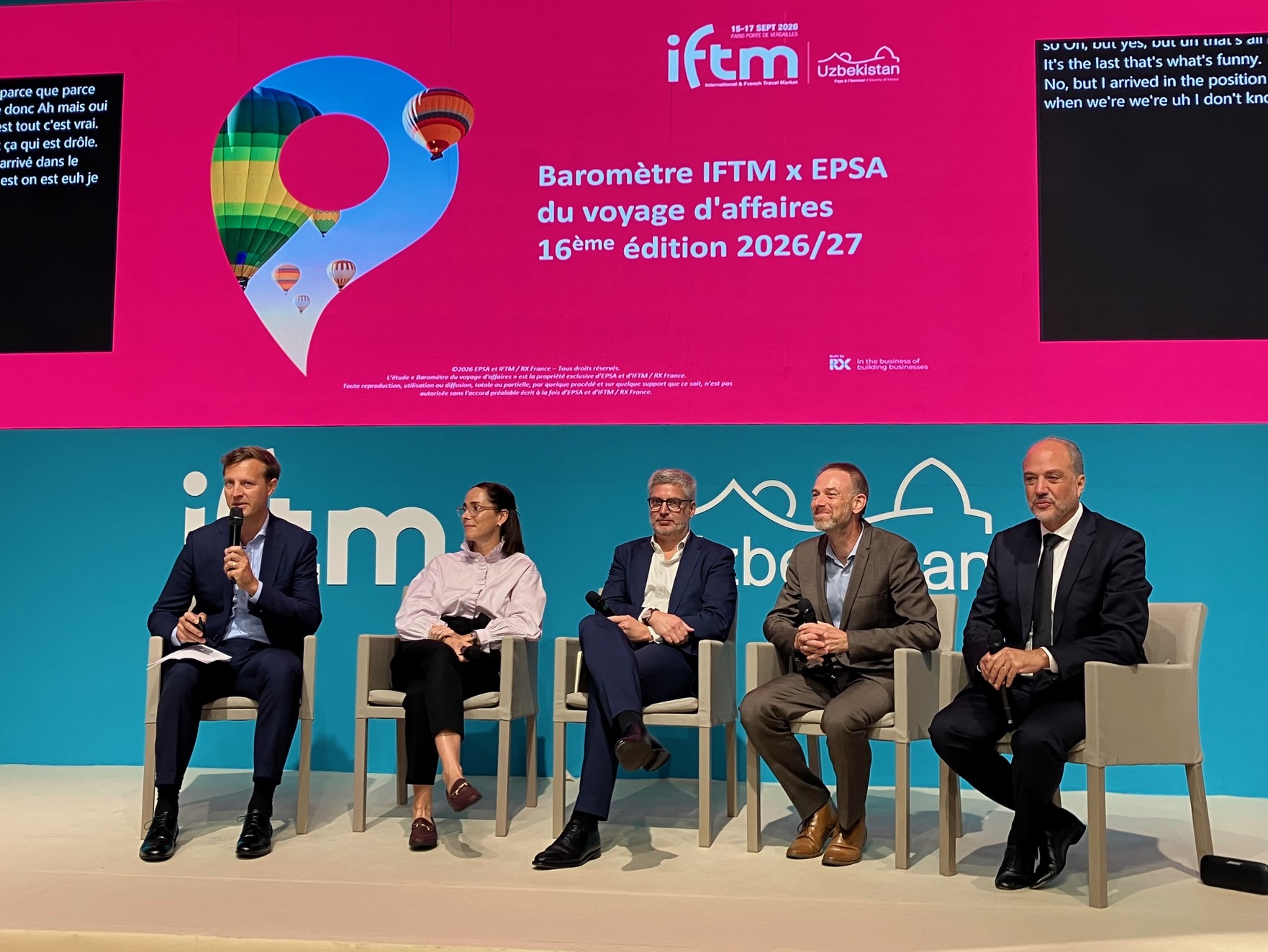


Turned into a fixed appointment, the annual IFTM-EPSA barometer of business travel is eagerly awaited by travel agencies specializing in corporate travel and by companies.
In a context of geopolitical and economic tensions, the IFTM hall was well attended on September 16 for the presentation of the 2026/27 edition.
Forecasts are especially uncertain as the 2026 uncertainties are likely to spill over into 2027, with a little extra: presidential and perhaps legislative elections in France!
It is therefore with great caution that the travel-industry consulting firm EPSA unveiled its projections.
The year 2026 is expected to close with a French business travel market of €31.6 billion, up 2.3%. For 2027, EPSA forecasts €32.7 billion, up 3.5% compared with 2026.
In a context of geopolitical and economic tensions, the IFTM hall was well attended on September 16 for the presentation of the 2026/27 edition.
Forecasts are especially uncertain as the 2026 uncertainties are likely to spill over into 2027, with a little extra: presidential and perhaps legislative elections in France!
It is therefore with great caution that the travel-industry consulting firm EPSA unveiled its projections.
The year 2026 is expected to close with a French business travel market of €31.6 billion, up 2.3%. For 2027, EPSA forecasts €32.7 billion, up 3.5% compared with 2026.
Questioning Airfare Prices
This trend is nevertheless deceptive as the forecast for France’s GDP growth in 2026 was revised downward to 0.4% by the Banque de France, which hopes for a slight rebound in 2027, to 0.9%.
The growth of the business travel market should indeed be largely driven by inflation, while “demand is expected to show near-stability, at -0.2%. Since 2020, clients and suppliers have learned to cope with successive crises” comments EPSA.
The greatest uncertainty lies in air travel prices, as kerosene prices surge again and the airlines are buying their fuel stocks for next year.
EPSA estimates that air travel prices could jump by 3.7% to 4.4% globally in 2027, and between 4.2% and 4.5% on the domestic market alone, with a confidence index on this forecast of only 6/10 as uncertainties persist.
The growth of the business travel market should indeed be largely driven by inflation, while “demand is expected to show near-stability, at -0.2%. Since 2020, clients and suppliers have learned to cope with successive crises” comments EPSA.
The greatest uncertainty lies in air travel prices, as kerosene prices surge again and the airlines are buying their fuel stocks for next year.
EPSA estimates that air travel prices could jump by 3.7% to 4.4% globally in 2027, and between 4.2% and 4.5% on the domestic market alone, with a confidence index on this forecast of only 6/10 as uncertainties persist.
Fuel Costs Up 53%!
Already in the first half of 2026 versus 2025, long-haul prices surged by 4.8%, versus 1.9% for short/medium haul and 2.6% in France, driven by kerosene prices, of course (the fuel cost per flight hour for an Airbus A320neo rose by 53% in September compared with January 2026) but also by higher airport taxes.
There remains a strong international demand but “with purchasing behaviors changing for companies, through later bookings,” notes David Marey of Air France.
It is also worth noting the low penetration of NDC: “about one in three bookings in France for business travel is made this way at Air France, compared with 60% for leisure. The education work must continue,” adds him.
There remains a strong international demand but “with purchasing behaviors changing for companies, through later bookings,” notes David Marey of Air France.
It is also worth noting the low penetration of NDC: “about one in three bookings in France for business travel is made this way at Air France, compared with 60% for leisure. The education work must continue,” adds him.
Also read : Business travel: how travel managers revise their criteria to control costs
The Transformation of Europe’s Skies Accelerates
In the end, total air traffic for the year 2026 is expected to reach 5.1 billion passengers worldwide. Even so, in France it slips slightly by 0.8% in the first half.
In this context, IATA expects a 50% drop in airline profits in 2026, with a continued consolidation of the global skies.
In Europe alone, the Lufthansa group will control 90% of Italian ITA Airways by early 2027.
The American investment fund Apollo acquired easyJet last August and the entry of Air France-KLM or Lufthansa into the capital of TAP Portugal, as part of the privatization of the latter, is set to be approved in the coming months.
In this context, IATA expects a 50% drop in airline profits in 2026, with a continued consolidation of the global skies.
In Europe alone, the Lufthansa group will control 90% of Italian ITA Airways by early 2027.
The American investment fund Apollo acquired easyJet last August and the entry of Air France-KLM or Lufthansa into the capital of TAP Portugal, as part of the privatization of the latter, is set to be approved in the coming months.
Train: Competition Slow to Emerge
For rail, price growth in 2027 should be more modest, between 1.4% and 1.7% in France, and between 1.8% and 2.2% in Europe.
This is due to higher toll costs for using infrastructure and sustained demand growth, with a need for companies to decarbonize their business travels.
And yet the supply side is slow to respond: the opening to competition, which could influence prices, is slow to materialize. On the Paris–Lyon route, the arrival of Trenitalia has translated into a 20% increase in traffic over six years, with an average price drop of -10%.
And the new generation TGVs promised by SNCF for the Paris–Marseille route for the 2024 Olympics, with higher capacities, are still awaited. The operator now hopes for service before the end of the year.
Ten sets have been delivered so far (out of 115 ordered) but technical problems delay their commercial start.
In the west (Brittany, Bordeaux…), competition influence on prices will have to wait until at least 2028, with the first trains of the newly licensed Velvet company, which has ordered 12 sets.
This is due to higher toll costs for using infrastructure and sustained demand growth, with a need for companies to decarbonize their business travels.
And yet the supply side is slow to respond: the opening to competition, which could influence prices, is slow to materialize. On the Paris–Lyon route, the arrival of Trenitalia has translated into a 20% increase in traffic over six years, with an average price drop of -10%.
And the new generation TGVs promised by SNCF for the Paris–Marseille route for the 2024 Olympics, with higher capacities, are still awaited. The operator now hopes for service before the end of the year.
Ten sets have been delivered so far (out of 115 ordered) but technical problems delay their commercial start.
In the west (Brittany, Bordeaux…), competition influence on prices will have to wait until at least 2028, with the first trains of the newly licensed Velvet company, which has ordered 12 sets.
Céline Dion Boosts Parisian Hotel Traffic
Amex GBT/CWT: The Merging Giants Shake Up the Field
Finally, in this still uncertain context, consolidation is also underway among TMCs to better control costs and provide comprehensive service to their clients.
The acquisition of Carlson Wagonlit Travel (CWT) by Amex GBT in 2025 gave birth to a new giant, whose business volume is expected to rise from €31 billion last year to €44 billion (including CWT integration) this year.
There is also the alliance between AMEX GBT and SAP Concur in 2025, with the launch of the offering Complete, a new co-developed solution based on artificial intelligence, which combines bookings, services, payments and expense management.
Far behind, the top 5 TMCs include BCD Travel (€21 billion), Navan (€7.8 billion), Flight Centre Travel Group (€7.7 billion) which owns FCM Travel in France and CTM (€6 billion) according to EPSA’s ranking.
The acquisition of Carlson Wagonlit Travel (CWT) by Amex GBT in 2025 gave birth to a new giant, whose business volume is expected to rise from €31 billion last year to €44 billion (including CWT integration) this year.
There is also the alliance between AMEX GBT and SAP Concur in 2025, with the launch of the offering Complete, a new co-developed solution based on artificial intelligence, which combines bookings, services, payments and expense management.
Far behind, the top 5 TMCs include BCD Travel (€21 billion), Navan (€7.8 billion), Flight Centre Travel Group (€7.7 billion) which owns FCM Travel in France and CTM (€6 billion) according to EPSA’s ranking.
New Acquisitions in the Pipeline?
The giant born from the merger of Amex GBT and CWT can, however, be seen as both a threat and a new opportunity, with some companies wary of such a supplier or the merger of the two.
“After a year of observation, we are being approached for tenders by multinationals and CAC 40 companies. And whereas the norm used to be three-year contracts, there is a new trend toward longer contracts, from 3 to 5 years,” comments Christophe Hamonic, CEO of FCM Travel France (€240 million in business volume for 2025/26).
Together, the five leaders nevertheless account for only 5.3% of global corporate travel spend (estimated at €1.6 trillion in 2025), leaving room for fully digital entrants and for new alliances.
“After a year of observation, we are being approached for tenders by multinationals and CAC 40 companies. And whereas the norm used to be three-year contracts, there is a new trend toward longer contracts, from 3 to 5 years,” comments Christophe Hamonic, CEO of FCM Travel France (€240 million in business volume for 2025/26).
Together, the five leaders nevertheless account for only 5.3% of global corporate travel spend (estimated at €1.6 trillion in 2025), leaving room for fully digital entrants and for new alliances.
Advice, Security, Data Protection…
Thus the Marietton Développement group plans to acquire TMCs abroad by the end of the year, notably in the Netherlands, Italy and Portugal, to strengthen its European presence and better serve its clients.
Also read : Marietton: acquisitions of TMCs expected soon
Because companies demand new commitments and services from TMCs, which require substantial resources. “They want advisory services to better procure and adapt their buying behavior in a context of rising prices” adds Christophe Hamonic.
They also express new expectations, particularly regarding data protection and sovereignty and the geosecurity of employees. “For example, we can identify all employees of a company in a specific area in 15 to 45 minutes, and implement a security plan in 1 hour and 30 minutes,” the CEO completes.
Also read : Marietton: acquisitions of TMCs expected soon
Because companies demand new commitments and services from TMCs, which require substantial resources. “They want advisory services to better procure and adapt their buying behavior in a context of rising prices” adds Christophe Hamonic.
They also express new expectations, particularly regarding data protection and sovereignty and the geosecurity of employees. “For example, we can identify all employees of a company in a specific area in 15 to 45 minutes, and implement a security plan in 1 hour and 30 minutes,” the CEO completes.