Summary
- Calabria’s 800 kilometers of coastline are far from the most visited
- Chianalea, one of Italy’s most beautiful villages
- Thousands of olive groves
- Welcome to Calabria’s little Switzerland
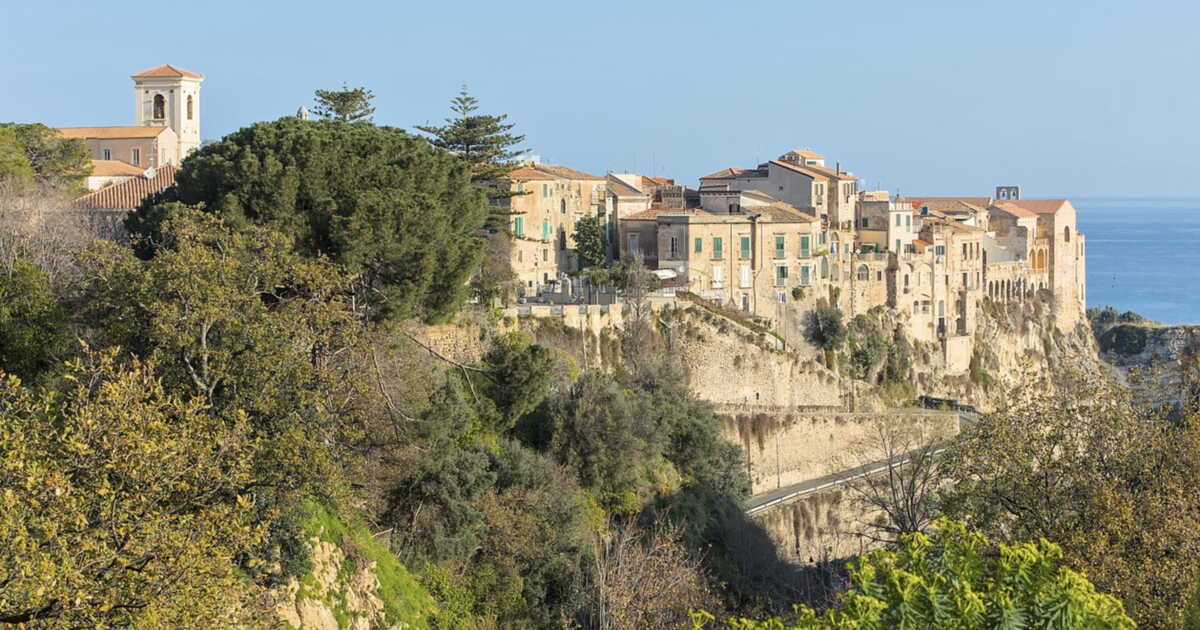
The old town of Tropea, on the Tyrrhenian coast, is unforgettable. In the late afternoon, Corso Vittorio Emanuele III, lined with palaces and salt-worn churches, presents itself for the ritual of the passeggiata, the evening stroll, with a generous helping of struscio (from the verb strusciare, “to rub”), a southern expression that evokes the sound of soles caressing the paving stones. At the end of the pedestrian avenue, walkers encounter the Affaccio del Corso, perhaps the most beautiful alley in Italy. Behind the wrought-iron railing, the sea, sixty meters below, is incredibly clear. On the sides, two pale sandy beaches spread like angel wings. In the distance, the hazy outline of Stromboli smoking, the string of other Aeolian Islands, and, on clear days, the Sicilian coast.
In Calabria, Calabria’s 800 kilometers of coastline are far from the most visited
As locals say in their Calabrian dialect: “Cu non vitti Tropea non vitti lu paradisu”, “He who has not seen Tropea has not seen paradise.” The proof is: from the edge of its cliff, the belvedere city reigns over a shore known as the Coast of the Gods. For in antiquity, this was a Magna Graecia colony, and the Olympian gods would have chosen to plant their earthly vacation here. Today, one can only marvel (and rejoice) that hordes of tourists have not had the same idea! In Calabria, the 800 kilometers of coastline are far from the country’s most crowded. As for the hinterland, it is often deserted. This is because the region is set apart: for Calabrians (and many Italians as well), this is no longer quite Italy.
A sentiment that fisherman Fortunato Polistena sums up with a quip: “Here, not all roads lead to Rome, but they all lead to the sea.” In his forties, a Herculean build and a weathered voice, this stalwart is one of the prominent faces of Scilla’s port, a town facing the Strait of Messina that separates the Italian mainland from Sicily. A region once feared by the Greeks: for Odysseus, passing through these waters was choosing between two threats, the whirlpool of Charybdis, swallowing ships, and the appetite of Scylla, a multi-headed sea monster that devoured crews. A legacy of that myth remains in the iconic expression, in Italian as in French, and in a fearsome statue towering in the main square of the upper town: sea serpents with sharp teeth gnawing a goddess. A nearby sign explains that the Homeric tale stems from a marine phenomenon: two currents—the Ionian flow and the Tyrrhenian waters—collide here, occasionally forcing cold waters to rise from the depths. So much so that in the height of August, when the air nears 40 degrees, the swimming temperature can suddenly drop to 14.
Chianalea, one of Italy’s most beautiful villages
Not something to frighten the local fishermen. In the shadow of Ruffo Castle, the fortress guarding the strait, the fishing hamlet of Chianalea—one of Italy’s most beautiful villages—threaded with narrow alleys from which the scent of fried fish escapes. Some houses have their feet in the water, letting residents claim it is Southern Italy’s Little Venice. But instead of gondolas, the quays welcome boats painted in a striking Cycladic blue. Some boast a 20-meter-tall mast-ladder, and a slender gangway at the bow that rises to twice that height. A long nose like the animal hunted from here: the swordfish. At sea, a lookout climbs to the top of the mast and shouts when he spots prey. The hunt can begin. Everything then unfolds at the end of the long gangway, at the bow of the boat. As soon as the silver back surfaces, the fish must be harpooned with a three-meter trident worthy of Poseidon. “It’s more of a hunt than fishing,” Fortunato warns. “In my family, we’ve been doing it for generations, from May to August.”
Back on dry land, after a long struggle to haul the catch onto the boat, the tasting in the port restaurants also tastes like eternity. Establishments in Chianalea such as Bleu de Toi and Piccola Venezia masterfully craft the iconic sandwich of Scilla’s people: in a warm focaccia, a slice of grilled swordfish, Tropea red onions, and salmoriglio, a divine blend of olive oil, capers, garlic, lemon, and fresh herbs. In this forgotten Mezzogiorno, Greek heritage is everywhere. On the southeast coast lies the ancient site of Locri Epizephyrea, where in the 7th century BCE the first written laws of the Greek world were proclaimed.
Near Crotone, on the aptly named Cape Colonna, a single Doric column—the last remnant of a Hera temple—surveys the winds with style. The archaeological treasure hunt continues inland, in search of the greko language. This idiom still spoken on the slopes of the Aspromonte consists of fossilized phrases dating back to antiquity, to which Byzantine and old Calabrian influences have been added over the centuries. Regarded as “seriously endangered” by UNESCO, the linguistic anomaly is now used by only about 200 active speakers. Including Olimpia Squillaci, 36, born in Bova, a perched village of 450 inhabitants, where street names are bilingual. This mother of a family, an academic specializing in philology, organizes annual Greko language summer camps. When she was a girl, her father, she recalls, insisted that the whole household speak in this dialect, like the old shepherds of the Aspromonte. “Back then, it was seen as a sign of backwardness; teachers at school would mock it.”
Olive groves by the thousands
But times have changed. Since the 1990s, the ancient paths linking the last Greek-speaking hamlets, including Bova, have been rehabilitated, giving rise to a 110-kilometer hiking route. The route passes through Galliciano, a hamlet of 30 souls perched at 625 meters, nicknamed the Acropolis of Magna Graecia. Isolation has kept the language alive. On the façades, Greek flags flutter. On Sundays, the Orthodox rite is celebrated in the small church. Giovanni Maisano, a local resident, runs the small ethnographic museum where, he says, “a rural life that hasn’t changed much” is revealed. One need only look down from the village to believe it. The panorama looks down on the groves—olive trees by the thousands, but also bergamot, the golden fruit of Calabria, which accounts for more than 50% of the region’s export revenue.
Bergamot, Calabria’s Green Gold
From November to February, along a narrow coastal strip between the Aspromonte mountains and the Ionian Sea, activity peaks. In bergamot orchards, the fruits of Citrus bergamia change color, moving from deep green to pale yellow. Harvest time has arrived. This hybrid of bitter orange and lemon is too acidic for everyday consumption. Yet the world clamors for it, because its zest contains an essential oil used notably in perfumery (bergamot essence is one of the key ingredients of the famous Eau de Cologne since its creation in the early eighteenth century).
Today, Calabria supplies around 90% of the world’s bergamot essential oil. Beyond perfumery, its zest and aroma flavor liqueurs, candies, jams, and pastries, and give the distinctive taste to the famed Earl Grey tea.
This South long plagued by the ’Ndrangheta (the local mafia) and rural exodus is now the poorest region in Italy. It has been forgotten as the cradle and heart of Greek colonies. At the National Museum of Magna Graecia in Reggio Calabria (the regional capital), two warriors recovered off Riace by an amateur diver leave visitors awestruck. Bronze-skinned, with muscles that could make a Chippendale jealous, their ivory-and-limestone gaze intense, these 5th-century BCE bronzes, a pinnacle of Greek art, could have been created by the master craftsman behind Athens’ Parthenon, the great Phidias himself! What would these burly giants think of the plan to connect Calabria to Sicily by a bridge? The Bridge is the other sea serpent of the Strait of Messina. Already, according to Pliny the Elder, the Romans once cobbled together a pontoon bridge from hundreds of boats to move elephants from Carthage to Rome. Then, from the Normans to the Bourbons, every successive ruler shared the same desire to bend geography to their will. This time, after dozens of failed attempts, the current Italian government seems determined. The project would become one of the longest suspension bridges in the world (3.3 kilometers). A 14-billion-euro undertaking, shadowed by mafia on both banks; all within a highly earthquake-prone zone, while secondary roads on both sides are in a dire state and hospitals and schools lack basic services? Rarely do southerners agree with the rest of Italy: a recent poll shows 70% of the population opposes the project.
Welcome to Calabria’s Little Switzerland
Meanwhile, in the Sila massif, the controversy seems distant indeed. To reach it, after Catanzaro, one must take a winding road that climbs between pine forests, high-altitude lakes, and pastures. The air here is said to be among the cleanest in Europe. At 1,300 meters above sea level, the hamlet of Villaggio Mancuso appears with its improbable wooden chalets. “Welcome to Calabria’s Little Switzerland” reads a sign.
Here, in 1929, amid the economic crisis, entrepreneur Eugenio Mancuso bought up an unsold stock of timber and hired unemployed carpenters from the region to build a Swiss-style resort for local residents. Development continued through the 1950s and 1960s. In winter, there is cross-country skiing; in summer, one hikes in the cool, watching cows graze. And once again one wonders if Calabria truly belongs to Italy.
➤ Article published in GEO magazine No. 571, “The Hidden Italy, from Marche to Calabria,” September 2026.
➤ Do you like GEO? Then, to miss nothing, explore our subscription options to receive GEO every month at home with ease.