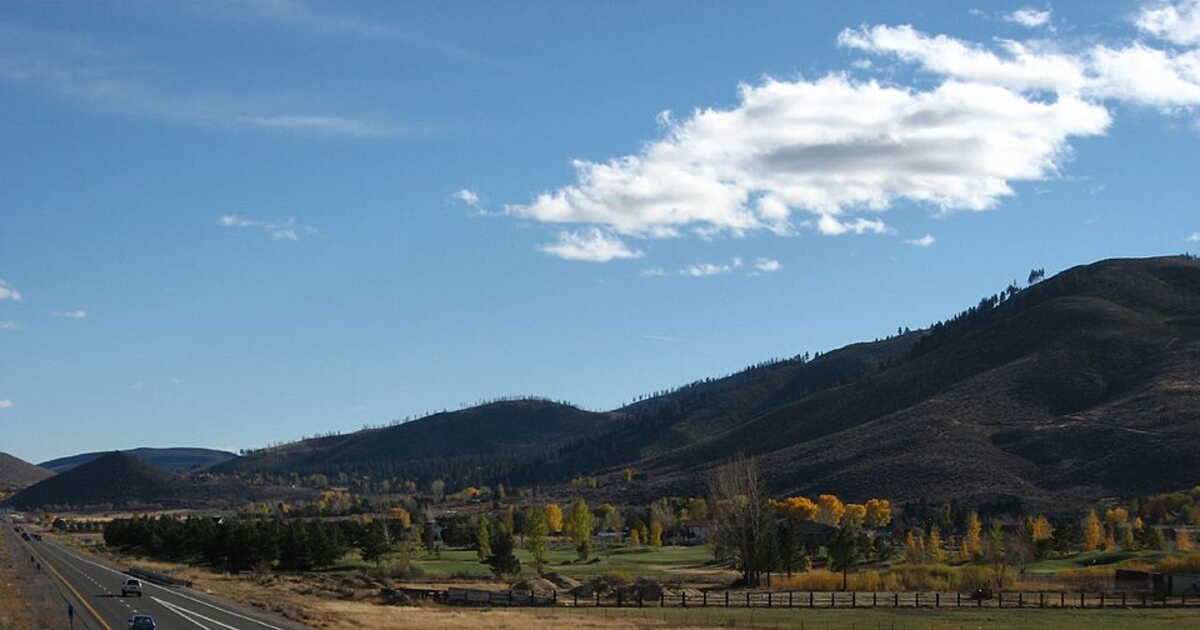
Stretching from Death Valley to the Tioga Pass peaks and passing through Yosemite National Park, the Eastern Sierra Tour offers 900 kilometers of magic and breathtaking views along the Nevada border. Arriving at San Francisco International Airport, head toward Truckee, about four hours from the coast by road. After an awe-inspiring view of the Golden Gate Bridge, you cross America’s granary, the region that produces the majority of the world’s nut crops we eat: almonds, pistachios, walnuts… And more incredible places await us.
To the north, Truckee and the cannibals
A few miles north of Lake Tahoe, Truckee cultivates a vibe different from California’s big cities. Here, there are no extravagant villas or Silicon Valley offices; local life is shaped by proximity to the mountains. The town attracts hikers, skiers and lovers of wide-open spaces, many of whom live there year-round.
On its main street, wooden facades and historic buildings recall the era of the Westward expansion. Behind this Western backdrop, one discovers a small, lively town, with restaurants, independent bookstores and record shops.
For a real American breakfast, head to the “Jax’s at the Tracks Diner” located in an old railcar, right beside the rail line connecting San Francisco to Chicago. Here, you can enjoy fluffy pancakes or a breakfast burrito before hitting the road.
A few kilometers further, we discover Donner Summit and its adjacent lake. It is in this mountainous region that the infamous Donner Party became trapped during the winter of 1846-1847. Departing from the East to reach California, this group of pioneers, consisting of several families, was blocked by exceptional snowfall. Of the roughly 87 expedition members, only 48 survived. Some of the survivors resorted to cannibalism to stay alive.
Lake Tahoe, crystal-clear waters and mountains
Lake Tahoe, straddling California and Nevada, covers 502 square kilometers and has about 116 kilometers of shoreline. It is one of the largest alpine lakes in North America.
Here, the first surprise comes from the water’s clarity. And there are no shortages of activities to enjoy it. Sailboats, motorboats, paddles and kayaks let you explore its shores from the water. The curious can even opt for a transparent kayak to observe the bottom in shallow zones.
But Tahoe isn’t just about water sports. In winter, its ski resorts attract winter sports enthusiasts, notably Palisades Tahoe, formerly Squaw Valley, which hosted the 1960 Winter Olympics. In the sunny season, the slopes turn into hiking and mountain biking terrain.
It is also in this region that the Pacific Crest Trail passes. Spanning about 4,265 kilometers, this legendary trail links the Mexican border to the Canadian border, crossing California, Oregon and Washington. Hikers who undertake the entire journey typically dedicate nearly five months to it!
Ghost towns and salt lakes
To leave Tahoe, the ideal route is to pick up US 395, the scenic highway that traverses deserts and mountains, heading to Mammoth Lakes. Along the way, stop at Bodie State Historic Park. Today, only coyotes reside there. They live in the wild, since hunting is prohibited in what is now a state park since 1962. Thus, they are quite curious about the humans who come to visit—but still, avoid stepping out of your car.
The inhabitants abandoned this spaghetti-western ghost town in 1942 because of the war, freezing the mining town in time. Preserved, “as is”, you can step into the saloon where Coca-Cola bottles sit alongside an old Levi’s jacket left there, and where the old jail and the bank are the last relics of a district that burned. Bodie was one of the region’s largest towns, and many films were shot there. Hell’s Heroes, released in 1930, is the last western to have found life on these lands.
A little further south, about a half-hour drive away, Mono Lake offers a landscape opposite to these desert expanses. Here, as the mountains separate us from Yosemite, we find Mono Lake, twice as salty as the ocean. Its most spectacular feature lies in its “tufa towers,” strange calcite formations that emerge from the water and create an almost unreal backdrop. These towers are not volcanic rocks, despite their appearance. They form underwater when the fresh waters from underground sources, rich in calcium, meet the lake’s alkaline waters. Calcium carbonate then gradually deposits. When the lake level drops, these formations that were submerged become fully visible. Swimming there is not really advised. Here, migratory birds mainly come for a lunch break.
Less than an hour by car, head to the Hot Creek geological site. Here, snowmelt water seeps deep underground and is heated by magma from an ancient volcano, creating numerous hot springs accessible via a hiking trail. But swimming is not allowed yet. Bathing is strictly prohibited due to the water’s temperature, and many people have died there in the past.
Bishop and the ancient pines
Last stop on this road trip through the United States, Bishop offers the vibe of a small mountain town at the foot of the White Mountains and the Sierra Nevada. The area is deeply tied to the history and culture of Indigenous peoples, notably the Bishop Paiute Tribe.
Each year, the Bishop Pabanamanina Pow Wow brings together participants from different Native American communities. Traditional dances, songs and gatherings allow visitors to discover traditions well away from touristy, folkloric representations. Because dates vary, it’s best to check with the community before planning your stay.
Before leaving the region, two excursions deserve to prolong the journey. The first takes you to Sabrina Lake, near the Aspendell hamlet. Surrounded by mountains and forests, this high-altitude lake is spectacular in autumn when the foliage turns golden.
The second leads into the White Mountains, to the Ancient Bristlecone Pine Forest. At first glance, the landscape seems almost hostile: rocky ground, sparse vegetation, and gnarled trees sculpted by the wind. Yet these Bristlecone pines are among the oldest individual organisms on the planet. These trees, which seem to belong to a distant cartoon realm, are nearly 5,000 years old in some cases, which is moving. So, before setting off again, why not take the opportunity to experience sylvotherapy and give one of them a hug?