

You don’t simply visit the Canal du Midi. You traverse it.
At the wheel of a license-free boat, by bicycle along the towpaths, on foot in the villages or from the terrace of a winery, everyone designs their own itinerary.
It is undoubtedly this ability to offer multiple ways of traveling that explains why, thirty years after its UNESCO World Heritage inscription, the Canal du Midi remains the emblematic destination of French inland-waterway tourism.
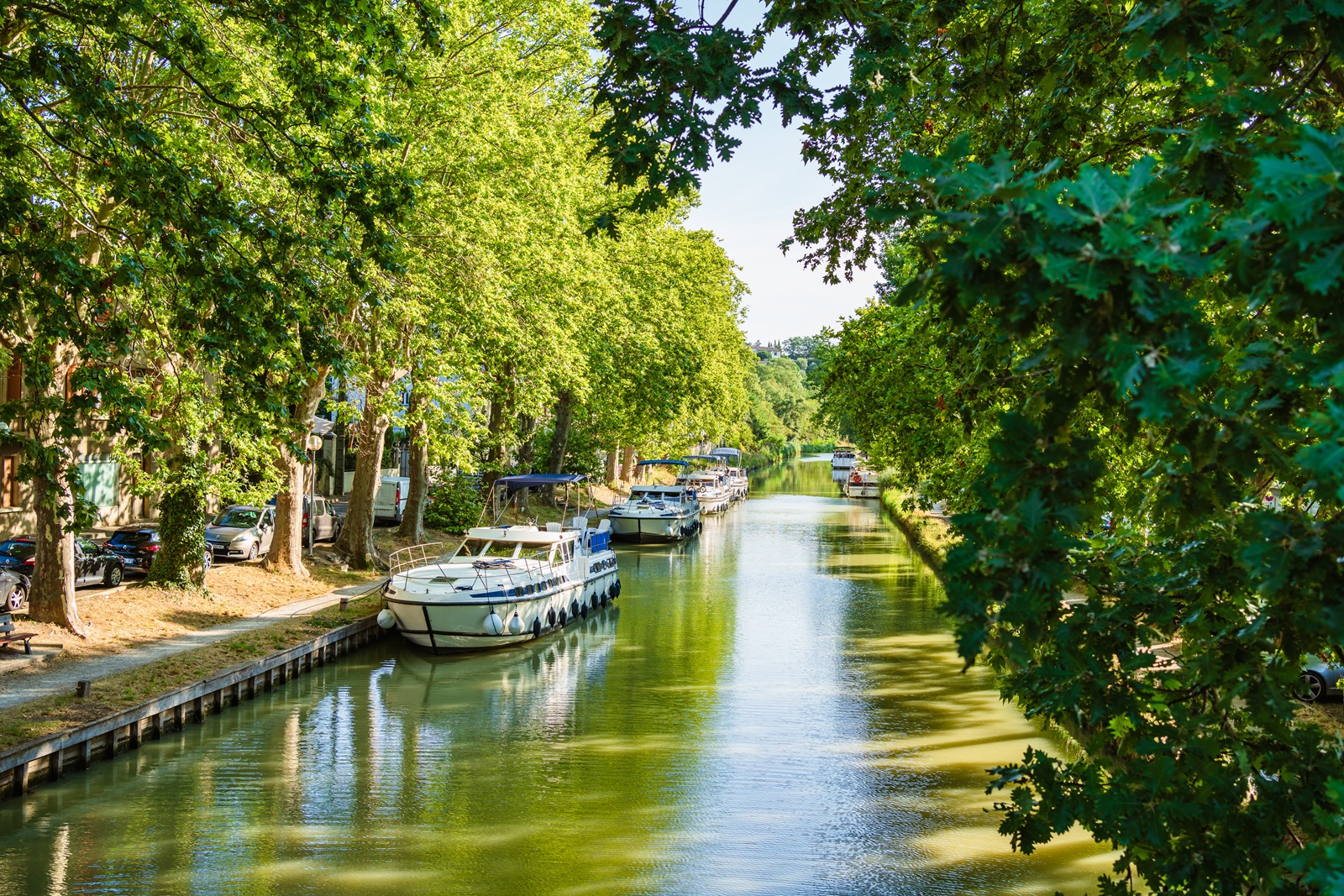
When UNESCO distinguished, in 1996, this feat imagined by Pierre-Paul Riquet in the 17th century, it saluted as much an engineering masterpiece as an exceptional cultural landscape. Four centuries later, the 240 kilometers linking Toulouse to the Étang de Thau remain navigable and continue to shape the territories they traverse.
The canal also constitutes the central link in a genuine waterway crossing of France, connecting the Atlantic to the Mediterranean thanks to the Canal de Garonne. A continuity that underlines the singularity of the Canal des Deux-Mers. Today, a recreational boater can still travel from Bordeaux to Sète without leaving inland waterways.
At the wheel of a license-free boat, by bicycle along the towpaths, on foot in the villages or from the terrace of a winery, everyone designs their own itinerary.
It is undoubtedly this ability to offer multiple ways of traveling that explains why, thirty years after its UNESCO World Heritage inscription, the Canal du Midi remains the emblematic destination of French inland-waterway tourism.
When UNESCO distinguished, in 1996, this feat imagined by Pierre-Paul Riquet in the 17th century, it saluted as much an engineering masterpiece as an exceptional cultural landscape. Four centuries later, the 240 kilometers linking Toulouse to the Étang de Thau remain navigable and continue to shape the territories they traverse.
The canal also constitutes the central link in a genuine waterway crossing of France, connecting the Atlantic to the Mediterranean thanks to the Canal de Garonne. A continuity that underlines the singularity of the Canal des Deux-Mers. Today, a recreational boater can still travel from Bordeaux to Sète without leaving inland waterways.
The locomotive of river tourism
 The UNESCO designation has greatly contributed to the Canal du Midi’s international renown. Today, it accounts for nearly 30% of French inland-waterway tourism, a status that professionals observe each season.
« Our number one destination remains the Canal du Midi, ahead of Burgundy », confirms Anne-Fleur Noual, marketing director of Riverly. This position illustrates the enduring appeal of this waterway among both French and international audiences.
European leader in no-license boat rental, Le Boat also makes it one of its flagship destinations. The operator notes that the Canal du Midi accounts for almost 30% of its bookings made in France and presents it as a “living heritage”, discovered as much along the water as at the stops.
The Canal du Midi: the laboratory of “fluvestre” tourism
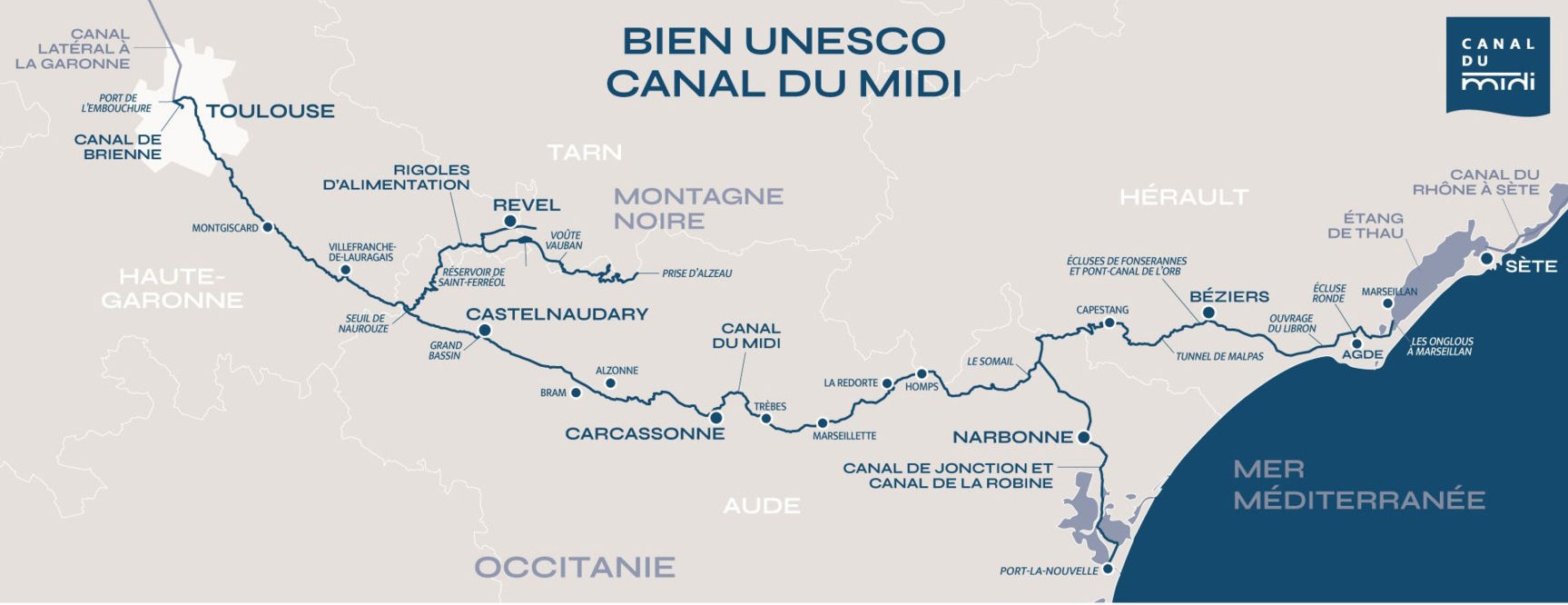
This success is also explained by the evolution of practices. The Canal du Midi is no longer limited to navigation: it has become one of the best illustrations of the “fluvestre” tourism, where experiences on the water naturally extend onto land.
Boaters alternate cycling along the towpaths, visits to Carcassonne, Castelnaudary or Le Somail, tastings in the Minervois vineyards and gastronomic discoveries. Cyclists, for their part, traverse the 240 kilometers from Toulouse to Sète, sometimes in three days, sometimes in a week, at the pace of villages and locks.
This complementarity between navigation, gentle itineraries, heritage and gastronomy today makes the Canal du Midi far more than a simple nautical destination. It makes it a fully-fledged tourist destination, capable of appealing to boaters as well as cyclists or wine-tourism enthusiasts.
Boaters alternate cycling along the towpaths, visits to Carcassonne, Castelnaudary or Le Somail, tastings in the Minervois vineyards and gastronomic discoveries. Cyclists, for their part, traverse the 240 kilometers from Toulouse to Sète, sometimes in three days, sometimes in a week, at the pace of villages and locks.
This complementarity between navigation, gentle itineraries, heritage and gastronomy today makes the Canal du Midi far more than a simple nautical destination. It makes it a fully-fledged tourist destination, capable of appealing to boaters as well as cyclists or wine-tourism enthusiasts.
The water challenge
The Canal du Midi owes its success not only to its history or its landscapes. To stay navigable, it now undergoes increasingly refined management in response to climate change.
« The years 2022, 2023 and 2025 were marked by episodes of severe drought in the Adour-Garonne basin, which concentrates a significant portion of the national water deficits » explains Jean Niquet, head of the Infrastructure, Water and Environment Service of Voies navigables de France Sud-Ouest.
Despite these conditions, the network operator has managed to preserve tourist activity. « On the Canal du Midi, navigation was nonetheless maintained at 99.8% of traffic during these difficult years. On the Canal latéral à la Garonne, no interruptions were recorded », he notes.
To achieve this, VNF has profoundly adapted its hydraulic management. « We raised the Saint-Ferréol dam operating level by 12%, organized water transfers from Montagne Noire to Ganguise, and implemented targeted restrictions at the end of the season », details Jean Niquet.
Beyond these adaptations, VNF also continues replacing the plane trees affected by the colored canker, the maintenance of civil engineering works and the preservation of landscapes that earned the Canal du Midi its World Heritage inscription.
« The years 2022, 2023 and 2025 were marked by episodes of severe drought in the Adour-Garonne basin, which concentrates a significant portion of the national water deficits » explains Jean Niquet, head of the Infrastructure, Water and Environment Service of Voies navigables de France Sud-Ouest.
Despite these conditions, the network operator has managed to preserve tourist activity. « On the Canal du Midi, navigation was nonetheless maintained at 99.8% of traffic during these difficult years. On the Canal latéral à la Garonne, no interruptions were recorded », he notes.
To achieve this, VNF has profoundly adapted its hydraulic management. « We raised the Saint-Ferréol dam operating level by 12%, organized water transfers from Montagne Noire to Ganguise, and implemented targeted restrictions at the end of the season », details Jean Niquet.
Beyond these adaptations, VNF also continues replacing the plane trees affected by the colored canker, the maintenance of civil engineering works and the preservation of landscapes that earned the Canal du Midi its World Heritage inscription.