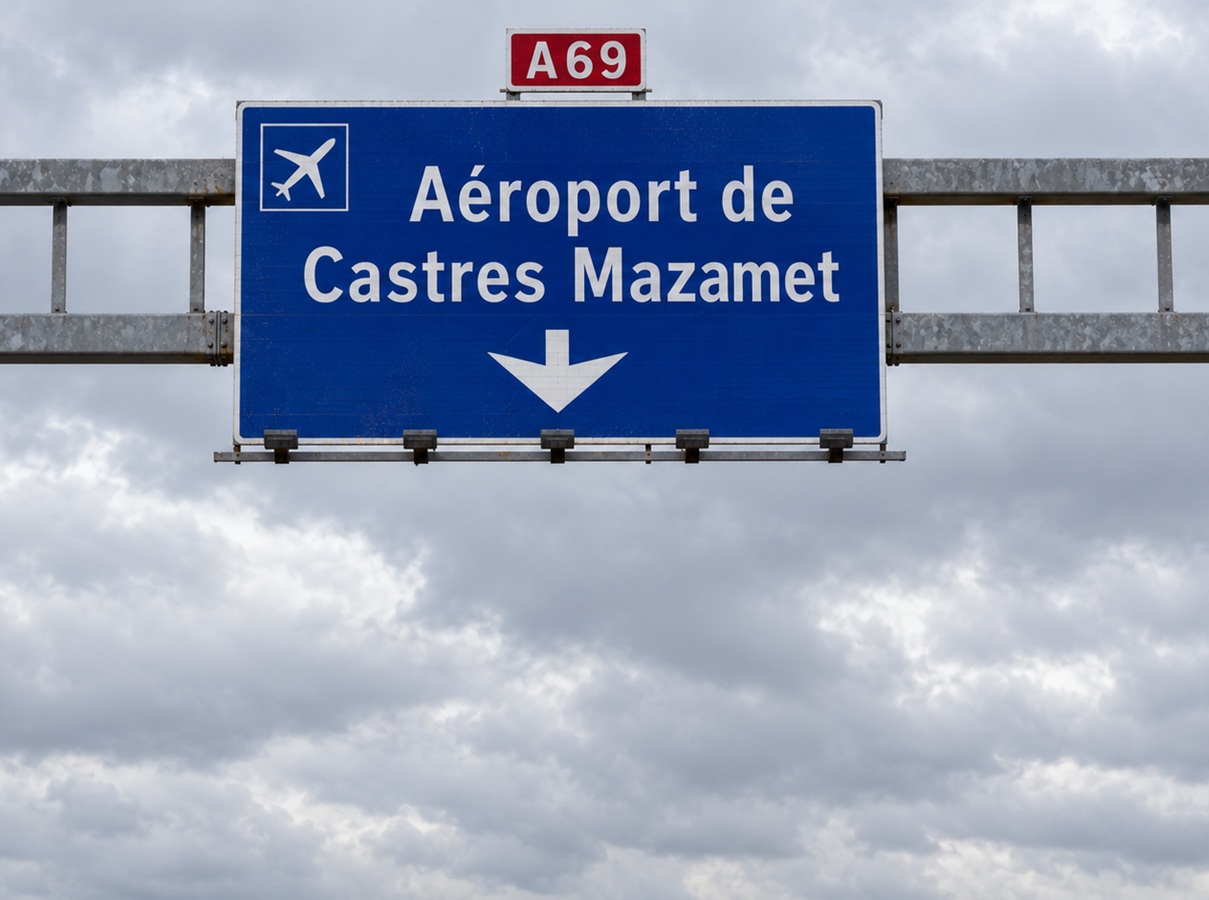


They were protesting the opening of the A69 motorway, connecting Castres to Toulouse.
This stretch, declared a public utility in July 2018, was slated to be inaugurated on October 15, 2026. Because of protests and last-minute security checks, the ribbon-cutting was postponed to the first week of November, with no exact date.
Before reaching that point, the project had generated a great deal of ink and sparked strong opposition in the region because of its environmental cost. And, almost a unique case in France, it also cast a shadow over the maintenance of an airport, namely Castres.
“We are in total uncertainty about the Castres-Paris line, which has been operated by Chalair for three years now. We are reaching the end of the DSP (public service delegation). The State tells us that, since we have the highway, it will terminate the DSP, simply to save money.
We do not want the State to disengage from its obligation of public service“, laments a worker in the Castres airport control tower.
Castres Airport: End of State Subsidy and Abandonment of Works
 Even though Reims did have an airport that was forced to close its passenger terminal in 2006, just six years after its renovation, due to modernization costs and the opening of the TGV Est line, commercial airports closing in France are a rare thing.
Yet, the threat weighs on the handful of Castres employees, who have experienced real roller-coaster months lately.
“This is an airport that was built in 1990. It opened up Tarn and the Castres metropolitan area, while the nearest high-speed line is in Bordeaux (300 km from Castres).
The Pierre Fabre group, a major local employer, is behind the airport. It also owns the rugby team, Castres Olympique.
Thirty years ago, it actively participated in the airport’s creation to ferry its executives. The problem is that since its creation there has been no strategic and commercial development, explains a disheartened employee.
Imagine that in 2025, only 30,259 passengers used the airport, a figure that, while up 6.6% from 2024, is entirely tied to its sole commercial route serving Paris Orly.
Aside from this activity, the facility hosts the aero club, some private jets, and the nearby parachute regiment.
“Without the OSP (public service obligation) for the Castres-Paris route, the airport cannot survive.
And then we face a second problem with our runway. It measures 1,820 meters in length and 30 meters in width. To develop Castres-Mazamet, we would have to rebuild the runway to accommodate larger aircraft, and because its surface is at the end of its life“, continues our interlocutor.
The total envelope for resurfacing the asphalt exceeds 6 million euros. This financing requires the agreement of the partners of the Castres-Mazamet airport joint authority.
The region and the department condition their participation in the runway’s refurbishment on the continuation of commercial activity, even though there is no “certainty about the future use of the infrastructure“.
Castres Airport vs A69: The State Favors the Highway, but…
But for several months now, the executive has faced strained finances and must quickly trim the budgets at the Treasury. To do so, it is conducting a spending purge.
Yet, by the end of 2025, the threat of cutting funding for the public service delegation loomed, and it was not only dependent on the 2026 Finance Bill.
“To accompany local authorities until the A69 comes into service, which will give Castres residents faster and smoother access to Toulouse, the public service delegation signed in 2023 for the Castres-Paris line, due to expire at the end of May 2026, was extended to mid-October 2026, the Ministry of Transport succinctly informed us, anticipating the line’s closure in October.
[The State’s financial commitment is maintained for this period.] The airport infrastructure will remain operational for business aviation and for its military activities.
And now the famous A69 returns to the forefront. At the start of September, the operator of the Castres-Paris line was also mired in total uncertainty, navigating day to day.
Alain Battisti, head of Chalair, told us then that he could not see clearly and wanted to know what would become of the service, just 15 days before the subsidy ended.
The road, which had shown a certain commercial success, was then weighed against the entirely new highway. It became the focus of a fierce battle between associations on one side and local elected officials and the Castres economic ecosystem, including the Pierre Fabre group, which had actually launched the airport.
Castres Airport: 185 Euros in Subsidies per Flight Ticket!
“The Toulouse airport is nonetheless about 1 hour and 20 minutes by car. We’ll gain 20 minutes, but it’s 90 kilometers away. So it isn’t a 60-kilometer stretch that will relieve our city,” he fumes.
The concessionaire, for its part, announced a time saving of about thirty minutes. Users will form their own judgment.
Yet the other potential bad surprise is the unfavorable opinion of the Conseil d’État regarding subsidies granted by local authorities to reduce toll prices by around 33%.
Without this authorization, the bill will rise from 12 to 20.40 euros for a round trip, enough to call into question the real value of such a stretch.
With the highway turning out to be not as advantageous and more expensive than expected, the maintenance of the air service under the public service delegation for the Tarn sub-prefecture has again become a priority in recent weeks.
“You have the workers whose position we understand well, then there are all the elected officials, the companies… the entire local fabric that wants to keep its airport“, explains the agglomeration.
It is a foundational infrastructure for the city, not so much for the general public, but for businesses, because the airport is near a very dense business zone, one of the most active in the Tarn. It also affects the image and attractiveness of our territory.
Thus, in response to the anger of the local authorities, the government did a U-turn. It was decided to extend the State subsidy in support of the service until 31 December 2026.
Local authorities reached a financial agreement to keep the line, but without Paris’s backing, the service will be provided at a reduced frequency from January 2027, and this will continue until the following May.