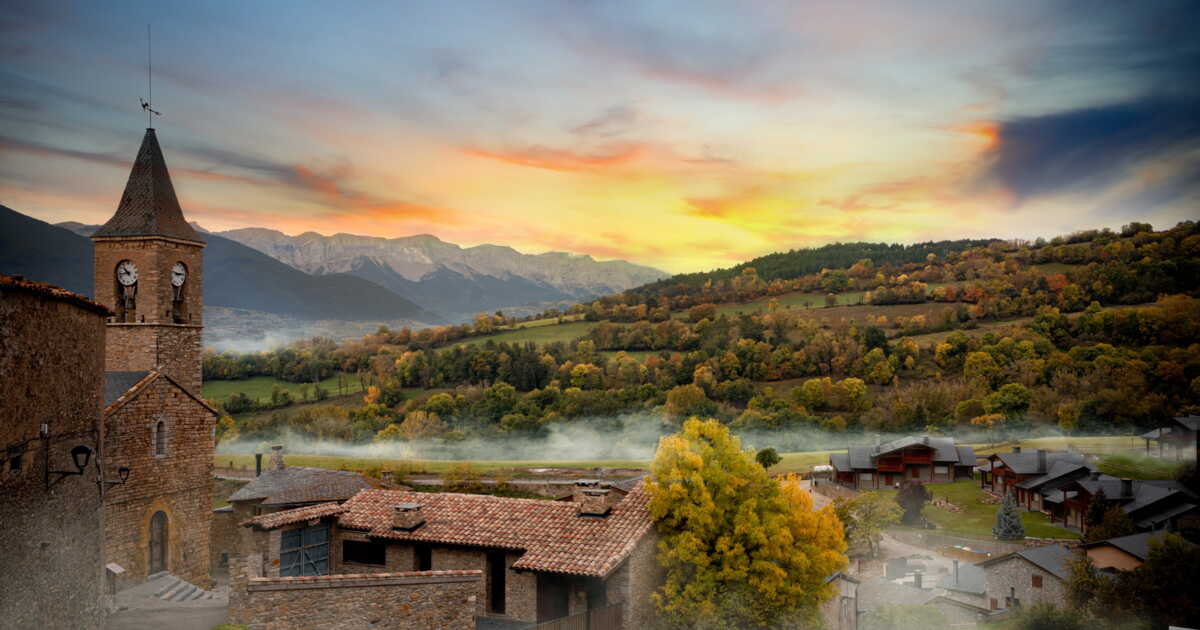
From the volcanic rims of Garrotxa to the lush valleys of the Val d’Aran, a journey to five experiences for enjoying the mountains at your own pace, far from the summer bustle.
Sponsored article by Visit Pirineus – Tourist Office of Catalonia
Admire the autumn colors in Garrotxa’s volcanic forests
Volcanic rocks cloaked in vegetation, forests turning golden, and medieval villages: in the eastern foothills of the Catalan Pyrenees, Garrotxa presents a singular landscape. With autumn’s arrival, its volcanic scenery unfolds into a real mosaic of colors. It’s the perfect excuse to lace up your hiking boots and set off to explore a region where nature seems to have reclaimed its domain. Among the must-see sites, the Fageda d’en Jordà deserves a detour on its own. This beech forest grows on an ancient lava flow from the Croscat volcano, and it impresses with gently rolling terrain, punctuated by small mounds called tossols and slender, towering trees. At this time of year, the leaves blanket the paths in a thick coppery layer as light filters through the trunks. Several trails let you walk through the forest and explore the Garrotxa Volcanic Zone Natural Park. After the stroll, head to Santa Pau, a stone village whose narrow lanes, arches, and ancient houses invite you to extend the experience.
Traveling from village to village along the Ripollès trails
And what if the best way to discover mountain villages was simply to join them on foot? In Ripollès, the trails wind between wooded valleys, meadows, and small towns that have kept their character. Some follow ancient communication routes once used by locals to move from one settlement to another. A entirely different take on hiking, allowing time to pause in the villages you pass through. Among them, Beget looks as if it came straight out of a postcard. Nestled in a green setting, this small town enchants with its stone houses and bridges, as well as its cobbled lanes. But its main treasure lies behind the walls of the Sant Cristòfol church, a Romanesque edifice whose current architecture dates largely to the 12th century. Inside is preserved the Majesty of Beget, a substantial polychrome wooden sculpture representing Christ on the cross, towering at about two meters. Dating from the same period, it ranks among the remarkable works of Catalan Romanesque art.
Savor seasonal products in the Cerdanya
Continuing to the west, the landscape changes. In Cerdanya, valleys open onto wide meadows, surrounded by mountains that sketch the horizon. Known for its sunshine and panoramas, this region of the Catalan Pyrenees is especially suited for autumn getaways. But here, the season is savored also on the plate! With the first rains and the return of cooler temperatures, mushrooms appear in the forest undergrowth. Cepes (porcini), delicious lactarius mushrooms, and other edible varieties take pride of place in the local cuisine. They appear on market stalls and on restaurant menus, alongside artisanal cheeses and cured meats. It’s also impossible to miss trinxat, one of the region’s emblematic specialties. This hearty dish, made from potatoes, cabbage, and pork, perfectly illustrates mountain cooking: simple, nourishing, and rooted in local produce.
Explore the glacial lakes and the vast landscapes of Pallars Sobirà
Want to gain a bit more height? Head to Pallars Sobirà, where the Catalan Pyrenees reveal their most spectacular face. It’s here that Catalonia’s highest peaks rise, starting with Pica d’Estats, which peaks at 3,143 meters. Between jagged mountains, deep valleys, and torrents, the region provides a fantastic playground for hiking enthusiasts. The area gives access to two exceptional natural spaces: the Alt Pirineu Natural Park, the largest in Catalonia, and the Aigüestortes i Estany de Sant Maurici National Park, the only Catalan national park, spanning several Pyrenean territories. This latter park is renowned for its more than 200 glacial lakes, nestled at altitude. Trails let you discover these bodies of water, as well as waterfalls and gorges, through hikes suitable for different levels, depending on routes and weather conditions.

Listen to the deer’s rut in the Val d’Aran forests
At the western end of the Catalan Pyrenees, the Val d’Aran offers a completely different atmosphere. Under the influence of the Atlantic climate, this valley is characterized by lush landscapes, expansive wooded areas, and rugged mountains with sharp reliefs. In autumn, when the broadleaved trees don vibrant colors, nature presents a spectacle as impressive as it is unusual: the deer’s rut. The forests resonate with the hoarse calls of males during the mating season. These powerful cries, aimed at attracting females and intimidating rivals, are especially audible at dusk and at dawn. To enjoy this experience without disturbing the animals, guided outings led by specialists are offered in the Val d’Aran. From designated observation points, visitors can appreciate the sonic spectacle and, with a bit of luck, glimpse the stags in their natural environment. An original way to discover the mountains, taking time to observe them… and above all, to listen.