

We were already aware of aviation’s CO2 emissions and their impact on global warming. We must now reckon with condensation trails, those white lines left by airplanes in the sky.
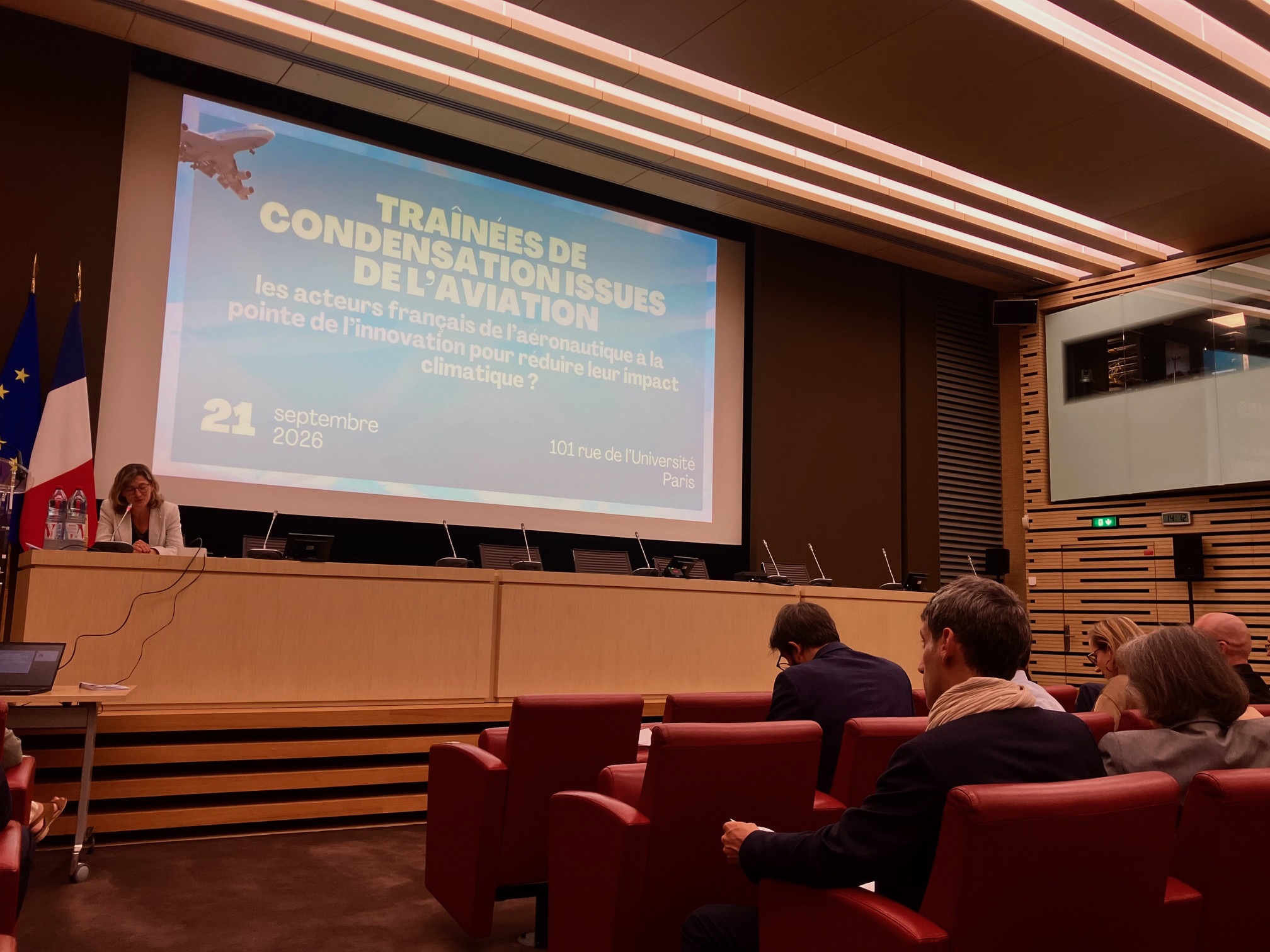
The topic was at the heart of a second symposium held at the National Assembly on September 21, bringing together elected officials, experts and professionals, notably from Airbus, Thales or Air France.
“This issue remains relatively unknown but is beginning to come to light,” recalled Christine Arrighi, Green Party deputy for Haute-Garonne and co-chair of the Aeronautics and Space Study Group, during a press conference held on the margins of the symposium.
While regretting that it had long been swept under the rug even though scientists were aware of it. “We can be pioneers on the subject. Last year, the focus was on the assessment. We must now move to practice, at a European level and then globally. We need a collective commitment, with the State taking the lead,” she adds.
The topic was at the heart of a second symposium held at the National Assembly on September 21, bringing together elected officials, experts and professionals, notably from Airbus, Thales or Air France.
“This issue remains relatively unknown but is beginning to come to light,” recalled Christine Arrighi, Green Party deputy for Haute-Garonne and co-chair of the Aeronautics and Space Study Group, during a press conference held on the margins of the symposium.
While regretting that it had long been swept under the rug even though scientists were aware of it. “We can be pioneers on the subject. Last year, the focus was on the assessment. We must now move to practice, at a European level and then globally. We need a collective commitment, with the State taking the lead,” she adds.
Delaying aviation-related climate warming by ten years
Concretely, the water vapor and combustion soot from aircraft form droplets that freeze, creating trails that persist in the atmosphere and would contribute to climate warming at a level similar to aviation’s CO2 emissions.
To raise public awareness and advance the sector, Christine Arrighi can rely on a new Klima Consulting report, commissioned by the NGO T&E (Transport & Environment).
“It concludes that the scientific evidence is now sufficiently robust. By partially avoiding the formation of these trails, one could delay aviation-related warming by ten years,” says Jérôme du Boucher, Deputy Director of Aviation for the Brussels-based NGO.
Read also: Why the increase in taxes on air transport is necessary for its decarbonization
To raise public awareness and advance the sector, Christine Arrighi can rely on a new Klima Consulting report, commissioned by the NGO T&E (Transport & Environment).
“It concludes that the scientific evidence is now sufficiently robust. By partially avoiding the formation of these trails, one could delay aviation-related warming by ten years,” says Jérôme du Boucher, Deputy Director of Aviation for the Brussels-based NGO.
Read also: Why the increase in taxes on air transport is necessary for its decarbonization
T&E calls for rapid implementation of measures
“Starting avoidance in 2030, aviation’s contribution to warming could reach 0.08° C in 2025 rather than 2040,” he adds, urging the swift adoption of measures.
They could be incorporated within the framework of the ongoing revision of the European carbon market by the European Commission, through free quotas for airlines that commit to the issue.
He notes, however, that these avoidance measures would not by themselves reduce the sector’s climate impact. Other measures are “necessary, such as the development of the synthetic fuels sector and the moderation of traffic.”
They could be incorporated within the framework of the ongoing revision of the European carbon market by the European Commission, through free quotas for airlines that commit to the issue.
He notes, however, that these avoidance measures would not by themselves reduce the sector’s climate impact. Other measures are “necessary, such as the development of the synthetic fuels sector and the moderation of traffic.”
Trails that form in cold, humid zones
On paper, intervening seems relatively straightforward and inexpensive. For these trails appear mainly in cold and humid regions.
They form most often in winter, at night and at high altitude. This is especially the case for transatlantic flights. It still requires more precise weather forecasting to accurately identify the affected zones.
“3% of flights generate 80% of the warming from condensation trails. This greatly helps us. It is difficult to implement blanket avoidance, but we can do it gradually, focusing on flights with the highest impact, particularly in winter when air traffic is lower,” adds Jérôme du Boucher.
They form most often in winter, at night and at high altitude. This is especially the case for transatlantic flights. It still requires more precise weather forecasting to accurately identify the affected zones.
“3% of flights generate 80% of the warming from condensation trails. This greatly helps us. It is difficult to implement blanket avoidance, but we can do it gradually, focusing on flights with the highest impact, particularly in winter when air traffic is lower,” adds Jérôme du Boucher.
Coordinated efforts between airlines and air traffic control
A change in routes (notably their altitude) or flight times to avoid zones that promote these trails requires sustained and coordinated efforts between Eurocontrol, which harmonizes European air navigation, the air traffic control bodies, and the airlines.
Airlines, for example, need to integrate a forecast tool for condensation trails into their flight planning software and train dispatchers who draw up flight plans and the pilots.
The network manager, for its part, must establish rules and procedures for a harmonized organization and to prevent airspace congestion. Moreover, current geopolitical problems can complicate the reorganization of flight schedules.
Airlines, for example, need to integrate a forecast tool for condensation trails into their flight planning software and train dispatchers who draw up flight plans and the pilots.
The network manager, for its part, must establish rules and procedures for a harmonized organization and to prevent airspace congestion. Moreover, current geopolitical problems can complicate the reorganization of flight schedules.