


In early February, French tour operators were “content” and “anticipating a third consecutive year in the black“.
Since then, the war in the Middle East has largely shuffled the deck.
Nevertheless, summer 2026 should not end too painful for French tour operators thanks to the resumption of immediate departures since June 1, as Patrice Caradec, president of the Syndicat des entreprises du tour-operating (SETO), stated at his latest press conference before the summer break on the morning of Thursday, July 2, 2026.
Even better, early bookings for winter 2026-27 are “encouraging“: they offer hope for “a rebound in sales for the coming winter“.
While trying to stay positive, the SETO president did not hide that the context was fragile: “The French have a fairly tight budget”, he repeated several times. And he emphasized: “the desire to travel is still there but they save, they do not want to decide too quickly”. And he concluded with this nice line: “one must distinguish between the willingness to purchase and purchasing power“.
Also read: Patrice Caradec (SETO) calls agencies “to reinvigorate the market”
Since then, the war in the Middle East has largely shuffled the deck.
Nevertheless, summer 2026 should not end too painful for French tour operators thanks to the resumption of immediate departures since June 1, as Patrice Caradec, president of the Syndicat des entreprises du tour-operating (SETO), stated at his latest press conference before the summer break on the morning of Thursday, July 2, 2026.
Even better, early bookings for winter 2026-27 are “encouraging“: they offer hope for “a rebound in sales for the coming winter“.
While trying to stay positive, the SETO president did not hide that the context was fragile: “The French have a fairly tight budget”, he repeated several times. And he emphasized: “the desire to travel is still there but they save, they do not want to decide too quickly”. And he concluded with this nice line: “one must distinguish between the willingness to purchase and purchasing power“.
Also read: Patrice Caradec (SETO) calls agencies “to reinvigorate the market”
The impact of the war in the Middle East
To begin with, the war in the Middle East has affected the tail end of the 2025-26 season, “nibbling away the progress made up to February“.
Result: SETO members posted revenue growth of only +2.5% for the period November 1, 2025 – April 30, 2026, with a per-booking revenue up by +1.1%. However, in France, strong ski performances boosted sales figures by +5.5%.
With the outbreak of the war in the Middle East, security uncertainty became evident: “the French were sometimes afraid to depart and not return“, according to Patrice Caradec.
Consequently, rising fuel prices, higher airplane tickets, and renewed inflation halted the momentum observed until then.
By the end of February, summer 2026 looked positive with +5.4% in business volume and +4.1% in the number of customers.
Alas, after three months (March, April, May) of significantly declining orders, SETO noted by the end of May — a period during which 73% of the summer’s activity had been completed — 85,000 fewer customers than in 2025 and 100 million less in business volume.
“As of May 31, we were down -6.7% across all summer sales, with 1.183 million customers“, emphasized Patrice Caradec. “To reach the Summer 2025 finale, there are 600,000 customers left to book for departures up to October 31, 2026.”
Result: SETO members posted revenue growth of only +2.5% for the period November 1, 2025 – April 30, 2026, with a per-booking revenue up by +1.1%. However, in France, strong ski performances boosted sales figures by +5.5%.
With the outbreak of the war in the Middle East, security uncertainty became evident: “the French were sometimes afraid to depart and not return“, according to Patrice Caradec.
Consequently, rising fuel prices, higher airplane tickets, and renewed inflation halted the momentum observed until then.
By the end of February, summer 2026 looked positive with +5.4% in business volume and +4.1% in the number of customers.
Alas, after three months (March, April, May) of significantly declining orders, SETO noted by the end of May — a period during which 73% of the summer’s activity had been completed — 85,000 fewer customers than in 2025 and 100 million less in business volume.
“As of May 31, we were down -6.7% across all summer sales, with 1.183 million customers“, emphasized Patrice Caradec. “To reach the Summer 2025 finale, there are 600,000 customers left to book for departures up to October 31, 2026.”
Not a summer too deadly in sight
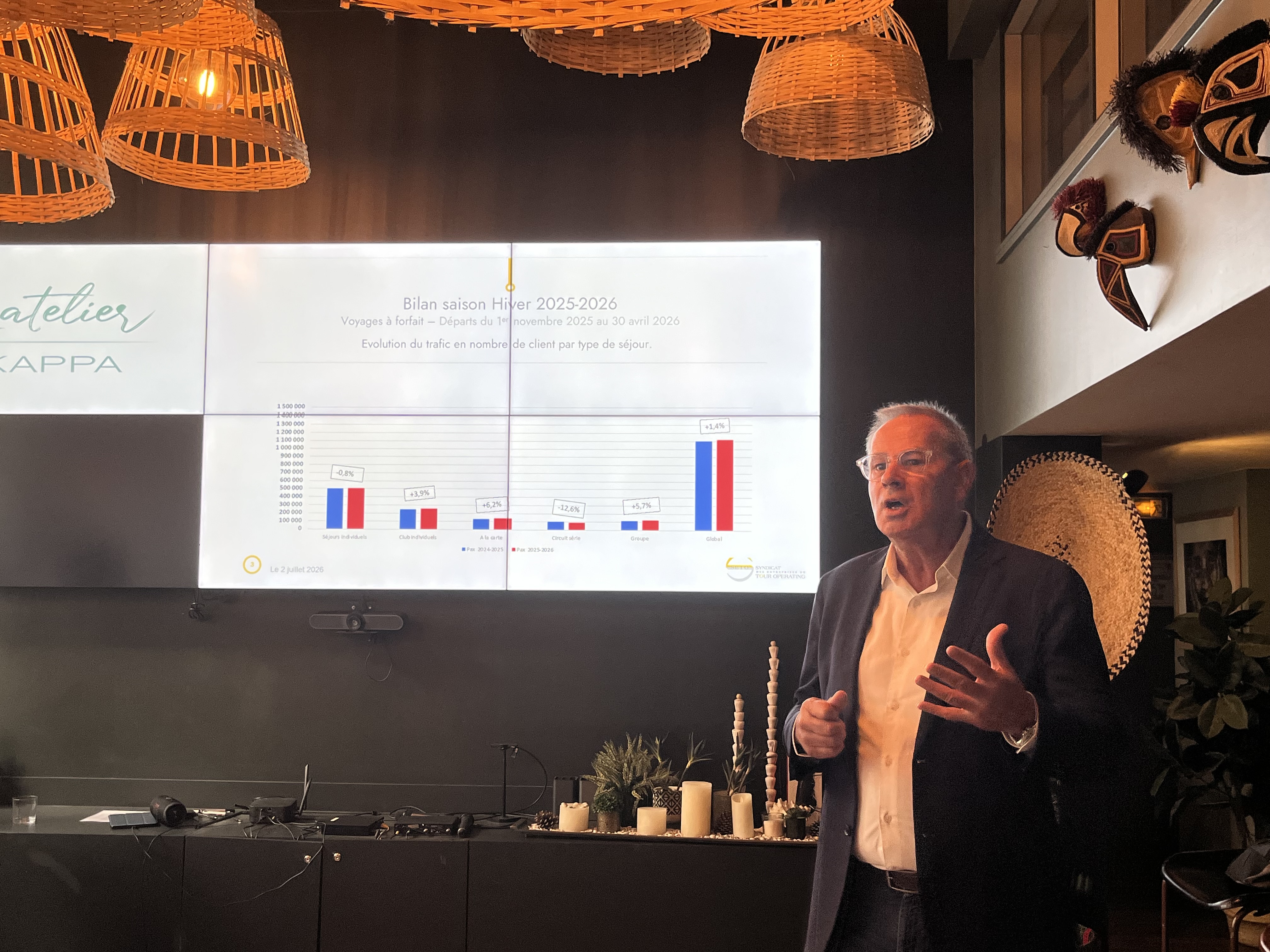
Nevertheless, summer 2026 (this season ends on October 31) should not be catastrophic. “At -6%, I would sign“, replied Patrice Caradec.
In June, sales stopped falling, even though the heatwave had a slight impact and the latest field feedback points to a rebound for immediate departures. In July and August, departures remain “still under strain” (respectively -7% and -9%).
In terms of customers, group tours drop (-19.5%), individual stays retreat (-9.4%). Only clubs hold steady (-0.5%).
The higher fuel costs continue to weigh on departure intentions. “Airlines that raised their fares very quickly are slow to remove fuel surcharges“, Patrice Caradec noted with some surprise. He also urged Air France to push in this direction after noting that the price of a barrel had fallen to 73 dollars on international oil markets.
“The heart of summer and the late season could offset the volume shortfall of recent months“, Caradec nevertheless argued.
In June, sales stopped falling, even though the heatwave had a slight impact and the latest field feedback points to a rebound for immediate departures. In July and August, departures remain “still under strain” (respectively -7% and -9%).
In terms of customers, group tours drop (-19.5%), individual stays retreat (-9.4%). Only clubs hold steady (-0.5%).
The higher fuel costs continue to weigh on departure intentions. “Airlines that raised their fares very quickly are slow to remove fuel surcharges“, Patrice Caradec noted with some surprise. He also urged Air France to push in this direction after noting that the price of a barrel had fallen to 73 dollars on international oil markets.
“The heart of summer and the late season could offset the volume shortfall of recent months“, Caradec nevertheless argued.
France fares well, but the Mediterranean islands don’t
France, sixth in SETO’s Top 10, is the only destination showing growth.
It is driven by the mountains, which are filling up thanks to their dynamism, attractiveness, and new activities on offer. “However, the business volume does not necessarily rise due to constrained budgets“, Caradec reminded.
A finding to be weighed against the underperformances of other destinations, particularly island destinations.
Thus, despite a -3% dip, Spain remains at the top of summer destinations for package holidays, thanks to solid performances on the mainland, while its islands are faltering (Balearic Islands: -9.7%; Canaries: -10.8%).
Likewise, Greece (-12.3%), the second-largest summer destination, shows a slight drop for the mainland but a sharp decline (-18.1%) for its islands.
Finally, Italy, the fourth-largest summer destination, holds steady for the mainland, but its islands also suffer: Sardinia -7.6%; Sicily -19%.
It is driven by the mountains, which are filling up thanks to their dynamism, attractiveness, and new activities on offer. “However, the business volume does not necessarily rise due to constrained budgets“, Caradec reminded.
A finding to be weighed against the underperformances of other destinations, particularly island destinations.
Thus, despite a -3% dip, Spain remains at the top of summer destinations for package holidays, thanks to solid performances on the mainland, while its islands are faltering (Balearic Islands: -9.7%; Canaries: -10.8%).
Likewise, Greece (-12.3%), the second-largest summer destination, shows a slight drop for the mainland but a sharp decline (-18.1%) for its islands.
Finally, Italy, the fourth-largest summer destination, holds steady for the mainland, but its islands also suffer: Sardinia -7.6%; Sicily -19%.
Other destinations under strain
Other destinations are also down this summer. To begin with, Tunisia (-9.1%), which nevertheless remains the third-largest destination in SETO’s Top 10.
Note also that the United States show a sharp decline (-37%), attributed by Patrice Caradec to the Trump effect, but also to the high prices charged in American hotels and restaurants.
Beyond a 19.9% drop for Indonesia, 16.3% for Croatia (perhaps due to competition from Montenegro and Albania), 14.4% for Turkey, 9% for Portugal, SETO also notes declines in Tanzania, Sri Lanka and Cuba whose figures are catastrophic.
And while Canada shows no decline, “it’s flat”, as Caradec insisted. “This destination needs to reinvent itself and tell another story. To show, for example, that Montreal is a young and dynamic city and that there are other Canadian provinces worth discovering“.
Finally, note that Asian destinations have been the most affected by the Middle East conflict. For accessibility reasons to Middle Eastern hubs this spring. “It was always possible to go there, but not at the same price“.
To date, Asia continues to suffer. More broadly, this is the case for long-haul destinations, where kerosene price increases add an additional estimated €120 to every airline ticket.
Note also that the United States show a sharp decline (-37%), attributed by Patrice Caradec to the Trump effect, but also to the high prices charged in American hotels and restaurants.
Beyond a 19.9% drop for Indonesia, 16.3% for Croatia (perhaps due to competition from Montenegro and Albania), 14.4% for Turkey, 9% for Portugal, SETO also notes declines in Tanzania, Sri Lanka and Cuba whose figures are catastrophic.
And while Canada shows no decline, “it’s flat”, as Caradec insisted. “This destination needs to reinvent itself and tell another story. To show, for example, that Montreal is a young and dynamic city and that there are other Canadian provinces worth discovering“.
Finally, note that Asian destinations have been the most affected by the Middle East conflict. For accessibility reasons to Middle Eastern hubs this spring. “It was always possible to go there, but not at the same price“.
To date, Asia continues to suffer. More broadly, this is the case for long-haul destinations, where kerosene price increases add an additional estimated €120 to every airline ticket.