“Il Ticino vi dà il benvenuto!” (“Ticino welcomes you”). Right after passing the Gotthard tunnel, the message is clear: here we speak Italian, live Italian, but we are indeed in Switzerland. For Lou and Matt, this shift in language immediately resonated like a breath of Dolce vita. Ticino is the gateway to the South, where the Alps begin to speak with a sunny accent. “We sometimes forget that Switzerland also has this Latin facet,” Lou continues. “As a result, in this region, it really feels like two journeys rolled into one!”
Locarno, a Cinematic City
The journey starts in Locarno, on the edge of Lake Maggiore. It looks exactly like a movie set. With its pastel façades and shaded arcades, the town has not lost any of its aristocratic 19th-century elegance. The heartbeat of the town happens on Piazza Grande, a vast open-air salon paved with river pebbles. Every summer, the esplanade becomes the most beautiful cinema hall in the world during the Locarno Film Festival. Meandering through the old town, between Baroque churches and hidden palaces, reveals the rich history of this part of Switzerland that was once under the influence of the Dukes of Milan. Locarno sits on the northern shore of Lake Maggiore, a lake shared with Italy. Also called Verbano, the lake enjoys a microclimate where mountain air blends with Mediterranean influences. Hence, as early summer arrives, temperatures rise higher, and the seaside towns lure visitors seeking to unwind along surprising white-sand beaches or on nicely laid-out lidos.
The Brissago Eden

That Mediterranean-alpine climate also makes the splendid gardens flourish all around. To see it for yourself, nothing beats setting sail. That’s exactly what our two travelers did, boarding for the Brissago Islands. The crossing from Locarno is, in itself, a contemplative experience: the boat cleaves water with metallic reflections, leaving behind the town and the mountains mirrored on the lake’s surface.

At the end of the cruise, another world awaits visitors: the Brissago Islands are a botanical paradise stranded in the middle of Lake Maggiore. Palm trees, bamboo, and exotic plants from around the globe thrive there. A stroll on the Grand Island San Pancrazio (the only one open to visitors) transports Lou and Matt to Asia, to America, to Africa, to Oceania, with more than 2,000 plant species. Its unique character, its isolation in the water, and the refinement of its architectural settings make it one of the finest botanical gardens in Switzerland. On the Small Island (St-Apollinare), the vegetation remains wild, offering a remarkable sanctuary for the local flora. The roots of these refinements lie with a baroness who, in the 19th century, aimed to transform the compact archipelago into an artistic home. A wealthy businessman later completed this aspiration by building a Roman bath, an orangery, and a quay.
The Emerald of the Verzasca Valley

For the second day, a change of scenery. With its emerald river, old stone bridges, and picturesque villages, the Verzasca Valley offers a unique setting for hiking. A stop in Sonogno, the last village in the valley. Here, the architecture is a hymn to granite: houses with limestone slate roofs and narrow lanes seem carved from the mountain. In the square, the Verzasca Museum is worth a visit, as the guardian of farm traditions. Lunch takes place in a Grotto, a Ticinese classic venue. Originally a simple room, often tucked into a cave—which gives it its name—the Grotto used to store food. Today, these spots have become traditional restaurants or meeting places for friends. There you can sample local specialties, have a barbecue, or sip a bianchino in a boccalino—white or red Merlot—still served in a ceramic bowl. On stone tables beneath ancient trees, Lou and Matt savored classic culinary treasures: creamy polenta simmered in a cauldron, accompanied by Alpine cheeses.

After that, it’s time to head to Lavertezzo, another gem of the valley. Perhaps one of Switzerland’s most photographed villages, it sits beside the river and is famous for its unforgettable emerald-water swimming. The village fascinates with its Baroque church and the Ponte dei Salti, a medieval two-arched bridge nicknamed the “Roman bridge,” which arches over the Verzasca.
Between Espresso and Peaks

The last morning opens with a timeless ritual: a strong espresso facing Lake Maggiore. An opportunity to enjoy the view and the terraces. The essence of Ticinese living, in a sentence! Here, taking time is the rule… Then we set off to wander under the sun. More than 200 kilometers of trails await visitors. Among these routes, Lou and Matt chose Monte Gambarogno, one of the finest itineraries. To reach it, you pass through a postcard-perfect landscape, at the heart of a chestnut grove, with villages whose houses glow in bright colors. Added to that is the untouched magic of the Gambarogno Botanical Park, perched on a hillside between Piazzogna and Vairano, where a collection of 450 magnolias, 950 camellias, 400 azaleas and rhododendrons flourishes. And a delicious stop at the magnificent and brand-new Capanna Gambarogno.
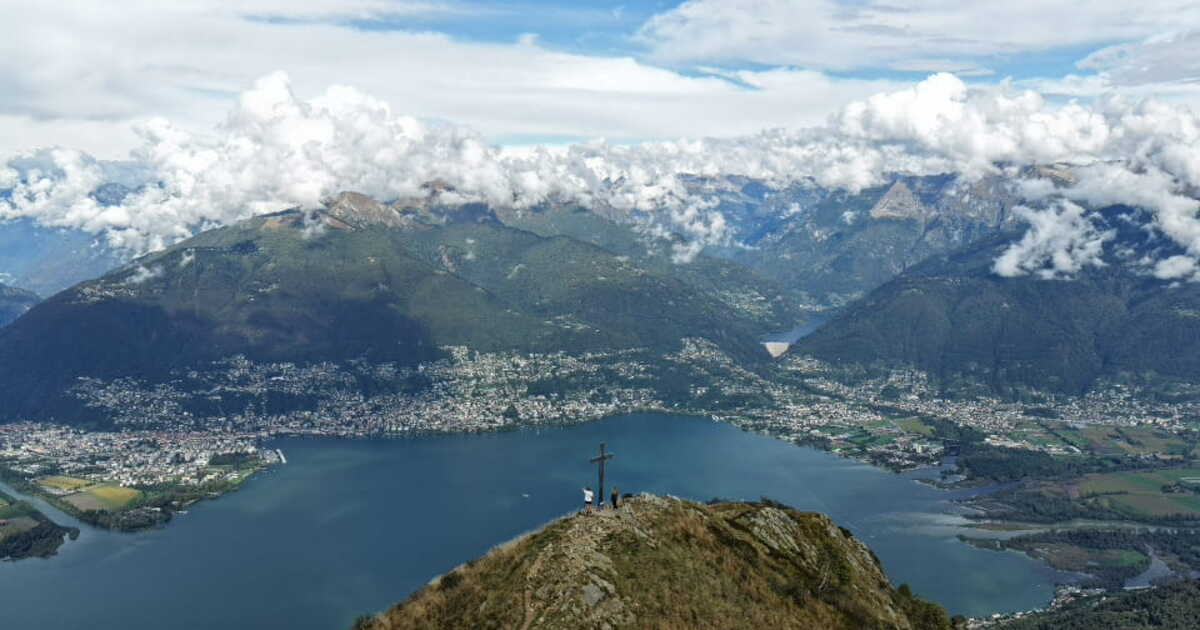
And at the summit, 1,734 meters above sea level, the view is incomparable over Ascona, Locarno, the Maggia river delta, and the entire Lake Maggiore region. A grand finale to this journey.
PRACTICAL
Planning your getaway :
https://www.myswitzerland.com/en and on www.ascona-locarno.com or www.ticino.ch.
Getting there :
TC TGV Lyria offers daily connections between France and Switzerland from Paris Gare de Lyon to Geneva, Lausanne, Basel or Zurich (about 4 hours). tgv-lyria.com
Getting around :
By train, thanks to the SwissTravelPass. A comprehensive ticket aimed at international visitors, granting access to the Swiss public transport network.
Note also that visitors staying at least one night in one of the partner accommodations enjoy free public transport in the region and discounted prices on various attractions thanks to the Ticino Ticket.