

Quand un itinéraire vélo démarre à Verdun, le cycliste sait à quoi s’attendre.
Verdun, c’est le théâtre de la bataille la plus meurtrière de la Première guerre mondiale, une boucherie de tranchées innommable, 300 000 soldats tués lors d’une année quasi entière, en 1916.
Impossible d’occulter cette histoire au moment d’enfourcher le deux-roues. D’autant que le territoire rend un hommage émouvant à ce drame, à travers plusieurs sites.
Centre mondial de la Paix, des Libertés et des Droits de l’Homme, citadelle souterraine, Mémorial de Verdun, ossuaire et fort de Douaumont, tranchée de Chattancourt…
Tous ces lieux de mémoire, situés dans un rayon d’une dizaine de km autour de la ville, sont accessibles à vélo.
Verdun, c’est le théâtre de la bataille la plus meurtrière de la Première guerre mondiale, une boucherie de tranchées innommable, 300 000 soldats tués lors d’une année quasi entière, en 1916.
Impossible d’occulter cette histoire au moment d’enfourcher le deux-roues. D’autant que le territoire rend un hommage émouvant à ce drame, à travers plusieurs sites.
Centre mondial de la Paix, des Libertés et des Droits de l’Homme, citadelle souterraine, Mémorial de Verdun, ossuaire et fort de Douaumont, tranchée de Chattancourt…
Tous ces lieux de mémoire, situés dans un rayon d’une dizaine de km autour de la ville, sont accessibles à vélo.
Towpath and Forest Foliage
The EuroVelo 19 route is, thankfully, less daunting.
Up to Dun-sur-Meuse, the end of the first stage, 42 km from Verdun, it runs due north along the Meuse via a greenway laid as close as possible to the river, before continuing its course after Samogneux on minor roads.
The towpath, slick beneath the forest canopy, forms the constant backdrop of this family‑friendly and tranquil trail, a quiet to be rediscovered along the entire itinerary.
Dun-sur-Meuse isn’t an international tourism capital. That said, its row of houses along the riverbank has charm, and you’ll quickly learn that it was the birthplace of Jean-Robert Ipoustéguy, a Basque name that doesn’t quite fit the region but recalls the memory of this 20th‑century sculptor whose works are scattered around the world (Tokyo, Washington, Berlin, London, Paris…).
You can also rest by the Vert Lake, at Doulcon, and sample the beer from the craft brewery La Dunoise.
Up to Dun-sur-Meuse, the end of the first stage, 42 km from Verdun, it runs due north along the Meuse via a greenway laid as close as possible to the river, before continuing its course after Samogneux on minor roads.
The towpath, slick beneath the forest canopy, forms the constant backdrop of this family‑friendly and tranquil trail, a quiet to be rediscovered along the entire itinerary.
Dun-sur-Meuse isn’t an international tourism capital. That said, its row of houses along the riverbank has charm, and you’ll quickly learn that it was the birthplace of Jean-Robert Ipoustéguy, a Basque name that doesn’t quite fit the region but recalls the memory of this 20th‑century sculptor whose works are scattered around the world (Tokyo, Washington, Berlin, London, Paris…).
You can also rest by the Vert Lake, at Doulcon, and sample the beer from the craft brewery La Dunoise.
Local Brewing History
Step 2 continues its northward journey, using exclusively small rural roads. If we were on the Tour de France, we would call this a liaison stage.
Thus, an hour will be enough to reach Stenay, after discovering the splendid Romanesque church of Mont-devant-Sassey, the day’s main patrimonial highlight. On arrival, beer awaits: a museum tells you everything about the local brewing history, followed by, as the expected reward, a tasting of a fine local foam.
Day 3, objective Sedan. The route winds through prairie and woodland landscapes, always guided by the river’s undulations. After Pouilly, you leave the Meuse department and enter the Ardennes. A difference? None! The border is invisible as the path remains bucolic in the alluvial folds, skimming west the Argonne plateau.
Thus, an hour will be enough to reach Stenay, after discovering the splendid Romanesque church of Mont-devant-Sassey, the day’s main patrimonial highlight. On arrival, beer awaits: a museum tells you everything about the local brewing history, followed by, as the expected reward, a tasting of a fine local foam.
Day 3, objective Sedan. The route winds through prairie and woodland landscapes, always guided by the river’s undulations. After Pouilly, you leave the Meuse department and enter the Ardennes. A difference? None! The border is invisible as the path remains bucolic in the alluvial folds, skimming west the Argonne plateau.
Sedan Fortress
In Mouzon, a charming town with yellow limestone houses, a possible stop at the Wool Felt Museum. This fabric once brought wealth to the industrial city, alongside metallurgy. Remilly-Aillicourt marks the approach to a section of the Trans’Ardennes greenway. Sedan then comes into view and stands out as one of the trip’s highlights, with a visit to its mighty fortress.
Built from the 15th century onward, repeatedly reinforced, it could house up to 4,000 soldiers, ready to clash from this strategic site with the neighboring German Empire.
Sedan is also a reminder of the crushing defeat of 1870, when the French army, cornered, had to surrender to the Prussians. In short, after the legs, the mind gets a workout as you dive once again into French history. Don’t miss also exploring the drapery adventure by visiting the Sedan Tapis Point factory.
Built from the 15th century onward, repeatedly reinforced, it could house up to 4,000 soldiers, ready to clash from this strategic site with the neighboring German Empire.
Sedan is also a reminder of the crushing defeat of 1870, when the French army, cornered, had to surrender to the Prussians. In short, after the legs, the mind gets a workout as you dive once again into French history. Don’t miss also exploring the drapery adventure by visiting the Sedan Tapis Point factory.
Charleville, Ducal City…
A quick hop further, here is Charleville-Mézières. Not that the 28 km separating the two towns are negligible. They still run along the river and even offer new pleasant breaks: the village of Donchéry; the marina at Vrigne-Meuse (from which you can rent license-free little boats to navigate the Meuse in summer); and the Ardennes Canal spur…
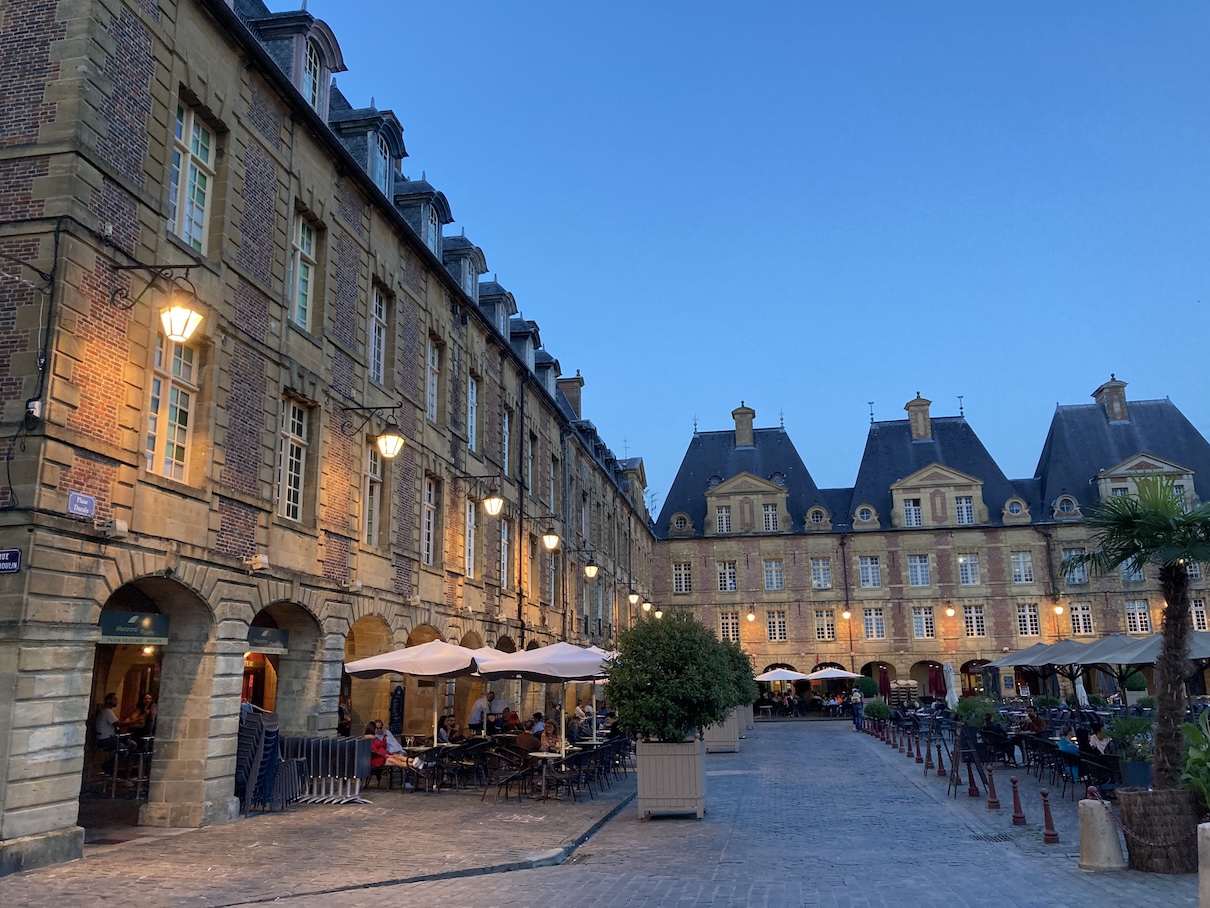
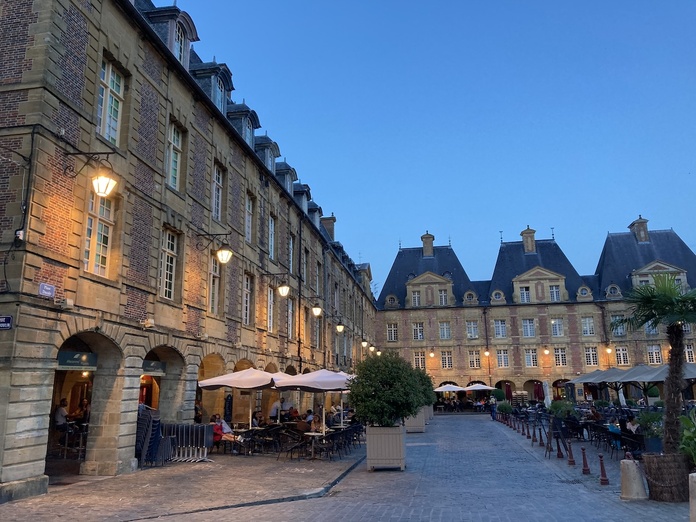
But Charleville-Mézières is such an astonishing city that it deserves a stop. “Upstairs,” you’ll find Charleville, a duchy-turned-principality enhanced by its remarkable Ducal Square with arcades, designed in the early 17th century by the brother of the architect of Place des Vosges—hence the obvious parallel. With its straight streets and brickwork, Charleville exudes a grace you wouldn’t suspect in these industrious Ardennes.
Charleville is also the homeland of Rimbaud. We will visit the museum dedicated to him, housed in the old ducal mill on the banks of the Meuse. As for Mézières, “at the bottom,” it is coming back to life. The successful restoration of the façade and the city hall square has given new vitality to this area, which should also benefit the nearby basilica Notre-Dame d’Espérance.
The continuation is pure cycle-tourist joy. EuroVelo 19 continues its gallop along the Meuse, following the valley that now intrudes like a notch into the Belgian plateau. A kind of hexagonal enclave, marked by an industrial history whose memory is recalled by the sound of the last operating forges.
But Charleville-Mézières is such an astonishing city that it deserves a stop. “Upstairs,” you’ll find Charleville, a duchy-turned-principality enhanced by its remarkable Ducal Square with arcades, designed in the early 17th century by the brother of the architect of Place des Vosges—hence the obvious parallel. With its straight streets and brickwork, Charleville exudes a grace you wouldn’t suspect in these industrious Ardennes.
Charleville is also the homeland of Rimbaud. We will visit the museum dedicated to him, housed in the old ducal mill on the banks of the Meuse. As for Mézières, “at the bottom,” it is coming back to life. The successful restoration of the façade and the city hall square has given new vitality to this area, which should also benefit the nearby basilica Notre-Dame d’Espérance.
The continuation is pure cycle-tourist joy. EuroVelo 19 continues its gallop along the Meuse, following the valley that now intrudes like a notch into the Belgian plateau. A kind of hexagonal enclave, marked by an industrial history whose memory is recalled by the sound of the last operating forges.