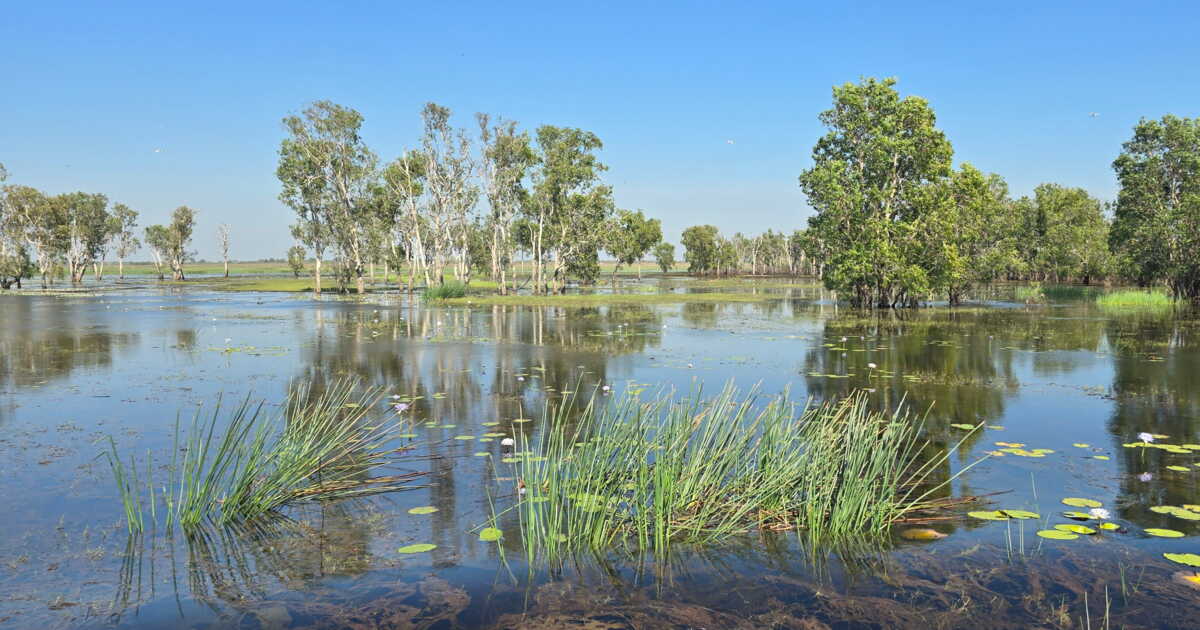
After a stretch of red dirt road, less than two hours from Darwin, the landscape gradually reveals a different face. Fences fade into tall grasses, termite mounds rise in the middle of the plains, and wetlands become the realm of birds and crocodiles. In June, while we were filing a report in the Northern Territory, we discovered the Finniss River Lodge, nestled at the heart of a vast cattle operation. An immersion accessible right at the core of Australia’s Top End.
In a Real Australian Family Station
The Finniss River Lodge story begins with Leo Venturini in 1987, when he purchases this enormous property spanning more than 20,000 hectares. Nearly forty years later, it still belongs to the family and functions first and foremost as a cattle station typical of the region, with around 4,500 head of cattle. Since 2022, however, the family business has diversified with the creation of the lodge, steered by his granddaughter, Olivia.
Staying at the Finniss River Lodge thus means stepping into the workings of a genuine cattle station. The wet season measures its reach. When rains push the water levels up by several meters, the roads can disappear under the floodwaters and cut the property off from the rest of the world. An airstrip enables the arrival of a small plane, and a helipad is also planned for helicopters. Large tanks collect rainwater, enabling the lodge to be entirely autonomous in its water supply.
With six rooms only and a pool facing the floodplains, the place can accommodate at most a dozen guests. Two guided excursions are organized each day, in the morning and late afternoon, and the small capacity makes it possible to travel with a guide in a very small group, or even individually. The station can be explored by 4×4 or by boat, observing the animals, discovering the different ecosystems of the property (floodplains and wetlands, paperbark forests, wooded savannas, pockets of rainforest, and coastal and mangrove zones) or learning about the station’s work. Depending on the season, one can witness the cattle gathering, see the animals move through the enclosures, or participate in certain tasks.
And then there is the “Cows and Canapés.” At sunset, visitors join a small group for the pre-dinner apéritif with a group of fewer than a hundred cattle selected for their particularly sociable temperament. The cows come of their own accord, seeking strokes, and some do not hesitate to lick hands or legs. A rather unconventional way to discover Brahman cattle, recognizable especially by the shoulder hump and their long ears. Native to tropical regions, they endure the intense heat and the harsh conditions of northern Australia.
From Giant Termite Mounds to Crocodiles, Wildlife to Discover
But the cattle are far from the only animals encountered here. The lodge’s guides are invaluable allies for discovering this wildlife: with so few visitors, you can take the time to pause, observe, and above all learn things that would easily escape an untrained eye. Without a guide, a termite mound might be just a big dirt bump at the edge of a track. But with someone who knows the bush, it becomes the starting point for a true lesson on insects, their organization, and the architecture of their habitat.
Did you know, for instance, that some Top End termite mounds reach six to eight meters tall, growing by about a meter every ten years? Inside, the termites construct a genuine network of galleries that allows them to regulate temperature naturally. Heat enters through certain parts of the mound, air circulates through the galleries, and exits through other openings. This natural ventilation system keeps interior temperatures much steadier, despite the scorching heat outside. This architecture is all the more remarkable because it is built and maintained continuously by tiny insects.
And these structures serve other species as well. The forest kingfisher (Todiramphus macleayii) uses the termite mounds to install its nest. To carve the entrance, the small bird darts at the wall with its beak leading, striking repeatedly in violent blows. And as our guide explained, it is this same bird that inspired an invention seemingly unrelated to the Australian bush: the nose of the Japanese Shinkansen.
In the 1990s, engineer Eiji Nakatsu sought to solve a problem faced by high-speed trains: when they entered a tunnel, they produced a large pressure wave that caused a deafening roar as they exited. By studying the shape of the kingfisher’s bill, particularly its streamlined profile, he conceived this principle to design the nose of the Shinkansen 500. The new shape significantly reduced the pressure wave and noise, while improving the train’s energy efficiency.
Even around the lodge, there’s no need to search far to find other inhabitants. At dawn and dusk, wallabies are everywhere, while Corella cockatoos number in the dozens in front of the rooms. More generally, the property is a paradise for birdwatchers, its wetlands and papyrus swamps hosting more than 1% of the world’s population of certain water birds (such as the semipalmated canaries), which classifies the site as an aquatic ecosystem of high conservation value.
Then comes the crocodile, the undeniable star of the Top End. On the property, you can observe the two species present in northern Australia: the saltwater crocodile (Crocodylus porosus) and Johnston’s crocodile (Crocodylus johnstoni). The former is decidedly more aggressive and imposing. It can live in freshwater, brackish, or marine waters. The latter, smaller, stays mainly in rivers, billabongs, and freshwater wetlands. In an airboat, the guide also explains how the station’s inhabitants live with these predators.
A coexistence that comes with its share of surprises: it is not uncommon to see cattle wading into water bodies, despite the presence of the reptiles. There are even occasions when cows are killed by them. But when temperatures rise, they do not hesitate to venture into the water, where they find both cooling and food.
Near Darwin, the Finniss River Lodge thus offers a concrete glimpse into the daily life of the extreme north of the country, between cattle farming and wildlife. A first approach before continuing on to Litchfield and Kakadu National Parks.